Best T-Shank Jigsaw Blades for Wood and Metal
What's inside
- Quick picks by cutting situation
- Tooth patterns: the most important comparison
- Blade materials: high-carbon steel, HSS, and bi-metal
- Length, width, and cutting control
- Head-to-head choices for common buyers
- T-shank compatibility and the U-shank question
- How to get cleaner, longer-lasting cuts
- Ownership realities: what wears first
- Bottom line
- Related Guides
- Quick picks by cutting situation
- Tooth patterns: the most important comparison
- Blade materials: high-carbon steel, HSS, and bi-metal
- Length, width, and cutting control
- Head-to-head choices for common buyers
- T-shank compatibility and the U-shank question
- How to get cleaner, longer-lasting cuts
- Ownership realities: what wears first
- Bottom line
- Related Guides
As an Amazon Associate I earn from qualifying purchases. This post may contain affiliate links at no extra cost to you.
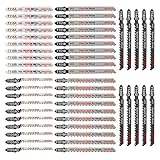
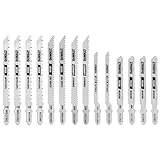
The best t shank jigsaw blades are Bosch T-shank or equivalent high-carbon-steel blades for wood, bi-metal blades for mixed materials, and hardened high-speed-steel blades with fine teeth for sheet metal; the right choice depends more on tooth pattern and TPI than on brand alone.
As an Amazon Associate we earn from qualifying purchases at no extra cost to you.


Quick picks by cutting situation
| Job | Best blade type | Typical length | Useful TPI range | Why it works |
|---|---|---|---|---|
| Fast curves in softwood | High-carbon steel, narrow body, ground or milled teeth | 3–4 in. (75–100 mm) | 6–10 | Coarse teeth clear chips quickly and a narrow blade turns easily |
| Clean plywood and laminate | High-carbon steel, reverse-tooth or fine ground-tooth blade | 3–4 in. (75–100 mm) | 10–20 | Fine or down-cutting teeth reduce splintering on the visible face |
| Thick hardwood | Longer high-carbon or bi-metal wood blade | 4–5 in. (100–125 mm) | 6–10 | Extra length and gullets prevent binding while removing dense chips |
| Thin steel | High-speed steel or bi-metal metal-cutting blade | 3–4 in. (75–100 mm) | 18–32 | Fine teeth distribute the load and reduce tooth snagging |
| Aluminum or nonferrous metal | Bi-metal or high-speed steel blade with a coarse metal pattern | 3–4 in. (75–100 mm) | 10–18 | Larger gullets help carry away soft, stringy chips |
These are starting points, not fixed rules. The material thickness should normally engage at least three teeth and preferably six to ten teeth at once. Too few teeth cause grabbing and vibration; too many teeth can rub, heat up, and cut slowly.
Tooth patterns: the most important comparison
Coarse, milled teeth
A coarse milled blade commonly has 6–10 teeth per inch and is the fastest choice for construction lumber, framing plywood, and rough curves. Its teeth are punched or milled into the blade and tend to leave a more aggressive cut surface. Use a slower feed rate in hardwood, since forcing a coarse blade can bend it away from the cut line.
Fine, ground teeth
Ground teeth are shaped after manufacture and usually produce a cleaner, more controlled cut than basic milled teeth. Blades in the 10–20 TPI range suit cabinet plywood, hardwood, plastic, and general finish work. They remove less material per stroke, so a jigsaw may cut more slowly, but the kerf is easier to control.
Reverse-tooth blades
Reverse-tooth patterns cut on the upstroke as well as the downstroke. They are useful when the top face of plywood, melamine, or laminate must remain relatively clean because the blade pushes against the visible surface rather than lifting fibers into it. They also demand a firm hold-down: the cutting action can lift the workpiece, and the saw may advance more slowly.
Progressive or variable-pitch teeth
Variable-pitch blades change tooth spacing along the cutting edge. They are a practical compromise for jobs that move between different wood thicknesses or materials. The larger teeth clear chips near the rear of the blade while the finer section helps reduce chatter near the cut surface. They are not automatically the cleanest or fastest option, but they are forgiving in general workshop use.
Blade materials: high-carbon steel, HSS, and bi-metal
- High-carbon steel (HCS): flexible and relatively inexpensive, making it the usual choice for wood, plastic, and occasional curves. Heat and abrasive materials dull it quickly.
- High-speed steel (HSS): harder and more heat-resistant, so it suits metal. It is less forgiving of twisting because the cutting edge is harder but generally more brittle.
- Bi-metal: combines a flexible carbon-steel body with a harder cutting edge. It costs more than HCS but is often the best ownership choice for mixed wood-and-metal work or occasional nails hidden in reclaimed lumber.
- Carbide-grit: uses abrasive grit instead of conventional teeth. It is intended for fiberglass, cement board, tile-like materials, or other abrasive stock, not for fast ordinary wood cuts.
For a woodworking-only kit, several HCS blades with different tooth patterns usually offer better value than buying every blade in bi-metal. For renovation work, bi-metal blades can pay for themselves by surviving an accidental nail or screw contact that would ruin a wood blade.
Length, width, and cutting control
Blade length is not the same as maximum cutting capacity. A 4-inch blade does not reliably cut 4 inches of wood: part of its length is held in the clamp, and the shoe, stroke, and material movement reduce usable depth. As a practical guide, select a blade at least 25 mm (1 inch) longer than the material thickness, while keeping exposed blade length as short as the cut allows.
Narrow blades make tighter curves, but their flexibility increases the chance of a bevelled edge if the user pushes sideways. Wider blades track straighter in long cuts and resist deflection, although they need a larger turning radius. For a tight inside cut, drill a starter hole large enough for the blade body and choose a narrow scrolling blade rather than twisting a standard blade through the corner.
Head-to-head choices for common buyers
| Your situation | Choose | Avoid | Reason |
|---|---|---|---|
| Occasional homeowner, mostly 1/2–3/4 in. plywood | Mixed pack of 10–12, 12–20 TPI HCS wood blades | Large specialist packs | Low cost and enough variety for repairs and small projects |
| Furniture maker cutting hardwood curves | Ground-tooth HCS blades, 8–12 TPI, narrow and medium widths | Very coarse framing blades | Better edge control and less tearing in dense stock |
| Renovator cutting unknown reclaimed wood | Bi-metal wood or demolition-pattern T-shank blades | Premium fine-finish blades | Hidden fasteners can destroy delicate teeth |
| Frequent sheet-metal work | HSS or bi-metal blades from 18–32 TPI | 6–10 TPI wood blades | Fine teeth reduce snagging and tooth breakage |
In general, expect roughly $5–$15 for a small pack of basic wood blades, $10–$30 for broader mixed-material packs, and more for specialist bi-metal, carbide-grit, or extra-long blades. Prices vary by pack size and tooth pattern, so compare cost per blade rather than the package price alone.
T-shank compatibility and the U-shank question
T-shank blades for jigsaw tools have a tang shaped like a small T and are the dominant modern standard. They fit most current quick-change jigsaws from manufacturers such as Bosch, DEWALT, Makita, Milwaukee, Metabo HPT, and many other brands, but the tool manual remains the final authority. A blade that physically enters the clamp may still be unsuitable if the clamp does not lock it securely.
U-shank jigsaw blades use a different mounting notch and are common on some older or basic saws. They are not interchangeable with T-shank blades unless the saw specifically supports both styles. “Universal shank jigsaw blades” can be a confusing label: it may mean a pack containing both shank types, or a blade marketed for broad tool compatibility. Check the actual tang illustration and your saw’s clamp rather than relying on the word “universal.”
Most jigsaw T-shank blades have no screw hole or separate retaining hardware because the saw’s clamp captures the tang. Remove the battery or unplug the tool before changing a blade, and confirm that the tang is fully seated. A partially engaged blade can wobble, cut at an angle, or eject under load.
How to get cleaner, longer-lasting cuts
- Match TPI to thickness. Aim for several teeth in the material. Move toward a finer pattern for thin sheet and a coarser pattern for thick wood.
- Support both sides of the cut. Place the work on sacrificial foam or a bench with the waste supported, but leave the blade path clear.
- Set the orbital action deliberately. Higher orbital settings cut wood faster but leave a rougher edge. Use low or zero orbital action for metal, plywood veneers, and finish cuts.
- Let the blade do the cutting. Excessive forward pressure bends the blade and increases heat. If the motor slows sharply, reduce feed pressure or choose a more suitable tooth pattern.
- Use lubrication for metal. A compatible cutting lubricant reduces heat and wear. Keep lubricant away from areas where contamination would interfere with finishing or bonding.
- Inspect after each demanding cut. Replace a blade when teeth are rounded, missing, blue from overheating, or requiring noticeably more force.
Ownership realities: what wears first
The teeth normally wear before the shank, but a bent blade can make the whole blade appear dull because it drifts away from the guide line. Heat is the main enemy of fine metal blades; resin buildup is a frequent problem in softwood and plywood. Unplug the saw, brush debris from the blade and shoe, and avoid storing blades loose where their teeth can strike one another. Do not straighten a bent blade and reuse it: even if it looks acceptable, it may cut at an angle or fail under load.
A sensible starter selection is one narrow 8–10 TPI wood blade for curves, one medium-width 10–12 TPI blade for general wood, one 12–20 TPI clean-cut blade for plywood, and one 18–24 TPI bi-metal blade for thin metal or accidental fasteners. That four-pattern approach is more useful than a large pack containing many nearly identical blades.
Bottom line
Choose T-shank jigsaw blades by the material first, then thickness, tooth pattern, and required edge quality. Coarse narrow HCS blades win on fast wood curves, fine or reverse-tooth blades are better for clean plywood, longer coarse blades suit hardwood, and HSS or bi-metal fine-tooth blades are the safe choice for metal. If your saw accepts only U-shank blades, do not assume a “universal” package will fit; verify the shank standard before buying.
