Best Angle Grinders Under $100
What's inside
As an Amazon Associate I earn from qualifying purchases. This post may contain affiliate links at no extra cost to you.
Best Angle Grinders Under $100
The best angle grinder under 100 for most home workshops is a 4-1/2-inch corded model with a 10- to 12-amp motor, tool-free guard, and a side handle that can be positioned for either hand. For occasional cutting and grinding, the Bosch 1375A, Makita 9557PBX1, and Metabo HPT G12SR4 are strong value choices; the DEWALT DWE402 is the better pick when heavier, more frequent work justifies spending near the top of the budget.
Quick comparison
| Model | Disc size | Motor | No-load speed | Approx. weight | Best suited to |
|---|---|---|---|---|---|
| Bosch 1375A | 4-1/2 in. | 6.0 amps | 11,000 rpm | 3.75 lb | Light cutting, deburring, and occasional grinding |
| Makita 9557PBX1 | 4-1/2 in. | 7.5 amps | 10,000 rpm | 4.5 lb | General workshop use and surface preparation |
| Metabo HPT G12SR4 | 4-1/2 in. | 6.2 amps | 10,000 rpm | 4.0 lb | Budget buyers and intermittent DIY work |
| DEWALT DWE402 | 4-1/2 in. | 11 amps | 11,000 rpm | 6.2 lb | Repeated grinding and demanding metalwork |
Weights and prices can vary by included accessories and regional packaging. Typical street prices for these corded grinders range from roughly $35 to $100, while kits containing multiple wheels, cases, or extra guards may cost more.
As an Amazon Associate we earn from qualifying purchases at no extra cost to you.

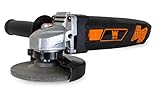
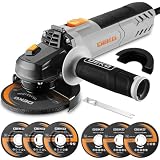

Best picks by situation
| Your situation | Recommended type or model | Why |
|---|---|---|
| Lowest practical cost | Metabo HPT G12SR4 | Compact 4-1/2-inch format with enough power for occasional household repairs |
| Lightest, simplest handling | Bosch 1375A | Lower weight reduces fatigue during deburring and short cuts |
| Most balanced general-purpose choice | Makita 9557PBX1 | Useful combination of 7.5-amp output, manageable size, and accessory value |
| Frequent heavy grinding | DEWALT DWE402 | 11-amp motor gives more reserve when removing welds or working thick steel |
| Limited storage or occasional use | Any compact 4-1/2-inch corded grinder | Smaller discs and a corded motor avoid battery storage and charging requirements |
What matters most below $100
Disc size and capacity
A 4-1/2-inch grinder is the most useful size at this price. It accepts widely available grinding wheels, flap discs, wire wheels, and thin cut-off wheels. It is compact enough for brackets, bolts, garden equipment, tubing, and small fabrication jobs.
Disc diameter is not the same as cutting depth. A new 4-1/2-inch cut-off wheel typically provides a practical maximum cut of around 1 inch, depending on the guard, material, and wheel wear. Do not remove the guard to gain depth. If you regularly cut large plate or masonry, a 5-inch or larger grinder may be more suitable, but it will generally cost more and demand better control.
Motor power and speed
Amperage is a useful guide for corded grinders, but it does not tell the entire story. A 6-amp motor can handle light steel, rust removal, and sharpening when the wheel is kept moving. A 7.5-amp model offers more working reserve. An 11-amp grinder is less likely to bog down during sustained grinding, although its additional weight can make overhead work tiring.
Most models in this group spin at 10,000 or 11,000 rpm without a load. Use only accessories rated for at least the grinder’s maximum speed. Flap discs and grinding wheels are not interchangeable with accessories intended for slower tools, and a wire wheel must be installed and operated according to its instructions.
Guard adjustment and controls
A tool-free guard is worth prioritizing. It lets you reposition the guard quickly so the enclosed section is between your hands and the wheel’s exposed area. Guards that require a screwdriver are usable, but they encourage poor positioning when changing from cutting to grinding.
Check the switch style before buying. A slide switch can be convenient for long grinding sessions but must be easy to shut off if the tool kicks back. A paddle switch requires continuous hand pressure and can be preferable for users who want the grinder to stop as soon as they release their grip. A lock-on feature is convenient but deserves extra caution during repositioning.
Vibration and ergonomics
At under $100, advanced vibration control is uncommon. Still, handle shape, balance, and wheel quality make a substantial difference. A two-position side handle should screw securely into either side of the gear housing. Hold the grinder with both hands, and avoid pressing hard enough to stall the motor; excessive force increases vibration, heat, and wheel wear.
Vibration often comes from a bent flange, a damaged wheel, an incorrectly mounted accessory, or a wheel that is out of balance. If a new wheel visibly wobbles or the tool vibrates sharply, switch it off, unplug it, and inspect the mounting parts before continuing.
How these grinders perform at common jobs
Cutting metal
Use a thin abrasive or fiber-reinforced cut-off wheel rated for the grinder’s speed. Keep the wheel perpendicular to the work and let it cut without twisting. A 4-1/2-inch grinder is effective for bolts, threaded rod, sheet steel, angle iron, and small tubing. It is a poor substitute for a saw when making many precise, identical cuts.
Grinding welds and edges
Use a grinding wheel designed for the material, normally with the grinder held at roughly a 15- to 30-degree angle. Move continuously rather than dwelling in one spot. A higher-powered model such as the DWE402 is advantageous for repeated weld removal, but the lighter Bosch or Metabo HPT models are easier to control for brief touch-up work.
Surface preparation
Flap discs are generally easier to control than hard grinding wheels for smoothing welds, removing paint from suitable metal surfaces, and blending edges. Wire wheels remove loose rust and coatings but can throw broken wires, so face and hand protection are essential. For concrete or masonry, use a compatible diamond cup wheel and dust shroud where the grinder and accessory support that setup. Indoor dry cutting can create hazardous dust; use appropriate dust control and respiratory protection.
Ownership costs and maintenance
The grinder itself is only part of the cost. Suppose a $60 grinder is used for 20 small projects over three years. The tool cost is about $3 per project before accessories. If each project consumes one $4 cut-off wheel and one $8 flap disc, consumables cost $12 per project, or $240 over 20 projects. Choosing a durable grinder matters, but using the correct wheel and avoiding premature wheel damage has the larger effect on operating cost.
- Inspect wheels before every use; discard cracked, chipped, warped, or wet abrasive wheels.
- Confirm that the wheel’s maximum rpm rating meets or exceeds the grinder’s no-load speed.
- Clean cooling vents with dry, low-pressure air after dusty work. Do not push debris farther into the motor.
- Check the power cord, guard, flange, and side handle regularly.
- Replace worn carbon brushes only if the model is designed for user service and the manual permits it.
- Never use a cutting wheel for side grinding; its edge is not designed to withstand that load.
The components that commonly wear first are abrasive accessories, the power cord near the plug, switch contacts, carbon brushes on serviceable models, and the gear-head bearings after prolonged overload. Keeping the tool clean and allowing it to cool during extended work helps, but no maintenance routine compensates for forcing a small grinder through thick material.
Safety features that should not be treated as extras
Look for a full wheel guard, a two-position side handle, a spindle lock that is protected from accidental activation, and a switch that can be reached without shifting your grip. Electronic features such as soft start, overload protection, or restart protection are helpful when available, but they do not replace proper technique.
Wear safety glasses plus a face shield, hearing protection, nonflammable clothing, and suitable gloves. Secure the workpiece, direct sparks away from people and combustible materials, and wait for the wheel to stop before setting the tool down. Unplug the grinder before changing accessories. For cutting or grinding coated, painted, or unknown metal, investigate the coating first rather than assuming the dust is harmless.
Bottom line
Choose the Bosch 1375A or Metabo HPT G12SR4 for occasional light work and the Makita 9557PBX1 for the best balance of power and handling. Choose the DEWALT DWE402 if repeated heavy grinding is the priority and its extra weight is acceptable. Whichever model you select, budget for correctly rated wheels, prioritize a secure adjustable guard, and match the accessory to the job rather than judging a grinder by motor amperage alone.