Best Direct Drive Force Feedback Steering Wheels
What's inside
- Best Direct Drive Force Feedback Steering Wheels
- Quick comparison of the leading direct drive systems
- Choose by situation, not just torque
- Mounting requirements are part of the purchase
- Pedals change the driving experience more than another few Nm
- Upgrade costs and ecosystem trade-offs
- Ownership realities: what wears out first
- Our buying verdict
- Best Direct Drive Force Feedback Steering Wheels
- Quick comparison of the leading direct drive systems
- Choose by situation, not just torque
- Mounting requirements are part of the purchase
- Pedals change the driving experience more than another few Nm
- Upgrade costs and ecosystem trade-offs
- Ownership realities: what wears out first
- Our buying verdict
As an Amazon Associate I earn from qualifying purchases. This post may contain affiliate links at no extra cost to you.
Best Direct Drive Force Feedback Steering Wheels
The best direct drive force feedback steering wheel for most sim racers is the Logitech G Pro Racing Wheel for a simple console-and-PC setup, while the Fanatec ClubSport DD+ is the stronger choice for PlayStation users who want a broader upgrade path; PC-only racers get better value from the Moza R9 or Simagic Alpha Mini.
Direct drive systems connect the steering wheel to the motor shaft, eliminating the belts or gears used in cheaper force-feedback wheels. That usually means sharper detail, less dead-zone, quieter operation, and more torque. The right choice depends less on maximum torque alone than on your platform, mounting hardware, pedals, space, and the cost of expanding the system later.
As an Amazon Associate we earn from qualifying purchases at no extra cost to you.


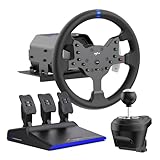

Quick comparison of the leading direct drive systems
| System | Peak torque | Platforms | Pedals included? | Approximate market range | Best suited to |
|---|---|---|---|---|---|
| Logitech G Pro Racing Wheel | 11 Nm | PC, PlayStation or Xbox versions | Usually sold separately | $900–$1,100 for wheelbase and rim | Console racers wanting a straightforward premium setup |
| Fanatec CSL DD | 5 or 8 Nm, depending on power supply | PC; console support requires a compatible Fanatec wheelbase and steering wheel | Often sold in bundles | $400–$800 for common bundles | First-time buyers and moderate-budget PC or console setups |
| Fanatec ClubSport DD+ | 15 Nm | PC and PlayStation with compatible Fanatec hardware | Usually sold separately | $1,000–$1,400 for wheelbase and rim | PlayStation users and racers wanting a mature ecosystem |
| Moza R5 | 5.5 Nm | PC | Common bundles include SR-P Lite pedals | $450–$650 for a bundle | New PC sim racers with limited space or budget |
| Moza R9 | 9 Nm | PC | Usually sold separately | $700–$1,000 with rim and basic pedals | PC racers who want room to grow without jumping to high torque |
| Simagic Alpha Mini | 10 Nm | PC | Usually sold separately | $900–$1,300 for a usable wheel-and-pedal package | PC users prioritizing detailed force feedback and metal hardware |
| Thrustmaster T818 | 10 Nm | PC | Sold separately | $700–$1,000 with a compatible rim | Existing Thrustmaster owners moving to direct drive |
Prices vary by steering wheel rim, power supply, pedals, taxes, and regional promotions. A wheelbase price is not the price of a complete driving station.
Choose by situation, not just torque
For a first direct drive setup under about $700
The Moza R5 bundle and the 5 Nm Fanatec CSL DD bundle are the most practical starting points. Both provide a substantial improvement over typical gear-driven wheels without requiring a full aluminum profile cockpit. The Moza package commonly includes a round wheel and SR-P Lite pedals, making the real purchase cost easier to predict.
The CSL DD has a particularly useful upgrade: its 180-watt Boost Kit increases output from 5 Nm to 8 Nm. If you buy the smaller power supply first, calculate the eventual cost rather than assuming the entry price is permanent. The 5 Nm level is adequate for many racers, but stronger force feedback gives more headroom for lower-strength settings and heavier steering rims.
For a serious PC racer who wants value
The Moza R9 is a balanced middle ground. Its 9 Nm output is enough for clear cornering load and road texture without imposing the mounting demands of a 15–25 Nm base. Moza also offers a broad PC ecosystem of wheel rims, shifters, handbrakes, and pedals.
The Simagic Alpha Mini is another strong PC option at roughly 10 Nm. Its metal construction and ecosystem appeal to racers who prefer a more premium feel than entry-level bundles provide. It is less attractive if you need PlayStation or Xbox support, because it is primarily a PC platform.
For PlayStation compatibility
Console compatibility narrows the field considerably. The Fanatec ClubSport DD+ supports PlayStation when paired with compatible Fanatec steering hardware, and the Logitech G Pro has dedicated console versions. Do not assume that a PC wheelbase becomes console-compatible after a firmware update: console authorization is normally tied to specific hardware.
The Logitech G Pro is easier to understand as a complete premium purchase because the console version is clearly separated by platform. Its 11 Nm output is strong enough for demanding racing titles, but Logitech’s ecosystem is not as broad as Fanatec’s. Confirm the exact wheel rim, pedal, and shifter contents before ordering.
For high-frequency league racing
If you race several times each week, consider the Fanatec ClubSport DD+, Simagic Alpha, Moza R12 or a higher-output Asetek base rather than buying the cheapest system and replacing it quickly. The benefit is not simply peak force. More torque headroom lets you run detailed force feedback without operating the motor near its limit, and stronger bases are generally paired with sturdier mounting patterns and higher-end accessories.
High-torque equipment also increases risk. A 15 Nm or stronger base should be mounted to a rigid cockpit or reinforced wheel deck, with software torque limits configured before driving. A folding stand or thin desk can flex, loosen fasteners, or make the steering feel inconsistent.
Mounting requirements are part of the purchase
| Wheelbase output | Practical mounting recommendation | Typical space implication |
|---|---|---|
| 5–6 Nm | Strong desk clamp or reinforced wheel stand | Usually workable in a bedroom or shared office |
| 8–12 Nm | Heavy-duty wheel stand or aluminum profile cockpit | Needs a stable floor footprint and pedal support |
| 15–21 Nm | Rigid cockpit with bolted wheel deck and pedal plate | Best treated as a permanent installation |
| 23 Nm and above | Very rigid profile or tubular chassis, with conservative torque settings | Large, heavy, and difficult to move regularly |
Check three measurements before buying: wheelbase mounting-hole pattern, the depth available behind the wheel deck, and pedal-plate adjustment range. A wheelbase can physically fit the desk while its cable ports or clamp still collide with the rear edge. Pedal sets also need enough length and angle adjustment to avoid an awkward knee position.
Pedals change the driving experience more than another few Nm
Included pedals are convenient, but budget pedal sets often use potentiometers or basic travel sensors. They can work well for casual driving, yet braking consistency usually improves more from a load-cell pedal than from upgrading a 9 Nm base to a 12 Nm base.
A load-cell brake measures force rather than only pedal position. For example, if a pedal is configured for a 60 kg maximum load and you typically brake at 30 kg, your normal braking point is approximately 50% of the available range. That gives more repeatable control than using nearly all of a short, soft pedal’s travel. The numbers are illustrative: use the manufacturer’s stated load range and adjust it to your rig and comfort.
When comparing bundles, separate the cost of the base, rim, pedals, and power supply. A $550 bundle with basic pedals may become a $900 system after a $250–$350 load-cell upgrade and a $100–$200 mounting solution. A more expensive bundle with capable pedals can therefore be cheaper to own over two years.
Upgrade costs and ecosystem trade-offs
- Fanatec: Offers especially broad compatibility across wheel rims, pedals, shifters, and handbrakes. The main advantage is a single connected ecosystem; the drawback is that the total cost rises quickly when adding premium pedals and a larger wheel rim.
- Moza: Provides a strong PC-focused range from the R5 through higher-torque bases. Its bundles are attractive, but console racers should look elsewhere unless their platform requirements change.
- Simagic: Appeals to PC users seeking substantial metal construction and refined accessories. Budget for separate pedals, mounting hardware, and any desired quick-release accessories.
- Logitech: Simple platform-specific purchasing and useful console support. It is less flexible if you want to mix many third-party components.
- Thrustmaster: The T818 can make sense for owners who already have compatible Thrustmaster rims and pedals. Starting from zero may provide fewer advantages than choosing a newer ecosystem.
Ownership realities: what wears out first
Direct drive motors have fewer belt or gear parts to wear, but the complete system is not maintenance-free. The most common trouble points are pedal potentiometers or load-cell wiring, loose wheelbase bolts, USB connectors, quick-release contacts, and steering-wheel buttons. Dust and pet hair can affect pedal sensors, while sweat and skin oils gradually damage alcantara if it is not cleaned and covered.
Use a dry microfiber cloth for the wheelbase and rim, clean pedal surfaces with a lightly damp cloth, and avoid spraying liquid into switches or connectors. Check mounting bolts after the first few sessions and periodically afterward. Never lift a heavy cockpit by the steering wheel or pull on USB and power cables.
Common setup mistakes include leaving the wheelbase at maximum torque, using a flexible desk with a high-output base, selecting the wrong console version, and installing a wheel rim that is too large for the available torque. A heavier 330 mm rim requires more motor effort than a 280–300 mm rim and can make a mid-range base feel weaker.
Our buying verdict
- Best overall for console flexibility: Logitech G Pro Racing Wheel, especially when a simple PlayStation or Xbox setup matters more than a huge accessory range.
- Best PlayStation upgrade path: Fanatec ClubSport DD+, provided you are prepared to buy compatible Fanatec components and use a rigid mount.
- Best first bundle: Moza R5 for PC racers who want pedals included and a compact installation.
- Best value middle tier: Moza R9 for PC users who want more headroom without committing to a large high-torque cockpit.
- Best premium PC alternative: Simagic Alpha Mini for racers who value detailed force feedback and substantial hardware.
Before choosing, set a total budget that includes pedals, mounting, a suitable power supply, and at least one future upgrade. For occasional racing in a shared room, 5–10 Nm is usually the sensible range. For frequent league racing on a permanent cockpit, 10–15 Nm offers useful headroom. More than that is worthwhile only when the chassis, pedals, space, and driving goals justify the extra cost.