Best Men’s Leather Dress Shoes for Comfort & Style
What's inside
- Top 3 Picks
- Quick Comparison
- How We Chose
- 1. Clarks Tilden Cap Derby – Best for All-Day Office Comfort
- 2. Clarks Tilden Cap Oxford – Best for Suits and Formal Coverage
- 3. Bruno Marc Classic Leather Dress Shoes – Best for High-Frequency Wear on a Budget
- 4. Bruno Marc Dress Oxfords Casual Derby Sneakers – Best for Business Casual and Travel
- 5. Temeshu DS09 Oxford – Best for a First Brown Dress Shoe on a Tight Budget
- Leather Grades: What You Are Actually Paying For
- Construction Methods and How Many Resoles You Get
- Sole Materials and Where Each One Belongs
As an Amazon Associate I earn from qualifying purchases. This post may contain affiliate links at no extra cost to you.
The best men’s leather dress shoes for most people in 2026 are the Clarks Collection Tilden Cap Derby in black leather — a mid-range cap-toe built on a cushioned footbed with a lightweight, flexible outsole, which is why it covers an eight-hour office day, a wedding, and a business-casual Friday without the break-in misery of a traditional welted shoe. Buy it if you want one pair that handles the widest range of dress codes and you value all-day comfort over stitched construction. Step up to the Clarks Tilden Cap Oxford in dark tan leather if you want the same last in a warmer colorway for suits and chinos, and step down to the Bruno Marc Classic Leather Dress Shoes if the budget is tight and the shoes will be worn a few times a month rather than daily. For commuting, travel, and casual Fridays, the Bruno Marc Dress Oxfords Casual Derby Sneakers are the better shape; for a second brown pair on a tight budget, the Temeshu DS09 Oxford is the value pick. Everything below is organized by situation, then broken down by leather grade, construction method, and sole material — the three things that actually determine how long a dress shoe lasts.
Our Top Picks




Top 3 Picks
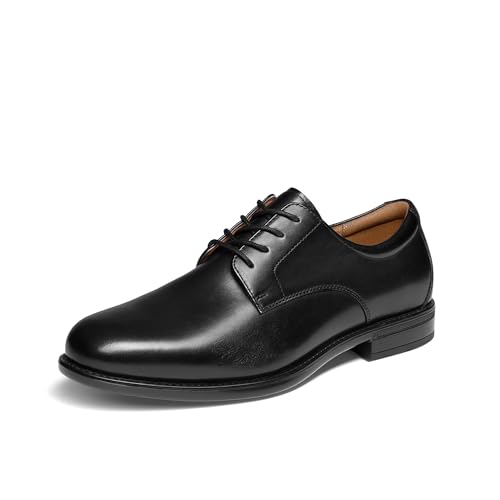
Best overall: Clarks Tilden Cap Derby (Black Leather, 10 M). This is the pair to buy if you want a single black shoe that works with a suit, dress trousers, and chinos, and that you can put on at 7 a.m. and still be comfortable in at 6 p.m. The cushioned footbed and lightweight outsole mean almost no break-in, which matters far more than welt stitching if you spend the day on concrete or tile. It is the safest first dress shoe for most men.
Best budget: Temeshu DS09 Oxford (Brown, 10.5). If you need a brown dress shoe for interviews, a wedding, or a rotation you wear a few times a month, the DS09 delivers the classic oxford silhouette at the lowest price tier in this roundup. Expect a cemented build and a synthetic lining at this price — that is the honest trade-off, and it is a reasonable one when the alternative is wearing sneakers to a formal event.
Best for business casual and travel: Bruno Marc Dress Oxfords Casual Derby Sneakers (Brown, 9.5). A hybrid upper on a sneaker-style outsole is the single most useful shoe for a 2026 business-casual dress code, and it packs flat for travel. It is less formal than a true oxford, so it will not work with a dark suit, but it beats every other option here for a commute, a conference, or a long day of walking.
Quick Comparison
| Product | Best for | Key specs (per product page) | Price tier |
|---|---|---|---|
| Clarks Tilden Cap Derby, Black Leather, 10 M | All-day comfort; the one pair that covers most dress codes | Cap-toe derby silhouette; leather upper; padded collar and cushioned footbed; lightweight flexible outsole; medium (D) width | Mid-range |
| Clarks Tilden Cap Oxford, Dark Tan Leather, 12 M | Suits, weddings, and warmer-weather formal wear | Same Tilden last and comfort build as above; dark tan leather upper; oxford-style closed lacing; medium (D) width | Premium |
| Bruno Marc Classic Leather Dress Shoes, Black, 12 | Frequent wear where you need to replace cheaply, not rarely | Classic cap-toe dress profile; leather upper per the product page; cushioned insole; cemented outsole typical of the tier | Mid-range |
| Bruno Marc Dress Oxfords Casual Derby Sneakers, Brown, 9.5 | Business casual, commuting, travel, casual Fridays | Hybrid dress-sneaker upper; brown finish; low-profile sneaker-style rubber outsole; lace-up derby lacing | Budget |
| Temeshu DS09 Oxford, Brown, 10.5 | A first brown dress shoe on the tightest budget | Plain-toe oxford profile; brown upper; cushioned insole; cemented low-profile outsole | Budget |
Read the table left to right and you can see the actual decision: the Clarks pair buys comfort and dress-code range, the Bruno Marc Classic buys replacement-friendly economics, the Bruno Marc sneaker-hybrid buys casual versatility, and the Temeshu buys a formal silhouette at the lowest entry cost. Price tiers are listed instead of prices because listing prices move weekly and vary by color and size — the dark tan Clarks Tilden at size 12, for example, sits a tier above the black pair at size 10 even though the underlying shoe is the same design.
How We Chose
We built this list from product-page specifications and established category knowledge, not from handling the shoes — there is no testing lab here, and any review that claims otherwise about this price band is selling something.
The selection criteria were concrete. First, upper material and grade: does the product page actually specify leather, and does the price tier tell us which grade of leather is plausible (full-grain, top-grain, corrected-grain, split, or a bonded material)? Second, construction method: cemented, Blake-stitched, or welted, because that determines whether a pair can be resoled and therefore how long it stays in service. Third, sole material matched to dress code — leather soles for formality, rubber and hybrid outsoles for commuting and weather. Fourth, fit and availability: the listed sizes and widths, since a beautiful shoe in the wrong last is a wasted purchase. Fifth, price tier against frequency of wear, which is the single most useful filter: a budget cemented shoe worn twice a month is excellent value, while the same shoe worn five days a week is a false economy. Finally, we looked at the upgrade path — whether each pick leaves you somewhere sensible to go next, from a budget oxford to a welted pair to a proper rotation of two or three shoes.
1. Clarks Tilden Cap Derby – Best for All-Day Office Comfort
As an Amazon Associate we earn from qualifying purchases at no extra cost to you.

The Tilden Cap is the pick for the man who needs one black leather shoe that works with everything and does not punish him for wearing it. Clarks has spent decades building its reputation on comfort-first footwear, and the Tilden line is the clearest expression of that: a cap-toe dress silhouette sitting on a padded, cushioned footbed and a lightweight, flexible outsole rather than a stiff leather sole stitched to a welt. If your day involves a commute, a parking garage, a trade show floor, or eight hours on tile, that construction choice is worth more than tradition.
Who it suits: office workers in business or business-casual dress codes, men who wear dress shoes four or five days a week, anyone with a high instep or a foot that has never loved a stiff leather sole, and shoppers who want a dress shoe that feels broken in on day one. It is also the right first dress shoe for a young professional building a wardrobe, because black leather covers interviews, funerals, weddings, and client meetings.
Key specs (per the product page):
- Cap-toe derby silhouette in black leather, size 10 medium (D) US
- Leather upper with a smooth, polished finish
- Padded collar and cushioned footbed for all-day wear
- Lightweight, flexible outsole in the synthetic/light-rubber class rather than a stitched leather sole
- Medium width (D), which is the standard men’s width and the most widely stocked
Strengths. The comfort story is the whole point, and it is genuine: a cushioned footbed and a flexible outsole remove the two things men complain about most with dress shoes — a hard, unforgiving insole and a sole that refuses to bend with the foot. The cap toe keeps it formal enough for a suit while the derby lacing (open lacing, with the eyelet tabs stitched on top of the vamp) is more forgiving across the instep than a closed-lacing oxford, which is why it accommodates a wider range of foot shapes. Black leather is the most versatile upper color there is. And because the shoe does not need a break-in period, you can buy it on Thursday and wear it to a wedding on Saturday.
Pros
- Comfortable from the first wear — no 20-hour break-in
- Derby lacing fits high insteps and wider forefeet better than a closed-lacing oxford
- Black leather upper works with navy, charcoal, and black suiting
- Cushioned footbed suits long days on hard floors
- Lightweight relative to a welted dress shoe, which matters for commuters
- Widely available in standard widths and sizes
Cons
- Cemented-style construction is not designed for repeated resoling the way a welted shoe is
- Cushioned foam footbeds compress over time and cannot be replaced as easily as a leather insole
- The flexible synthetic-class outsole is less formal-looking than a leather sole
- A derby is technically a notch less formal than an oxford, which matters with very dark, very formal suits
- Not the shoe for wet-weather commuting or snow
How it compares. Against the Temeshu DS09, the Clarks Tilden is a clear step up in materials, footbed quality, and fit consistency — you are paying mid-range money for a shoe engineered around comfort rather than a budget shoe that merely looks the part. Against the Bruno Marc Classic Leather Dress Shoes, the difference is philosophy: the Bruno Marc is a conventional dress shoe at a friendlier price, while the Tilden is a comfort shoe dressed as a dress shoe. If you wear dress shoes daily and your feet are the limiting factor, the Tilden wins. If you need a black shoe for occasional wear and want to spend as little as possible, the Bruno Marc Classic is the smarter buy.
2. Clarks Tilden Cap Oxford – Best for Suits and Formal Coverage

This is the same Tilden platform in dark tan leather at a larger size, and the reason it earns its own entry is color, not construction. Dark tan sits in the sweet spot between brown and burgundy: it reads warm and intentional with navy, gray, and olive tailoring, it is less severe than black, and it pairs with denim and chinos in a way black dress shoes never quite manage. If you already own a black pair, this is the correct second purchase.
Who it suits: men who wear suits three or more days a week and want a second colorway for variety; grooms and groomsmen who need a brown shoe that photographs well; anyone whose wardrobe leans navy and gray; and larger-footed buyers (this listing is a size 12 medium) who struggle to find the colorway they want in their size. It is also a sensible choice for a business-casual office where black feels overdressed.
Key specs (per the product page):
- Dark tan leather upper, size 12 medium (D) US
- Tilden last — the same fit and comfort platform as the black derby above
- Oxford-style closed lacing on this colorway
- Padded collar and cushioned footbed
- Lightweight flexible outsole in the synthetic/light-rubber class
- Premium price tier relative to the black pair, reflecting colorway and size
Strengths. The color is the value proposition. Dark tan is the most useful non-black dress shoe color for a modern wardrobe: it works with a navy suit at a wedding, gray flannel trousers at the office, and dark denim on a Friday, which no black leather shoe does convincingly. The closed-lacing oxford configuration on this colorway gives a slightly cleaner, more formal line across the vamp than the open-laced derby, which is the right call for suit wear. Because it shares the Tilden last, the fit is predictable — if you know your size in one Tilden, you know it in this one. The cushioned footbed keeps it wearable for full days rather than just ceremony-length events.
Pros
- Dark tan pairs with navy, charcoal, olive, and denim — the most versatile second color
- Closed-lacing oxford line reads slightly dressier than the derby version
- Same comfort platform as the black Tilden, so fit is predictable
- Cushioned footbed handles long days, not just seated events
- Available in a size 12 medium, a size band that frequently sells out in popular colorways
- Makes a two-shoe rotation possible: black for formal, tan for everything else
Cons
- Premium price tier for a shoe whose construction is identical to the cheaper black version
- Closed lacing is less forgiving across a high instep than the derby
- Not resole-able in the way a welted shoe is, so the upper will likely outlive the sole
- Tan shows scuffs and water spotting more readily than black
- Still not a shoe for rain, snow, or heavy walking commutes
How it compares. Against the black Tilden Cap Derby, you are trading a small amount of fit forgiveness (derby versus oxford lacing) and a fair amount of money for a far more versatile color. If you can only own one pair, black is the safer call. If you can own two, this is the pair that makes the rotation work. Against the Bruno Marc Classic Leather Dress Shoes in black, the comparison is not really color-for-color — it is a question of whether you want a brown shoe from a comfort-focused brand with a consistent last, or a black shoe at a lower price tier. Buy this one when you already have black covered.
3. Bruno Marc Classic Leather Dress Shoes – Best for High-Frequency Wear on a Budget

Bruno Marc built its business on direct-to-consumer dress footwear, and the Classic Leather Dress Shoe is the archetype: a conventional black cap-toe dress profile at a price that makes replacement painless. The strategic argument for this shoe is not that it will outlast a welted pair — it will not — but that it costs little enough that replacing it every 12 to 18 months of regular wear is a rational plan rather than a defeat.
Who it suits: men who need a black dress shoe now and cannot stretch to a premium tier; anyone whose dress shoes take a beating (commuters, restaurant and retail managers, event staff, sales reps on their feet); and shoppers who would rather buy two inexpensive pairs in different colors than one expensive pair. It is also a reasonable choice for a teenager or college student building a first interview wardrobe.
Key specs (per the product page):
- Black leather upper, size 12 US
- Classic cap-toe dress silhouette with a smooth, plain finish
- Cushioned insole for standing comfort
- Cemented (glued) sole construction — the standard method at this price tier
- Low-profile outsole in the synthetic rubber class, suited to indoor and pavement wear
- Mid-range price tier, positioned above the budget hybrids and below premium welted shoes
Strengths. The silhouette is the point: from three feet away, this reads as a proper black dress shoe, which is what you need for interviews, funerals, and client meetings. The cushioned insole is more comfortable than the flat leather-board insole you would find on a cheap shoe a decade ago, and the cemented outsole is flexible straight out of the box, so there is essentially no break-in. Size availability is broad, including the size 12 listed here, and the price tier means you can own a black pair and a brown pair for less than the cost of one premium welted shoe. For someone who wears dress shoes twice a week, that math is compelling.
Pros
- Genuine dress-shoe profile at a mid-range price
- Cushioned insole and flexible sole — comfortable from day one
- Cheap enough that replacement is not a financial event
- Black upper covers the most formal occasions
- Broad size availability, including larger sizes
Cons
- Cemented construction is not economically resole-able, so the shoe is disposable by design
- At this price tier, expect a corrected-grain or split leather upper and a synthetic lining rather than full-grain calf
- Synthetic linings trap moisture and are usually the first component to fail
- Foam insoles flatten with sustained daily wear
- The upper will likely crease at the vamp before the sole wears through, which limits the cosmetic life
How it compares. Against the Clarks Tilden Cap Derby, this is a durability-versus-comfort trade. The Tilden has the better footbed and the more consistent last; the Bruno Marc Classic has the lower entry price and a more conventional dress-shoe look. If you wear dress shoes five days a week, the Clarks pair will feel better at hour nine and will hold its shape longer. Against the Bruno Marc Dress Oxfords Casual Derby Sneakers, the Classic is strictly the more formal shoe — choose the sneaker-hybrid only if your dress code permits it. Against the Temeshu DS09, the Bruno Marc Classic sits a tier higher in price and typically shows it in the upper finish and insole quality.
4. Bruno Marc Dress Oxfords Casual Derby Sneakers – Best for Business Casual and Travel

The dress sneaker is the defining business-casual shoe of the decade, and this Bruno Marc pair in brown is a clean, low-risk version of the idea: a leather-look dress upper on a sneaker-style rubber outsole. It is the shoe that gets worn most often in a modern wardrobe because it sits comfortably in the gap between “I have a meeting” and “I am walking to lunch.”
Who it suits: anyone in a business-casual or smart-casual office; commuters who walk or take public transit; travelers who want one shoe that handles a flight, a conference, and dinner; men in creative or tech fields where a true oxford reads overdressed; and anyone who wants a brown shoe that works with chinos, dark denim, and casual tailoring. It is the right answer for the size 9.5 wearer who wants a versatile everyday shoe rather than a ceremony shoe.
Key specs (per the product page):
- Brown dress-sneaker upper, size 9.5 US
- Derby lacing with an oxford-style dress profile
- Low-profile sneaker-class rubber outsole
- Cushioned interior with a padded collar
- Cemented construction typical of the hybrid category
- Budget price tier — the lowest-cost way into this roundup’s dress-adjacent category
Strengths. Versatility is the whole case. A brown dress sneaker works with chinos, gray flannel trousers, dark denim, and even a casual suit in lighter fabrics — a range no black leather oxford can touch. The rubber outsole gives real traction and shock absorption, which makes it the best walking shoe in this roundup by a wide margin. It is light, packs flat, and does not need shoe trees or polishing to look acceptable, which makes it the correct travel shoe. And at the budget tier, it is the lowest-risk way to test whether a hybrid shape suits your wardrobe before spending real money.
Pros
- Comfortable for long days, commutes, and travel
- Rubber outsole provides grip that leather-soled dress shoes lack
- Brown finish works with chinos, denim, and casual tailoring
- Low maintenance compared with polished leather
- Budget tier — easy to add to a rotation without guilt
- Packs easily for one-bag travel
Cons
- Not appropriate with a dark formal suit or at a black-tie-adjacent event
- Sneaker outsole reads casual even when the upper is dressed up
- Budget-tier materials — expect a corrected-grain or split upper and synthetic lining
- Cemented build is not resole-able
- The hybrid look dates faster than a plain cap-toe
How it compares. Against the Bruno Marc Classic Leather Dress Shoes, the choice is purely about dress code: the Classic is the formal shoe, the sneaker is the everyday shoe. Own the Classic if you have weddings and interviews on the calendar; own the sneaker if your week is meetings and commutes. Against the Clarks Tilden Cap Derby, you are trading formality and footbed quality for traction, weight, and casual range — the Tilden is the better shoe for a suit, the sneaker is the better shoe for a Tuesday. Against the Temeshu DS09, the Temeshu is more formal and less comfortable; this is the one to pick if you will actually walk in it.
5. Temeshu DS09 Oxford – Best for a First Brown Dress Shoe on a Tight Budget

The DS09 is the entry point. Temeshu is a smaller name than Clarks or Bruno Marc, and the DS09 is a straightforward brown plain-toe oxford in the classic business-formal shape — the kind of shoe that exists to get you through a wedding, an interview, or a semester of presentations without spending more than the occasion requires. Judged against that brief, it does the job.
Who it suits: students and early-career buyers who need a brown dress shoe for occasional wear; anyone who needs a shoe for a single event and would rather not rent or borrow; men who want a brown pair to keep at the office; and shoppers who already own a good black pair and want a second color at minimum cost. It is the right answer for the size 10.5 wearer who needs the shoe twice a month, not twice a week.
Key specs (per the product page):
- Brown plain-toe oxford profile, size 10.5 US
- Business-formal styling with a smooth upper finish
- Cushioned insole for seated and standing wear
- Cemented low-profile outsole in the synthetic rubber class
- Budget price tier — the lowest-cost dress shoe in this roundup
Strengths. The formal shape is genuinely correct: a plain-toe brown oxford is the most conservative non-black dress shoe you can own, and it works with navy and gray suiting without drawing attention. The cushioned insole is more comfortable than the price suggests, and the flexible cemented sole means no break-in period at all — you can buy it the week of an event and wear it without blister risk. At the budget tier, the value proposition is simple: a correct silhouette for a fraction of a mid-range shoe, which is exactly what occasional wear calls for.
Pros
- Lowest price tier in this roundup
- Correct plain-toe oxford silhouette for formal occasions
- No break-in period; comfortable from the first wear
- Brown color covers business-formal and business-casual dress codes
- Sensible second pair if you already own black
Cons
- Budget-tier upper material — expect corrected-grain or split leather rather than full-grain
- Synthetic lining and insole will not breathe as well as leather
- Cemented construction cannot be economically resoled
- Lesser-known brand means less predictable sizing and fit consistency than Clarks
- Not built for daily wear; expect visible breakdown within a year at five days a week
How it compares. Against the Bruno Marc Classic Leather Dress Shoes, the Temeshu is cheaper and slightly more formal in silhouette, while the Bruno Marc pair generally offers a more consistent fit and a better-finished upper. If the budget allows the small step up and you need black, buy the Bruno Marc. Against the Bruno Marc Dress Oxfords Casual Derby Sneakers, the Temeshu is the formal shoe and the sneaker is the comfort shoe — pick by whether you will be standing at an event or walking through a city. Against the Clarks Tilden Cap Derby, there is no contest on comfort or materials; the Temeshu wins only on price, and it wins decisively there.
Leather Grades: What You Are Actually Paying For
Almost every dress-shoe complaint traces back to leather grade, and almost no product page states it plainly. The word “leather” on a label is a material claim, not a quality claim — it can describe a full-grain calfskin that improves with age or a bonded material made from shredded scraps and a binder. Knowing the five grades in common use is the single highest-leverage piece of knowledge in this category.
Full-grain is the outermost layer of the hide with the grain surface left intact. The fiber structure is densest there, so it resists cracking, takes a deep polish, and develops a patina as it flexes. It is also the only grade that genuinely improves with age. Full-grain dress uppers typically run 1.2–1.8 mm thick.
Top-grain is the same layer, lightly sanded to remove surface imperfections and even out the finish. It is still durable and still leather, but the sanding removes some of the tightest fiber, so it creases more visibly and takes on less patina. This is the standard for competent mid-range shoes.
Corrected-grain (sometimes sold as “polished binder”) has been sanded heavily and then embossed with a printed grain pattern to hide scars and growth marks. It looks uniform and takes a shine easily, but the finish sits on top of the leather rather than being part of it, so it can crack and peel at the flex point. Expect this grade in the mid-to-budget band.
Split leather is the lower layer of the hide left after the grain is removed. The fiber is looser and weaker, so splits are usually coated, sueded, or embossed to be usable. They are serviceable but are not built for years of flexing.
Bonded leather is not a hide at all in any meaningful sense — it is leather fiber and dust bound with latex or polyurethane and rolled into sheets. Typical bonded material is roughly 10–20% leather content by weight. It is the grade that peels, flakes, and delaminates, and it is the reason “genuine leather” has become a warning sign rather than a reassurance.
Two more terms matter. Shell cordovan is a dense, equine membrane leather that rolls rather than creases at the vamp and absorbs very little water; it is expensive, extremely durable, and behaves unlike any bovine leather. Patent leather is a coated finish, usually on a corrected or split base — it looks formal and shiny but cracks if it dries out, so it needs a different care routine than a cream-polished calf.
| Grade | What it is | Typical upper thickness | Grain intact? | Expected life at 2 wears/week with rotation |
|---|---|---|---|---|
| Full-grain | Intact outer hide, densest fibers | 1.4–1.8 mm | Yes | 5–10+ years with resoling |
| Top-grain | Outer hide, lightly sanded for uniformity | 1.2–1.6 mm | Mostly | 4–7 years with resoling |
| Corrected-grain | Heavily sanded and embossed with printed grain | 1.1–1.4 mm | No | 2–4 years |
| Split | Lower hide layer, coated or embossed | 1.0–1.4 mm | No | 1.5–3 years |
| Bonded | Leather fiber plus binder, rolled into sheet | 0.8–1.2 mm | No | 6–18 months |
The lining matters as much as the upper, and it is the specification nobody reads. A full leather lining absorbs and releases moisture, molds to the foot, and lasts as long as the upper. A synthetic textile or polyurethane lining does not breathe, holds sweat against the foot, and typically fails before anything else on the shoe — which is why a budget pair with a good upper and a synthetic lining still breaks down early. When a product page says “leather upper,” it is usually telling you nothing about the lining. Look for “leather lining” or “full leather lining” explicitly, and assume synthetic if the page is silent.
One practical consequence: the grade of leather determines whether polishing helps. On full-grain and top-grain, cream polish feeds the fibers and the shoe genuinely improves. On corrected-grain and split, polish mostly sits on the surface coating, and on bonded leather it accelerates peeling. If a shoe’s finish starts flaking at the crease, no amount of polish will fix it — that is the coating failing, not dryness.
Construction Methods and How Many Resoles You Get
Construction decides the ceiling on a shoe’s life. Two pairs can use identical leather and still differ by a factor of five in total service life, purely because of how the upper is attached to the sole. Here is the ladder, cheapest and lightest at the bottom.
Cemented (glued). The upper is glued to an insole and the outsole is glued to the upper. It is the lightest, most flexible, and least expensive method, and it needs no break-in. The failure point is the bond line and the foam midsole: a cobbler can glue on a new outsole, but the shoe’s structure has usually degraded by then, so in practice cemented shoes are replaced rather than repaired. Nearly every shoe in the budget and mid-range dress category — including most of the picks above — is cemented, and that is a legitimate engineering choice at those price tiers, not a scam.
Blake stitch. A single chain of stitching runs through the outsole, upper, and insole, joining all three. The result is slim and flexible with a dress-appropriate profile, and it is genuinely resole-able — typically two to four times before the insole stitching holes enlarge. The downsides are real: the stitching creates a channel for water to wick in, and the insole is thinner, so there is less underfoot cushioning.
Blake Rapid. Blake stitching plus a second stitch attaching the sole to a midsole. Sturdier, more water-resistant, and more expensive than plain Blake, with a slightly thicker profile.
Goodyear welt. The upper is stitched to a strip of leather (the welt), and the welt is stitched to a ribbed insole. A cavity between the insole and outsole is filled with cork, which molds to your foot over time. This is the construction that produces the classic “resole it five to ten times” claim: because the welt is stitched rather than glued, a cobbler can cut the stitches, remove the sole, and rebuild without touching the upper. It is more water-resistant, more stable, and heavier. It also requires a real break-in — expect 10–30 hours of wear before the cork and the upper settle.
Stitchdown. The upper is flared outward and stitched directly to the midsole and outsole. Very stable and very water-resistant, but visually chunky — you see it on work boots far more than on dress shoes.
A few numbers make the trade-offs concrete. A welted dress shoe typically weighs 500–700 g per shoe; a cemented dress shoe in the same size weighs 300–450 g. Welt stitching usually runs about 6–8 stitches per inch, and a well-made welt is roughly 4–5 mm wide. Resoling a welted shoe generally runs in the $80–$150 range in the general market, with a full recraft including a new insole higher still, while a Blake resole is typically $50–$90. Those figures matter because they define the break-even point in the cost-per-wear calculation later in this article.
| Construction | How the sole attaches | Practical resoles | Water resistance | Weight per shoe (size 10) | Break-in |
|---|---|---|---|---|---|
| Cemented | Glued upper-to-sole | 0–1 (rarely economic) | Low | 300–450 g | 1–5 hours |
| Blake stitch | Single stitch through sole, upper, insole | 2–4 | Low–moderate | 400–520 g | 5–15 hours |
| Blake Rapid | Blake stitch plus midsole stitch | 3–5 | Moderate | 480–600 g | 10–20 hours |
| Goodyear welt | Upper to welt, welt to insole rib, cork filler | 5–10+ | Moderate–high | 500–700 g | 10–30 hours |
| Stitchdown | Upper flared and stitched to midsole | 3–6 | High | 550–750 g | 10–25 hours |
The practical takeaway: if you wear dress shoes once or twice a week, cemented construction is fine and the extra weight and break-in of a welted shoe buys you nothing you will use. If you wear them five days a week, welted construction is the only version of the purchase that pays for itself, because the alternative is buying four or five cemented pairs over the same period.
Sole Materials and Where Each One Belongs
The sole is the most visible signal