How to Compare Power Tool Prices Without Getting Distracted by Specs
What's inside
As an Amazon Associate I earn from qualifying purchases. This post may contain affiliate links at no extra cost to you.
Comparing power tool prices gets difficult when one listing shows a bare tool, another includes two batteries, and a third advertises a high voltage or torque figure that may not matter for your work. Start with the job and the full cost of getting a usable tool. Specs come later, when they help rule out a poor fit.
Start with the job, not the spec sheet
Write down what you need the tool to do, how often you will use it, and what materials you will work with. An occasional homeowner assembling furniture or drilling pilot holes does not need to pay extra for a heavy-duty drill designed for daily site use. Someone driving long fasteners into framing all week may notice the difference in power, battery capacity, and durability.
Be specific about the task. “Drill holes” could mean a few small holes in pine or repeated large holes in hardwood. “Cut lumber” could mean trimming a couple of boards or making dozens of cuts during a renovation. The harder and more frequent the work, the more likely a sturdier tool and better battery system will earn their cost.
Compare complete, usable kits
A tool-only price can look like a bargain until you add a battery and charger. Compare the cost of a complete setup, including any accessories you genuinely need. If you already own compatible batteries and a charger, a bare tool may be the best value. If you are starting from scratch, compare kits on equal terms.
| Price item | What to check | Why it matters |
|---|---|---|
| Bare tool | Battery and charger included? | A low sticker price may not buy a usable setup. |
| Battery kit | Number, capacity, and platform compatibility | A second battery can reduce downtime; a larger one adds cost and weight. |
| Accessories | Are the bits, blades, or case useful to you? | Bundled extras have value only if you would otherwise buy them. |
| Warranty and returns | Length, coverage, and seller terms | A cheap purchase is less attractive if a defect is costly to resolve. |
For example, a $99 bare tool is not cheaper than a $149 kit if you need to spend $70 on a compatible battery and charger. But if you already own batteries in that system, paying for another charger and battery may be wasted money.
Account for the battery platform
Battery compatibility can matter more than a small difference in tool price. Once you own several batteries and chargers from one system, adding a compatible tool can be economical. Starting a new system carries a higher first-purchase cost, but may make sense if its tools better match your regular work.
Do not assume two batteries with similar voltage or brand names fit the same tools. Check the exact platform and compatibility information. Also consider whether the range includes the other tools you expect to buy. If you only need one drill, platform expansion is less important than it is for someone building a set.
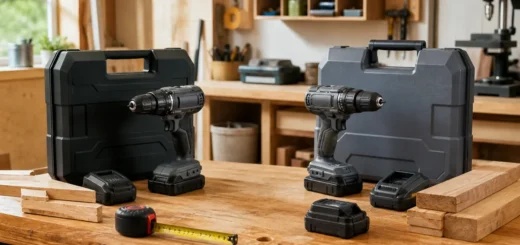
For occasional household repairs, a cordless drill kit with a battery and charger is often a simpler comparison than piecing together components. A lower-priced kit can be entirely adequate for light assembly and small holes; it may struggle with long, repeated drilling in dense material or feel less comfortable during extended use.
Use specs as a filter, not a scoreboard
Specs are useful when they answer a real question. For a drill, check whether it has the clutch settings, chuck size, and drilling mode you need. For a saw, confirm that the blade size and cutting depth handle your stock. For a sander, compare the pad size and dust collection arrangement. These checks prevent a mismatched purchase.
More is not automatically better. A higher-capacity battery can provide longer runtime, but it usually costs more and may make a handheld tool heavier. A larger tool may be useful for sustained heavy work and awkward for overhead tasks. Peak power figures and maximum speed do not tell you how comfortable the tool is, how long it runs under load, or how well it holds up over time.
When the choice is close, compare practical features: weight with the battery fitted, grip comfort, adjustment ease, included blade or bit type, and whether replacement consumables are easy to find. If possible, handle the tool in a store. A difference of a few ounces can matter when sanding overhead for 20 minutes, even if it looks minor in a listing.
Compare costs over the time you expect to use it
For a tool used twice a year, a dependable budget option may cost less per job than a premium model that sits in a drawer. For a daily-use tool, downtime, battery wear, and repairs can outweigh a modest purchase saving. Think about likely use rather than an imagined worst-case project.
Check what is covered by the warranty and whether registration is required. Look at the return window, especially if you cannot test the tool before buying. A missing accessory is a small problem if it is inexpensive and easy to source; a proprietary battery that is unavailable or unusually costly is a more serious one.
A cordless impact driver kit may be worth its extra cost if you regularly drive many screws or fasteners. For a few small screws now and then, a drill with a clutch may already cover the job. Buying both tools is not automatically better value if one will rarely leave the shelf.
Watch timing, but verify the deal
Tool prices often move around major retail sales and seasonal promotions. Spring can bring discounts aimed at renovation and yard work; holiday sales may include bundles or free-tool offers. These patterns are not guarantees, so compare the current kit contents and price against other retailers rather than treating a sale badge as proof of value.
Bundle arithmetic deserves care. A free bare tool is valuable if it is one you would buy and it uses your existing batteries. It is not a saving if it adds an unwanted tool to the receipt. Similarly, a large battery bundle may be useful for a demanding job but poor value if you mainly need a lightweight tool for short tasks.
Make the final choice with a short checklist
Before buying, confirm that the tool handles your material and workload, the price includes what you need to use it, and its battery fits your existing system—or that you have included the cost of starting one. Then check returns, warranty terms, and the price of common replacements such as batteries, blades, or bits.
If two options both meet the job requirements, choose the less expensive one unless the pricier tool offers a benefit you will actually use: longer runtime, better balance, a useful warranty, or a platform that supports tools you plan to add. That is a better reason to spend more than a bigger number on a spec sheet.