Best Affordable Jobsite Table Saw for Weekend Woodworkers
What's inside
As an Amazon Associate I earn from qualifying purchases. This post may contain affiliate links at no extra cost to you.
A weekend woodworker usually needs a table saw for breaking down plywood, sizing framing lumber, and making repeatable cuts—not for running a cabinet shop all day. The best value is often a compact jobsite saw with a folding stand, a usable fence, and enough power for the materials you actually cut. Spending more can buy smoother adjustments and better support, but a higher price does not automatically mean safer or more accurate work.
As an Amazon Associate we earn from qualifying purchases at no extra cost to you.


What “affordable” should buy you
For occasional home projects, look first at saws in the roughly $250–$500 range, with sale prices often lower. At the bottom of that range, expect simpler stands, more plastic parts, and a fence that may need careful checking before each cut. Around $350–$500, you are more likely to get a sturdier rolling stand, better outfeed support, or smoother fence adjustments. These are general price bands, not a guarantee of current pricing; check the delivered price and included accessories.
A basic 10-inch, corded jobsite saw is enough for most weekend tasks. Its blade can usually cut material close to 3 inches thick at 90 degrees, though check the manufacturer’s stated capacity. A 15-amp motor is common. It can rip ordinary construction lumber and sheet goods, but a long, heavy cut through dense hardwood may slow the blade. Feed steadily rather than forcing the stock; pushing hard can worsen cut quality and increase kickback risk.
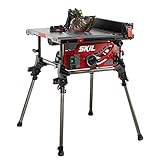
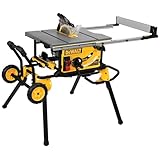
Compare 10-inch jobsite table saws by fence design, stand, warranty, and included safety equipment—not just motor amperage.
Where the money goes
| Option | Typical value | Best for | Trade-off |
|---|---|---|---|
| Entry-level jobsite saw | Lowest purchase cost; basic fence and stand | Occasional cuts in lumber and smaller panels | More setup checks; limited support for long stock |
| Mid-priced jobsite saw with folding stand | More convenient storage and transport | Regular weekend projects in a garage or driveway | Costs more; stand still needs a level, stable surface |
| Used jobsite saw from a reputable brand | Can offer stronger features for less | Buyers able to inspect and test before paying | Unknown wear, missing parts, or a damaged fence can erase the savings |
Prioritize the fence and usable capacity
The fence matters more than a long list of convenience features. Lock it and check whether it stays parallel to the blade; a fence that shifts or pinches stock makes accurate ripping difficult and can contribute to kickback. On a new saw, follow the manual’s alignment procedure and verify the setup with a reliable square or measuring method before cutting. On a used saw, test the fence at several positions across the table and check that the rails, locking mechanism, and blade guard are present and functional.
Rip capacity is the maximum width the saw can cut between the blade and fence, and it varies by model. For plywood, wider capacity can help, but a wide table extension does not support a full sheet by itself. A 4-by-8-foot sheet is awkward and potentially dangerous to handle alone on a small saw. Use a helper or a proper outfeed and side-support setup, or break sheets down with a track saw or circular saw first. If your projects mostly use boards under 6 feet long, paying extra for maximum rip capacity may bring little benefit.
Choose the stand for your workspace
A folding stand is worth paying for if you regularly move the saw or need to store it upright. Look for a stand that locks securely and does not rock when the saw is set up. Wheel size matters on rough driveways, but it matters less in a smooth garage. If the saw will stay on a bench, a less expensive model without a rolling stand can be a sensible buy—provided the bench is solid, level, and leaves enough room for the workpiece.
Check what comes in the box. A blade, push stick, guard, riving knife, and anti-kickback pawls may be included, but not every package has the same equipment. A cheap saw missing safety parts can cost more once replacements are added. Never remove the guard or riving knife just to make a difficult cut; choose a different tool or setup when the operation cannot be done safely with the saw’s prescribed protection.
When the cheaper saw is enough
Buy the lower-priced option if you make a few dozen cuts a month, store the saw between projects, and can tolerate pausing to check fence alignment. It is also reasonable for rough construction cuts where a small amount of cleanup is expected. Spend more if you routinely rip long boards, need to set the fence quickly and repeatedly, or transport the saw often. Better controls and a stable stand save time, but they do not replace careful feeding, proper support, and safe habits.
A saw can still struggle on thick hardwood even if its specifications look similar to a pricier model. Keep the blade sharp and appropriate for the cut, use a steady feed rate, and stop if the motor labors or the stock binds. A dull or dirty blade can make a capable saw seem underpowered. Forcing a stalled cut is not a way to make a budget tool perform like a larger stationary saw.
Buy by total cost, not the sale tag
Prices often dip around major holiday sales and seasonal promotions, but a discount is useful only if the saw has the features you need. Compare the final price with tax and delivery, then check whether the stand, blade, and safety components are included. Also compare return terms: a fence or stand problem is easier to resolve when the retailer offers a straightforward return window.
For a used saw, inspect the tabletop for damage, test the tilt and height adjustments, and make a short cut if the seller permits it. Confirm that the blade stays square at 90 degrees and that the fence locks without sliding. Missing guards, bent rails, a motor that cuts out, or a blade that visibly wobbles are reasons to walk away unless replacement costs are clear and still leave a meaningful saving.
If portability is the priority, compare jobsite table saws with folding stands. If your work is mostly sheet breakdown rather than repeatable narrow rips, a track saw and guide rail may be a better use of the budget. For most weekend shops, though, a basic jobsite saw with a dependable fence and the right support setup is the practical middle ground.