Best Affordable Tools for Basic Car Repairs in a Garage
What's inside
As an Amazon Associate I earn from qualifying purchases. This post may contain affiliate links at no extra cost to you.
Basic car repairs rarely require a professional tool chest. For oil changes, battery work, brake inspections and small under-hood jobs, a compact set of dependable hand tools and safe lifting gear goes a long way. The best value comes from buying the right sizes and safety equipment first, then adding specialty tools when a repair actually calls for them.
As an Amazon Associate we earn from qualifying purchases at no extra cost to you.


Start with a socket set
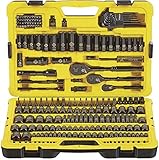
A 3/8-inch drive socket set is the most useful first purchase for many home garages. Look for both metric and SAE sockets, a ratchet, a short extension and a selection of combination wrenches. Most modern cars use metric fasteners, but older vehicles and aftermarket parts may use SAE sizes. A set covering roughly 8–19 mm and 3/8–3/4 inch handles many basic jobs.
Chromium-vanadium steel is common in affordable hand tools and is adequate for routine car work. A polished finish is easy to wipe clean, but matters less than sockets that fit snugly and a ratchet that engages reliably. Avoid using chrome sockets with an impact wrench; they can crack under impact loads. For occasional work, a budget 3/8-inch set is usually fine. Pay more if the ratchet skips, the socket markings are hard to read or the set lacks commonly used sizes.
Compare metric and SAE 3/8-inch socket sets by included sizes and warranty, not just the piece count. A box padded with tiny bits is less useful than a smaller set with the sockets your car needs.
Buy lifting gear for safety
A floor jack is for raising a vehicle, not holding it up. Use a pair of jack stands rated for the vehicle and place them on firm, level ground at the manufacturer’s lift points. Chock the wheels that remain on the ground. Never crawl under a car supported only by a jack, and do not use a jack or stands on soft asphalt that may sink in warm weather.
For a typical passenger car, a 2-ton jack may be sufficient if its specifications and lifting range suit the vehicle, but a 2.5- or 3-ton model is a common practical choice for added capacity and versatility. Check the minimum saddle height for low cars and the maximum lift height for the job. A small, inexpensive scissor jack can work for roadside wheel changes; it is slow and awkward for repeated garage repairs. A hydraulic floor jack is faster, but takes up more space and needs periodic checks for leaks.
Buy stands separately if a jack bundle does not include a pair with clear capacity markings and secure locking mechanisms. Compare floor jacks and jack stands after checking their individual ratings. Do not assume a bundle’s total capacity means each stand can support the full vehicle.
Compare common budget buys
| Tool | Typical budget range | Best for | Trade-off |
|---|---|---|---|
| 3/8-inch socket set | $25–$70 | Routine fasteners and basic maintenance | Cheapest sets may skip sizes or have weak ratchets |
| Floor jack | $80–$180 | Frequent wheel and under-car work | Heavy and bulky; check lift range and saddle height |
| Jack stands, pair | $30–$80 | Supporting a raised vehicle | Must be matched to the car and used on firm ground |
| Torque wrench | $25–$70 | Wheel fasteners and specified torque jobs | Needs careful storage and periodic accuracy checks |
| Digital multimeter | $15–$50 | Battery and basic electrical checks | Low-cost units may be slow or poorly protected |
These are broad U.S. retail ranges, not fixed prices; sales and shipping can shift them substantially. A good comparison is the tool’s useful features and warranty against its price, rather than the number of pieces in the package.
Add a torque wrench for critical fasteners
Hand-tightening is not a reliable way to install wheels, spark plugs or other fasteners with specified torque. A 3/8-inch click-type torque wrench covering a range around 10–80 ft-lb suits many light automotive tasks, while wheel-lug torque may call for a 1/2-inch wrench with a higher range. Check your vehicle manual: required values vary, and one wrench may not cover every job.
Budget click wrenches can be useful for occasional home repairs if they click consistently and have a stated range. Their main failure mode is misuse: using one as a breaker bar, forcing it past its range, or leaving it set at a high value for months. Follow the maker’s storage instructions, keep it clean and avoid extensions that change the effective leverage unless you know how to account for them. For an occasional oil filter or light repair, a torque wrench may not be the first purchase; for wheel work, it is worth budgeting for.
Choose electrical tools carefully
A basic digital multimeter can help distinguish a weak battery from a charging or connection problem. A low-cost meter is adequate for checking battery voltage and continuity, but probe quality and clear settings matter. Set the meter to the correct mode before testing; measuring current across a battery in the wrong configuration can blow the meter’s fuse or cause a short. A battery’s resting voltage alone does not prove it is healthy under load.
A test light is cheaper and simpler for some basic 12-volt circuit checks, but it is not suitable for every electronic system. Avoid probing airbag wiring, control modules or unfamiliar circuits. If electrical diagnosis is not a regular job, a modest meter is better value than a professional scan tool. Compare automotive digital multimeters for protected inputs, readable displays and sturdy leads.
Spend by job and season
Before buying, list the next two or three repairs and check the vehicle’s manual for required sizes, lift points and torque values. That prevents paying for tools you will not use. Keep a basic tool kit, wheel chocks, gloves, eye protection and a work light near the car; a $15 light can save more time than an oversized socket set.
For occasional repairs, store-brand hand tools are often a sensible buy. Brand names may offer better ratchets, stronger warranties or more consistent fit, but those advantages matter most when tools see frequent use. Compare warranty terms and whether claims require shipping tools away. Seasonal promotions around major holidays and spring car-care periods can reduce prices, but check the normal price first: a discount on a larger set is not a bargain if it duplicates tools you already own.
Buy safety equipment before convenience upgrades. If a repair requires a special puller, spring compressor or high-torque impact tool, rent or borrow it when practical rather than improvising. A cheap tool that fits the job is good value; a cheap tool that slips on a fastener, fails under load or encourages an unsafe shortcut is not.