Best Budget Shop Stool for Long Garage Repair Sessions
What's inside
As an Amazon Associate I earn from qualifying purchases. This post may contain affiliate links at no extra cost to you.
Long garage repairs punish your back, knees, and patience. A good shop stool will not make a four-hour brake job comfortable, but it can keep you from crouching on concrete or constantly standing up to move around the vehicle. For most home garages, the best budget choice is a padded rolling mechanic’s stool with a low back or no back, a stable five-wheel base, and a published weight rating of at least 250 pounds.
Expect to spend roughly $35 to $60 for a basic rolling stool, $60 to $100 for a better-padded model with a tray or adjustable height, and $100 or more for a heavy-duty shop seat. The cheapest stool is often fine for occasional oil changes. It becomes less attractive when you spend several hours doing suspension, brake, detailing, or engine-bay work.
As an Amazon Associate we earn from qualifying purchases at no extra cost to you.


The best budget stool type for garage repairs
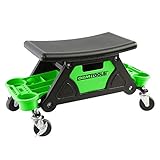
A rolling mechanic’s stool is usually more useful than a fixed shop stool. Its casters let you reposition without standing, and the low seat works well for wheels, hubs, brakes, and workbenches. Look for a seat height around 15 to 20 inches. A seat that is too low forces your knees sharply upward; one that is too high makes it harder to reach lower vehicle components.
A rolling mechanic shop stool with a tool tray is especially practical. The tray prevents you from repeatedly walking back to the toolbox for sockets, screwdrivers, clips, or a flashlight. The trade-off is clearance: trays can catch on jack stands, floor jacks, and dropped parts when you move around a vehicle.
For bench work, woodworking, or using a grinder, consider an adjustable-height shop stool instead. A seat range of about 22 to 32 inches can cover a workbench and a standing-height assembly table, but these stools are less convenient beside a car. They also tend to have a taller center of gravity, so they need a broad five-leg base.
Features that matter during long sessions
| Feature | Budget target | Why it matters |
|---|---|---|
| Seat padding | At least 2 inches of firm foam | Thin foam bottoms out against the frame during long repairs. |
| Seat height | About 15–20 inches for vehicle work | Keeps your knees and back in a workable position near wheels and hubs. |
| Base | Five legs, roughly 20–24 inches wide | Reduces tipping when reaching for tools or leaning around a fender. |
| Casters | 2–3 inch wheels, preferably non-marking | Rolls over small debris without damaging a coated garage floor. |
| Weight rating | 250 pounds minimum; 300+ is better | Leaves margin for work clothes, tools, and leaning force. |
| Storage | Under-seat tray or side compartments | Keeps frequently used tools close, but may reduce floor clearance. |
Padding quality matters more than a thick-looking cover. Cheap foam can compress within months, leaving you sitting on a hard plastic or metal pan. Firm, moderately thick foam is preferable to soft foam that collapses immediately. If the listing does not state the seat material, user photos often reveal whether the cushion is a thin pad attached over a rigid shell.
Casters are another common failure point. Small hard plastic wheels work on smooth concrete but jam on cracks, floor mats, and scattered gravel. Larger wheels roll better, though they add cost and can raise the seat slightly. Check that each caster is fastened securely and that replacement wheels are available before buying an unfamiliar stool.
Budget options compared
The cheapest fixed stool remains a reasonable buy if you only sit for 15 or 20 minutes at a time. It has fewer parts to fail and does not roll away when you lean against the car. However, fixed stools make you twist and stand more often, which becomes tiring during a long repair.
| Stool category | Typical price | Best use | Main compromise |
|---|---|---|---|
| Fixed padded stool | $25–$45 | Occasional repairs and simple bench work | No repositioning; usually limited storage |
| Rolling mechanic stool | $35–$75 | Brake, suspension, detailing, and under-car work | Casters collect dirt and can roll on sloped floors |
| Rolling stool with tray | $55–$100 | Long jobs requiring many hand tools | Tray can catch on equipment and adds bulk |
| Adjustable-height shop stool | $50–$120 | Workbench and mixed-height tasks | Less stable and less useful at wheel height |
A padded garage shop stool without wheels is the sensible cheaper option for a tight budget. Pay extra for rolling storage only if you will actually use it. A tray filled with tools can make a stool harder to move, and exposed tools can become a tripping hazard around a vehicle.
Common failure modes and safety checks
Do not treat the published weight capacity as a suggestion to exceed. Your body weight plus a tool pouch, jacket, and leaning force can approach the limit quickly. A 250-pound rating is adequate for many users, but a 300- or 350-pound-rated frame provides useful margin and usually indicates stronger hardware.
Inspect the welds and fasteners when the stool arrives. Uneven welds, loose caster bolts, or a seat that rocks on its mount are reasons to return it. Sit down slowly and test it on the actual garage floor. If one caster hangs above the floor, the base is poorly assembled or warped.
Rolling stools are unsafe on sloped driveways. Even a gentle slope can let the stool move while you are applying force to a stuck fastener. Use wheel chocks, work on level flooring, and keep the stool clear of a vehicle jack and jack stands. Never use a rolling stool as a step.
When to buy and where brand value matters
Budget stools commonly get discounted during spring garage-cleanup promotions, Father’s Day sales, and November holiday events. Compare the actual delivered price rather than the claimed percentage discount. A stool listed at $49 with free shipping is often a better deal than a $35 stool carrying a large shipping charge.
Established tool brands generally offer better replacement casters, clearer weight ratings, and more consistent hardware. That does not automatically make their entry-level stool more comfortable. If two stools have the same steel base, padding, and caster size, the cheaper one can be the better value for light use.
For a long repair session, prioritize the seat and base before branded graphics. A heavy-duty rolling shop stool is worth the extra money for frequent use, heavier users, or rough concrete. Otherwise, a basic five-wheel padded mechanic’s stool around $40 to $60 is the budget sweet spot: stable enough for garage work, easy to replace, and not overloaded with features that add cost without improving comfort.