How to Find the Best Value in Cordless Tool Batteries
What's inside
As an Amazon Associate I earn from qualifying purchases. This post may contain affiliate links at no extra cost to you.
The lowest price on a cordless battery is not always the best value. A cheap battery that fits only one tool, runs hot under load or loses capacity quickly can cost more per year than a pricier pack that works across a whole platform. Compare usable capacity, compatibility, warranty and sale timing—not just the number printed on the label.
As an Amazon Associate we earn from qualifying purchases at no extra cost to you.


Start with the tools you own
Battery platforms are usually brand-specific, and packs from different voltage families often do not interchange. Before shopping, check the tool’s battery system and the exact compatibility list. A battery that physically clicks into place is not necessarily approved for every tool, charger or generation.
If you own one drill and use it occasionally, buying into a new platform just to save a few dollars on a pack rarely makes sense. If you already have several tools from the same brand, another compatible battery may be more useful than a cheaper pack that serves only one job. For an established platform, compare batteries for your existing tool platform against the cost of a kit that includes a battery and charger.
Read capacity and voltage carefully
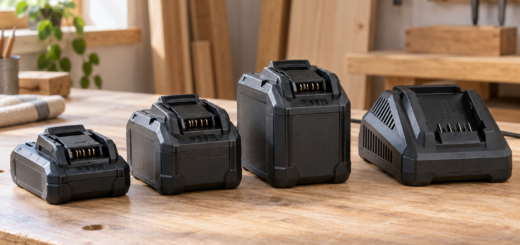
Amp-hours (Ah) describe capacity, not power by themselves. On the same platform, a 5.0Ah pack can generally run longer than a 2.0Ah pack under comparable conditions, but it will usually weigh more and cost more. Actual runtime depends on the tool, material and workload: driving screws in softwood draws less energy than cutting thick stock or grinding.
Voltage matters too, but do not compare a 5.0Ah pack at one voltage directly with a 5.0Ah pack at another and assume they store the same energy. Watt-hours (Wh) are a more useful cross-voltage comparison when the manufacturer provides them: voltage multiplied by Ah gives a rough Wh figure. Even then, pack design and tool efficiency affect how much of that energy reaches the work.
For light household work, a compact 2.0Ah or similar pack may be the best value: it is lighter, often cheaper, and enough for short drilling or assembly jobs. For repeated cutting, sanding or other demanding work away from an outlet, a larger pack can reduce interruptions. A second mid-size battery may be more practical than one very large, heavy pack if you need to keep working while another charges.
Compare price per capacity, with limits
Price per Ah is a quick screening tool within the same voltage platform. Divide the price by the Ah rating: a $60, 4.0Ah pack costs $15 per Ah. That does not prove it is a better buy than a $40, 2.0Ah pack at $20 per Ah; the smaller battery may suit occasional use, and large packs can be heavier than your tool needs. Use the calculation to shortlist options, then check warranty, compatibility and included accessories.
| Option | What it suits | Value trade-off |
|---|---|---|
| Compact pack, around 2.0Ah | Drilling, fastening and light home repairs | Lower cost and weight; more charging on long jobs |
| Mid-size pack, around 4.0–5.0Ah | Mixed DIY work and longer sessions | More runtime; higher price and added tool weight |
| Large-capacity pack | Long, demanding work with compatible tools | Fewer swaps; expensive and cumbersome on compact tools |
| Third-party replacement pack | Budget-conscious owners willing to verify carefully | Potential savings; quality, fit and support can vary |
Price the whole kit, not just the battery
Battery-and-tool kits can be a better deal than a bare battery, especially during promotions. Compare the kit price with the separate prices of the tool, battery and charger you would actually buy. Do not count a second charger as savings if you already have one, and check whether the kit battery has the capacity you need. Some low-priced bundles include small packs that are fine for light work but frustrating on high-drain tools.
Warranty terms matter because batteries are wear items. Read the manufacturer’s coverage period and exclusions, and keep proof of purchase. A warranty does not mean normal capacity loss is automatically covered. Store packs away from extreme heat, avoid leaving them discharged for long periods, and use the charger recommended for that platform. Heat, repeated deep discharge and heavy loading can shorten service life.
When is a third-party battery worth considering?
Third-party packs can cost less, and for an occasional-use tool that does not face heavy loads, the savings may be reasonable. The risk is that performance and protection circuitry vary between sellers and batches. Poor fit, inaccurate capacity claims, overheating, early failure and limited warranty support are common reasons the lowest-priced pack disappoints. A pack should not feel loose in the tool or charger, and stop using it if it swells, smells unusual or becomes excessively hot.
For tools used daily, high-draw equipment or batteries shared across expensive tools, an original-brand pack is usually the safer value. If you still choose an aftermarket option, buy from a seller with a clear return policy, verify the exact platform and model compatibility, and do not assume a higher advertised Ah rating means better real-world runtime. Compare aftermarket replacement batteries only after checking those details.
Use seasonal sales without buying the wrong pack
Battery deals often appear with tool promotions around major shopping periods and during spring or holiday sales. Bundles may offer better value than a standalone pack, but advertised savings can be misleading if the kit includes a tool you do not need. Check the same battery’s recent price where possible, compare the bundle against separate items, and confirm whether the promotion applies to the capacity you want.
For a first purchase, a drill kit with a battery and charger can establish a platform at a sensible cost. For an existing owner, a mid-capacity replacement battery may be a more useful purchase. Either way, buy for the work you actually do: the best value is the pack that fits your tools, lasts through a typical job and does not leave you paying for capacity or accessories you will not use.