How to Tell Whether a Factory-Reconditioned Tool Is a Good Value
What's inside
As an Amazon Associate I earn from qualifying purchases. This post may contain affiliate links at no extra cost to you.
A factory-reconditioned tool can be a smart way to buy a better brand for less, but “reconditioned” is not a fixed standard. One tool may have been returned unopened; another may have needed a motor, switch, or battery replacement. Judge the specific offer by its seller, warranty, included parts, and final price—not by the label alone.
What “factory-reconditioned” actually means
Factory-reconditioned usually means the manufacturer or a repair facility working for it inspected and restored a tool that had been returned, used for a demonstration, or found to have a fault. The work may range from cleaning and testing to replacing worn components. It does not necessarily mean the tool is equivalent to new, nor does it tell you what was repaired.
Check who performed the work. A manufacturer’s own outlet or an authorized seller is generally easier to verify than a third-party listing using similar wording. Read the condition description and warranty terms before comparing prices. “Open box,” “seller refurbished,” and “factory reconditioned” can refer to different levels of inspection and support.
Compare the total cost, not just the sticker price
Compare the reconditioned tool with the new version that has the same voltage, kit contents, and warranty. A bare tool can look inexpensive beside a new kit, but it may not include a battery, charger, case, blade, or other essentials. Add the cost of anything you need to start the job.
| Check | Why it matters | What to verify |
|---|---|---|
| Price gap | A small discount may not compensate for reduced warranty or uncertain history. | Compare the same tool configuration, including battery and charger. |
| Warranty | Repairs can be expensive after coverage ends. | Length, covered parts, labor, and who handles a claim. |
| Return policy | You may discover a problem only after testing the tool. | Return window, restocking fee, and who pays return shipping. |
| Included items | Missing accessories can erase the savings. | Battery, charger, case, guard, blade, and manuals, as applicable. |
| Battery condition | A weak pack can cost as much as the discount. | Whether the battery is new, reconditioned, or excluded. |
As a practical rule, a discount of around 20% may be too modest if the reconditioned tool has a shorter warranty or no easy returns. A discount closer to 30% or more is more compelling when the tool includes the same essentials and has a clear warranty. These are comparison points, not guarantees: a new tool on sale can still be the better buy.
Match the purchase to the job
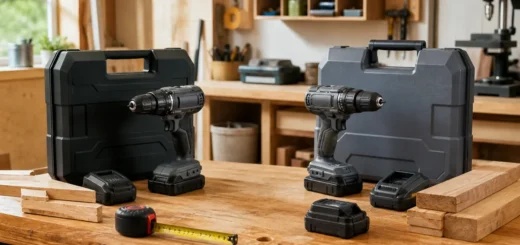
Reconditioned makes the most sense when you know what you need and the tool is easy to test. A drill or impact driver from an established cordless platform can be good value if you already own compatible batteries. In that case, you are not paying twice for a charger and pack. Compare current offers on reconditioned cordless drill and driver kits, but check each listing for the actual condition and warranty.
For occasional home repairs, a less expensive new tool may be the sensible choice. If you drill a few holes each year, an entry-level new drill with a full warranty can beat a discounted professional model that has unknown wear. If you use a tool daily or depend on it for paid work, downtime matters. A known warranty and quick parts support may be worth more than the initial savings.
Be more cautious with tools that rely on precise alignment or take heavy loads: table saws, miter saws, planers, and large grinders. A tool can run while still having a bent arbor, damaged fence, worn bearings, or a cracked guard. If you cannot inspect and test it, demand a strong return policy. For a job needing a dependable saw immediately, compare new sale prices on cordless circular saws as well as reconditioned options.
Inspect and test before the return window closes
When the tool arrives, photograph the box and contents before unpacking. Check the model number and compare the included items with the listing. Look for cracked housings, damaged cords, loose handles, missing guards, bent shafts, and signs of heavy use. Cosmetic scuffs alone are not necessarily a concern; damage to a safety feature or structural part is.
Test the tool with the right battery or accessory, following the manual. Run it unloaded briefly, then under a moderate load. Listen for grinding, rattling, or a change in speed; check for excessive vibration, burning smells, smoke, and unusual heat. A brushed motor may spark slightly at the vents, but heavy or uneven sparking is a reason to stop and contact the seller. Do not open the housing or bypass a guard to investigate.
For a cordless tool, test the battery and charger too. A pack that shows a full charge but quickly loses power may be a costly weak point. If possible, compare runtime with a known-good battery of the same capacity. A charger that flashes an error or a pack with a damaged case should be reported promptly.
Use sales timing to improve the comparison
Prices on new tools often fall during major retail sale periods and around gift-buying holidays. Check those prices before committing to reconditioned stock; the gap can shrink enough that new is preferable. Reconditioned inventory is less predictable, so waiting for a particular tool may not work, and a low listed price is not useful if the seller has no stock or imposes costly shipping.
For a tool you need now, compare the complete checkout price and delivery date. For a non-urgent purchase, track the new price for a few weeks and set a maximum price for the reconditioned version. If that ceiling is not met, skip it. Paying a little more for new is reasonable when the tool is safety-critical, the warranty is substantially better, or a replacement would interrupt an important job.