Best Affordable Portable Fan for Workshop Ventilation
What's inside
As an Amazon Associate I earn from qualifying purchases. This post may contain affiliate links at no extra cost to you.
What to buy for workshop ventilation
For most home workshops, the best affordable portable fan is a 20-inch high-velocity floor fan with a metal frame, three speeds, and a guarded blade. It is usually a better value than a small desk fan when you need to move air across a work area, and less costly than a commercial drum fan that may be excessive for a garage or one-person shop.
Choose the fan for the job, though. A fan can make a hot shop more tolerable and help push stale air toward an open door. It does not remove dust at the source, filter fumes, or make an unsafe atmosphere safe. For sanding dust, use tool-connected extraction or a suitable dust collector. For paint, solvents, fuel vapors, or other hazardous fumes, use ventilation equipment rated for that environment; an ordinary motor and fan may be an ignition risk.
As an Amazon Associate we earn from qualifying purchases at no extra cost to you.


Match size and airflow to the space
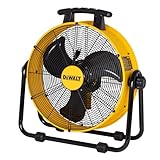
A 12- to 16-inch fan is easier to carry and store, and can be enough for a bench or a small shed. Its airflow is more limited, so expect to move it around or work closer to it. A 20-inch floor fan is a practical step up for a typical one-car garage. A 24-inch drum fan can shift more air over a broader area, but it is heavier, louder, and takes up more floor space.
Manufacturers sometimes advertise airflow in cubic feet per minute (CFM). Treat that number as a comparison point, not a guarantee: test conditions differ, and a high rating does not tell you how much air will reach your work position. Check whether the fan has speed settings, a stable base, and a tilt adjustment that directs the air where it is useful. If a listing gives no airflow figure, that is not automatically a deal-breaker for a basic fan, but it makes comparisons harder.
For a typical garage, start with a 20-inch high-velocity floor fan. If you need to reposition air through a larger space or toward an open doorway, compare it with a 24-inch portable drum fan. Buy the larger size only if you have room to place it safely and can tolerate the extra noise.
Portable fan options compared
| Type | Best fit | Trade-off | What to check |
|---|---|---|---|
| 12- to 16-inch floor fan | Bench area, small shop, occasional use | Less reach and airflow | Stable base, tilt adjustment, guarded blades |
| 20-inch high-velocity fan | Garage workshop and general air circulation | Can be loud at high speed | Speed settings, handle, cord length, service access |
| 24-inch drum fan | Large open areas and moving air toward an exit | Bulkier, heavier, harder to store | Wheel or handle quality, base stability, rated airflow |
| Rechargeable jobsite fan | Remote bench or short tasks without a nearby outlet | Limited runtime and typically less airflow per dollar | Battery compatibility, runtime at each speed, replacement cost |
Features worth paying for—and ones you can skip
On a budget fan, prioritize a solid base, a metal safety grille, and controls that are easy to reach. A carry handle and tilt adjustment are useful if the fan will move between a bench, floor, and doorway. A longer cord can prevent an awkward extension-cord run, but still follow the fan’s electrical rating and your shop’s safety practices. Keep cords away from sharp edges, hot work, and walkways.
Pay attention to noise. A fan that is too loud to run while you work may end up switched off. If possible, check customer feedback for reports of rattling, vibration, and motor noise rather than relying on airflow claims alone. A loose grille or unbalanced blade can turn into a persistent buzz. An unstable base can make a fan walk across a smooth floor, especially on high speed; place it level and do not leave it where it can be kicked or struck.
For occasional use, a basic corded fan is often the sensible buy. Battery power is convenient where outlets are absent, but it can cost more once you include a compatible battery and charger. A rechargeable cordless jobsite fan makes sense for short tasks or a remote work area—not as a direct substitute for a larger corded fan running through a long hot afternoon.
Place the fan to move air out
Simply pointing a fan at yourself provides comfort but may leave warm, dusty air circulating around the shop. When conditions allow, put the fan near an open door or window so it blows outward, and open another door or window on the opposite side for replacement air. Avoid blocking the inlet with a wall or stored materials. If you cannot create a clear path for air to enter and exit, the fan may mostly stir the same air.
Keep the fan out of the path of flying chips, grinding sparks, water, and materials that could cover the grille. Do not remove the guard to improve airflow. Stop using the fan if the cord insulation is damaged, the motor smells hot, or the blades scrape the housing. Unplug it before cleaning; dust buildup around the grille and motor can reduce airflow and may contribute to overheating. Follow the manufacturer’s cleaning instructions, especially around the motor.
When to buy and how to keep the cost down
Fan prices often become more competitive when retailers clear summer stock, while demand rises during the first hot spell. Prices vary by retailer and region, so compare current listings rather than assuming a particular month guarantees a bargain. Before paying extra for a premium brand, check the warranty, parts availability, and whether the more expensive fan offers a useful difference—such as quieter operation, better mobility, or a longer cord.
For a fixed shop with outlets, a basic 20-inch corded fan is generally the value pick. Choose a smaller fan when portability and storage matter more than reach. Step up to a drum fan for a genuinely larger space, not just because its size sounds more powerful. Whatever the price, ventilation has limits: use extraction for dust and proper, purpose-rated equipment for hazardous vapors.