Best Value Dehumidifier for a Damp Garage Workshop
What's inside
As an Amazon Associate I earn from qualifying purchases. This post may contain affiliate links at no extra cost to you.
A garage workshop does not need living-room comfort. It needs enough moisture control to keep hand tools from rusting, wood stock from taking on water, and stored materials from growing mildew. For most small, enclosed garages, the best value is a portable compressor dehumidifier rated around 35–50 pints per day under the newer U.S. rating standard. The right choice depends less on the headline pint number than on temperature, drainage, and how damp the space actually gets.
As an Amazon Associate we earn from qualifying purchases at no extra cost to you.


Start with the garage, not the label
Measure the workshop’s floor area and note whether it is insulated, heated, and connected to the house. A reasonably sealed 300–500-square-foot garage with regular dampness is a sensible match for a 35–50-pint unit. A larger, leaky garage or one with standing water may need more capacity—or, first, a fix for the water source. A dehumidifier cannot keep up economically with rain entering under a door or wet concrete continually releasing moisture.
Buy a basic hygrometer before upgrading to a larger machine. Aim for roughly 45–55% relative humidity. If readings stay below 60% and tools are not rusting, a smaller unit may be adequate. If the garage remains above 65% for days, especially in warm weather, choose more capacity and check for leaks and poor drainage.
The best-value category
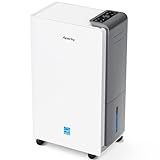
For a typical small workshop, start by comparing 35–50-pint compressor dehumidifiers. This is usually the useful middle ground: large enough to make a difference without paying for a commercial machine. Look for an adjustable humidistat, automatic restart after a power interruption, a washable filter, and a continuous-drain connection.
Advertised capacity is measured under specified test conditions, and newer U.S. ratings are not directly comparable with older, larger pint figures. Compare machines using the same rating standard where possible. Also check the operating-temperature range: many household compressor units lose efficiency in a cold garage and may stop to defrost. If the workshop regularly falls below about 60°F, check the manual before buying rather than assuming a bigger compressor will solve it.
A unit with a built-in pump can be worth its extra cost when the drain is above the machine or across the room. Otherwise, gravity drainage is simpler and generally avoids another component that can clog or fail.
Compare the practical options
| Type | Good fit | Typical trade-off | Value verdict |
|---|---|---|---|
| Small compressor, about 20–30 pints | Compact, moderately damp garage; occasional use | May run nearly nonstop in a larger or leaky space | Cheapest sensible option if humidity is only mildly high |
| Mid-size compressor, about 35–50 pints | Most enclosed one- or two-car workshop areas | Needs room for airflow; can struggle in cold conditions | Best balance for regular warm-season moisture control |
| Desiccant unit | Cold spaces where compressor models frequently defrost | Often uses more electricity and may warm the room | Worth considering when low temperature is the main constraint |
| Commercial or high-capacity unit | Large space or persistent, heavy moisture load | Higher purchase cost, noise, and power demand | Do not buy unless a smaller unit has proved inadequate |
Drainage and placement matter
A tank that holds a few pints can fill quickly in a damp garage. If you must empty it by hand, the machine may stop while you are away, making its advertised capacity irrelevant. For a nearby floor drain, use a continuous-drain hose that matches the outlet and slopes down steadily. Keep the end secure and check that the drain itself is not blocked. A kink, uphill section, or loose fitting can leave water in the tank or on the floor.
Set the unit on a level surface with the manufacturer’s required clearance around the air intake and outlet—often several inches. Keep it away from sawdust, grinding dust, and direct splashes. Fine workshop dust can clog the filter and coil, reducing airflow and moisture removal. Clean the washable filter regularly, and do not operate the machine where its intake is being fed a cloud of dust.
Budget for running cost and timing
Check the nameplate wattage and estimate cost with this formula: watts ÷ 1,000 × hours per day × your electricity rate per kilowatt-hour. For example, a 500-watt unit running 8 hours a day at $0.20 per kWh uses about $0.80 a day. Actual use varies: a humidistat may switch the compressor off once the target is reached, while a damp, unsealed garage may keep it running for long stretches.
Buy before the first humid spell if you want the widest choice; prices and stock can tighten during peak summer demand. Late-season promotions can be good value, but check return terms and warranty coverage, and test the unit promptly. A new dehumidifier that never brings humidity down may be undersized, running in temperatures outside its rated range, or fighting a leak—not necessarily defective.
When the cheaper unit is enough
A smaller machine is a reasonable purchase for a well-sealed garage used a few days a week, especially if a hygrometer shows humidity only briefly crossing 60%. Choose a larger capacity when moisture is persistent, the space is bigger, or you need faster recovery after wet weather. Do not pay extra for Wi-Fi or a pump you will not use before paying for reliable drainage, a useful humidistat, and a model rated for your garage’s temperature.
If humidity remains high despite continuous operation, inspect roof and wall leaks, door seals, and drainage around the slab. Fixing water entry is often cheaper than running a dehumidifier around the clock. Once the source is controlled, a mid-size household unit may be all the workshop needs.