
What's inside
- Top Picks at a Glance
- Wet Saw Comparison Table
- How Blade Size and Rip Capacity Decide the Choice
- 1. DEWALT D36000S 10-Inch Wet Tile Saw with Stand: Best Overall
- 2. DEWALT D24000S 10-Inch Wet Tile Saw with Stand: Best Value Pro Saw
- 3. VEVOR 10-Inch Wet Tile Saw with Stand: Best Budget 10-Inch
- 4. Delta Cruzer 10-Inch Wet Tile and Stone Saw: Best Alternative 10-Inch Brand
- 5. QEP 22700Q 700XT 3/4 HP Wet Tile Saw: Best Compact for Ceramic
- 6. Flyrivergo 900W 8-Inch Wet Tile Saw: Best Mid-Size Tabletop
- 7. VEVOR 7-Inch Wet Tile Saw: Best Entry Price
- Also Consider
- How We Chose
- Buying Guide
- Safety and Setup Basics
- Frequently Asked Questions
- Which One Should You Buy?
- Sources
As an Amazon Associate I earn from qualifying purchases. This post may contain affiliate links at no extra cost to you.
The best wet saw for tile is a 10-inch bridge-style saw if you cut large porcelain or lay whole floors, and a compact 7-inch tabletop saw if you only tile a bathroom, backsplash or shower surround now and then. Of the models compared here, the DEWALT D36000S is the strongest all-round pick for serious work because of its stated 37-inch rip capacity, and the QEP 700XT 3/4 HP is the most sensible compact pick for occasional ceramic jobs.
Our broader wet tile saw guide on this site explains the saw types and how a wet saw works. This article takes a different, narrower angle: it compares specific models by the two numbers that decide whether a saw fits your tile, namely blade diameter and rip capacity, and it shows how to match those numbers to the tile you actually plan to cut. We did not personally use these saws. This guide is research-based, built from listing details, manufacturer information and independent review summaries, and we say “not listed” wherever a spec could not be confirmed. Ceramic and porcelain, tabletop and bridge-style saws, and best wet saws for cutting tile at different budgets are all covered below.
As an Amazon Associate we earn from qualifying purchases at no extra cost to you.


Top Picks at a Glance
- Best Overall: DEWALT D36000S 10-inch wet tile saw with stand
- Best Value 10-Inch Pro Saw: DEWALT D24000S 10-inch wet tile saw with stand
- Best Budget 10-Inch: VEVOR 10-inch wet tile saw with stand
- Best Alternative 10-Inch Brand: Delta Cruzer 10-inch wet tile and stone saw
- Best Compact for Ceramic: QEP 22700Q 700XT 3/4 HP with 7-inch blade and table extension
- Best Mid-Size Tabletop: Flyrivergo 900W 8-inch wet tile saw
- Best Entry Price: VEVOR 7-inch wet tile saw
Wet Saw Comparison Table
| Product | Blade size | Rip capacity | Other key specs | Best for | Price tier |
|---|---|---|---|---|---|
| DEWALT D36000S | 10 in | About 37 in (about 41 in with plunge), per retailer spec sheets | 15 A, 1,220 MWO per listing; 4,200 RPM and 3-3/8 in cut depth per retailer sheets; 0-45 degree bevel | Large-format porcelain, floors | Premium |
| DEWALT D24000S | 10 in | About 25 in for the D24000 saw, per retailer sheets | Corded, with stand | Bathrooms, kitchens, tilers on a budget | Premium |
| VEVOR 10 in with stand | 10 in | Not listed | 65Mn steel blade; 0-45 degree bevel; stand | Budget 10-inch work | Mid-range |
| Delta Cruzer 10 in | 10 in | Not listed | Wet tile and stone saw | Stone and tile hobbyists | Mid-range |
| QEP 700XT | 7 in | Not listed | 3/4 HP motor; table extension | Ceramic wall and floor tile | Budget |
| Flyrivergo 900W | 8 in | Not listed | 900 W motor | Mixed tile jobs | Budget |
| VEVOR 7 in | 7 in | Not listed | 65Mn steel blade; 3,600 RPM; 0-45 degree bevel | Occasional small jobs | Budget |
How Blade Size and Rip Capacity Decide the Choice
Two numbers do most of the work when you choose a tile saw. Blade diameter sets how deep the saw can cut, which matters for thick porcelain, stone and pavers. Rip capacity is the longest straight cut the saw can make from the blade to the fence, and it decides whether your tile fits at all. A simple rule: pick a saw whose rip capacity is at least as long as your largest tile dimension, with some margin for the fence and the tile’s overhang.
| Tile size you plan to cut | Minimum rip capacity | Likely saw class |
|---|---|---|
| 4 x 4 or 6 x 6 in wall tile | 6 in | Any compact 7-inch tabletop |
| 12 x 12 in floor tile | 12 in | 7-inch or 8-inch tabletop; diagonals need about 17 in of travel |
| 12 x 24 in plank tile | 24 in | 10-inch bridge saw or a large tabletop with a table extension |
| 24 x 24 in large format | 24 in, plus about 34 in for diagonals | 10-inch bridge saw with the longest rip |
| 24 x 48 in or larger slabs | 48 in | Rail saw or professional cutting; beyond this list |
For diagonals, multiply the side by about 1.41. A 12-inch tile cut corner to corner needs roughly 17 inches of travel, and a 24-inch tile needs about 34 inches, which is more than most saws can do in one pass and the reason many installers snap large tile into pieces after scoring. We list the diagonal capacity where retailer sheets give one: the D36000 is quoted at 24 by 24 inches.
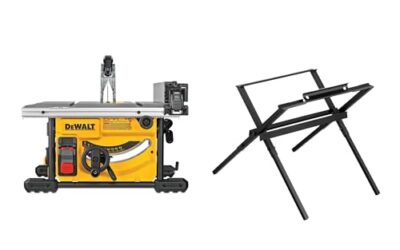
1. DEWALT D36000S 10-Inch Wet Tile Saw with Stand: Best Overall
- Blade: 10 inch diameter, 5/8 inch arbor, per retailer sheets
- Rip capacity: about 37 inches, about 41 inches with the plunge feature
- Motor: 15 amp, 1,220 MWO (maximum watts out) per the listing; 4,200 RPM per retailer sheets
- Cutting depth at 90 degrees: about 3-3/8 inches; crosscut about 8-1/2 inches; diagonal about 24 x 24 inches
- Bevel: 0 to 45 degrees
- Weight: about 91 lb for the saw alone, per retailer sheets; 3-year warranty; stand included
Best for: flooring installers and ambitious DIYers cutting large porcelain, stone or long plank tile. Skip if: you only cut a few wall tiles; it is heavy, bulky and costly.
The standout number is the rip capacity. Retailer sheets agree on about 37 inches, with one outlier at 36, which lets you rip a 36-inch tile in half or run long cuts on 12 x 24 plank without turning it around. Cutting-clearance to the left of the blade is quoted as about 18 inches in the same sheets. The 15-amp motor and large-diameter blade give power to push through dense porcelain without slowing, and the package is described as including a submersible pump, water pan and trays, a cart-side extension, an angle and rip guide, and a porcelain blade.
In practice, a saw of this size is a commitment. At roughly 91 lb without the stand, it is a two-person lift into a truck, and you need space for it plus a water supply. Maintenance is regular: clean the pan and pump after each job, because tile slurry hardens. If you cut tile weekly, the reduced hassle is worth it. If you cut it twice a year, consider renting.
Pros: Longest stated rip capacity here; powerful motor; bevel and plunge features; stand and blade included; warranty. Cons: Heavy; premium cost; overkill for small jobs.
2. DEWALT D24000S 10-Inch Wet Tile Saw with Stand: Best Value Pro Saw
- Blade: 10 inch
- Rip capacity: about 25 inches for the D24000 saw (about 28 with plunge), per retailer sheets
- Weight: about 69 lb for the saw alone, per retailer sheets
- Corded, stand included in the S version
Best for: bathroom and kitchen remodels where you cut 12 x 12 and 12 x 24 tile and want a proven jobsite saw with a smaller footprint than the D36000S. Skip if: you regularly cut tile longer than 24 inches.
This model is the lighter, shorter-rip sibling of the first pick. The roughly 25-inch rip capacity is enough for 12 x 24 plank and for most floor tile, and the smaller frame is easier to load into a van. It uses the same 10-inch blade size, so you can buy blades that suit porcelain, ceramic or stone. Because some spec details such as motor wattage are not given in the listing title, check the maker’s sheet if you need them. Compared with a compact saw, the extra power and deeper cut make a visible difference on thick porcelain and pavers.
Pros: Pro-grade 10-inch design; lighter than the D36000S; suited to most floor tile; stand included. Cons: Shorter rip; premium cost; not for large-format tile.
3. VEVOR 10-Inch Wet Tile Saw with Stand: Best Budget 10-Inch
- Blade: 10 inch, 65Mn steel blade, per the listing
- Bevel: 0 to 45 degrees adjustable
- Stand: included
- Rip capacity, motor power and weight: not listed in the title
Best for: DIYers who want a 10-inch blade and a stand without paying jobsite-saw prices. Skip if: you need confirmed specs or daily professional durability.
The appeal here is size at a lower price. A 10-inch blade gives a deeper cut than the 7-inch compact class, and the stand makes it more practical for floors. The missing detail is the biggest caveat: the listing title does not give rip capacity or motor wattage, so confirm those on the maker’s page before you buy, particularly if you plan to cut 24-inch tile. Blade quality is also a variable on budget saws; many users replace the stock blade with a diamond blade chosen for porcelain.
Pros: 10-inch capacity at a budget-friendly tier; stand included; bevel cuts. Cons: Key specs not listed; durability for heavy daily use unknown; blade may need upgrading.
4. Delta Cruzer 10-Inch Wet Tile and Stone Saw: Best Alternative 10-Inch Brand
- Blade: 10 inch
- Use: wet tile and stone cutting
- Rip capacity, motor and weight: not listed
Best for: DIYers who want a known tool brand and a 10-inch saw that can cut stone as well as tile. Skip if: you need verified numbers; we could not confirm rip capacity from the listing.
The Cruzer name is aimed at the woodworking and home-improvement crowd more than at tile contractors. It makes sense if you already own other tools from the same line and appreciate a familiar service network. Because we cannot confirm the motor power, the rip distance or the weight from the listing, treat it as a model to compare against the VEVOR and DEWALT saws rather than a default recommendation. Always confirm the capacity against your largest tile before committing.
Pros: 10-inch blade; positioned for tile and stone; familiar brand. Cons: Specs not listed; premium-leaning price tier for what is stated; limited detail.
5. QEP 22700Q 700XT 3/4 HP Wet Tile Saw: Best Compact for Ceramic
- Blade: 7 inch
- Motor: 3/4 HP
- Includes: table extension
- Rip capacity: not listed in the title
Best for: bathroom walls, backsplashes and ceramic floor tile up to around 12 inches. Skip if: you cut thick porcelain daily or tile longer than the table allows.
A 7-inch saw is the classic homeowner tool. It is light enough to carry, fits on a workbench and is simple to set up. The listing mentions a table extension, which helps support longer tile as it passes the blade. A 3/4 HP motor is adequate for ceramic and thinner porcelain, but expect slower feed on dense porcelain. Cuts get cleaner when you let the blade do the work and keep the water flowing.
Pros: Compact; table extension; recognisable tile-tool brand; low price tier. Cons: Smaller blade; limited depth; rip capacity not given.
6. Flyrivergo 900W 8-Inch Wet Tile Saw: Best Mid-Size Tabletop
- Blade: 8 inch
- Motor: 900 W
- Rip capacity and weight: not listed
Best for: DIYers who want a bit more blade and power than a 7-inch saw without moving up to a stand-mounted 10-inch. Skip if: you need an established service history; this is a lesser-known brand.
Eight-inch blades are less common, which is the model’s selling point. The extra inch over a 7-inch blade gives more cutting depth. A 900 W motor is a clear number to compare with other tabletop saws, but the listing does not give a rip distance. This makes it a reasonable pick for mixed jobs, as long as you verify the cut size against your tile.
Pros: Larger blade than 7-inch saws; stated motor wattage; budget-friendly. Cons: Specs incomplete; less proven; parts and blades may be harder to find.
7. VEVOR 7-Inch Wet Tile Saw: Best Entry Price
- Blade: 7 inch, 65Mn steel blade
- Speed: 3,600 RPM
- Bevel: 0 to 45 degrees
Best for: a single bathroom or backsplash project where you want to avoid renting. Skip if: you will cut tile regularly or want a long service life.
The advantage here is cost. For one project, a low-priced saw can cost less than a rental plus travel. The compromises are limited power, fewer features and unknown rip capacity. Plan to take your time with the feed rate, and consider replacing the stock blade with a continuous-rim diamond blade for cleaner edges on glazed tile.
Pros: Lowest entry cost in this group; bevel cuts; light. Cons: Limited power; specs incomplete; not built for heavy use.
Also Consider
EliteEdge 7-Inch Wet Tile Saw
A 7-inch tabletop saw rated at 3,450 RPM with 0 to 45 degree bevel cuts and a water reservoir, as listed. A basic pick for small jobs.
Takywep 7-Inch Wet Tile Saw
A 7-inch tabletop saw described as 6,500 RPM with a copper motor and a water reservoir for porcelain and ceramic. Treat the speed claim as a marketing number and check the blade rating.
Towallmark 7-Inch Wet Tile Saw
A near-twin of the Takywep model, again 7 inch and 6,500 RPM by its listing. Compare cost and warranty between the two.
iQ Power Tools iQTS244 10-Inch Dry Cut Tile Saw
A dry-cut saw, so a different category. It uses dust control instead of water. If you cut tile indoors and want less mess, it is worth a look, but it belongs to a different class and a much higher cost than a wet saw.
How We Chose
This guide is research-based. We did not personally use these saws on tile. We reviewed each listing in the site’s product store, then cross-checked the DEWALT specifications with several retailer spec sheets and an independent review of the D36000. Where retailer sheets disagreed slightly, for example on a rip figure of 36 versus 37 inches, we gave the figure most sheets agree on and flagged the outlier. For brands where the listing gave only a blade size or a motor rating, we published only that and wrote “not listed” for the rest. We chose models across three blade classes (7, 8 and 10 inch) so you can compare how blade size and rip capacity change what a saw can do, and we use relative price tiers rather than dollar amounts.
Buying Guide
Start with your largest tile
List the biggest tile you will cut and compare it to the rip capacity. If the saw cannot rip your tile in a single pass, you will have to score and snap or use a different tool. For 12 x 24 plank, a minimum of 24 inches is required, and a margin helps. For 24 x 24, check both the straight rip and the diagonal capacity.
Choose the blade diameter by thickness and material
Seven-inch blades handle ceramic and thinner porcelain well. Larger blades cut deeper, which suits thick stone, pavers and stacked cuts. A 10-inch saw such as the D36000S quotes a cutting depth of about 3-3/8 inches at 90 degrees, while smaller saws cut shallower. Where the depth is not listed, assume a smaller capacity and confirm before you buy.
Look at the water system and the table
A good pump keeps water flowing across the blade for the whole cut, which prolongs blade life and keeps dust down. A table that holds tile flat and a sturdy fence keep cuts square. Table extensions, like the one on the QEP 700XT, support longer tile. Look for a splash guard and a pan that is easy to empty.
Plan for the blade
The blade matters as much as the saw. Continuous-rim diamond blades give the smoothest cut on glazed tile and porcelain; segmented blades cut faster on harder stone. Replacing a stock blade on a budget saw is a common upgrade. Make sure the arbor size matches, for example 5/8 inch on the D36000.
Decide between buying, renting and snapping
For one small bathroom, a manual cutter plus a rental saw for a few cuts can cost less than buying. If you tile more than one room, buying a mid-priced saw usually pays off. Pros who cut daily should look at the 10-inch jobsite class.
Safety and Setup Basics
- Plug the saw into a GFCI-protected outlet, since water and electricity are always close together.
- Wear eye and ear protection, and a dust mask or respirator when cleaning dried slurry; tile and stone dust can be hazardous to breathe.
- Unplug the saw before changing the blade or adjusting the guard.
- Keep fingers well away from the blade, and feed tile at a steady, moderate rate rather than forcing it.
- Fill the water pan to the recommended level and check the pump is working before each cut.
- Follow the maker’s manual for blade direction, fence setting and placement of the saw on a stable surface.
Frequently Asked Questions
What is the best wet saw for tile?
For large porcelain and whole-floor jobs, the DEWALT D36000S with its quoted 37-inch rip capacity is the best pick here. For bathrooms and backsplashes, a compact 7-inch saw like the QEP 700XT is usually enough.
What is the best wet saw for ceramic tile?
A 7-inch tabletop saw with a 3/4 HP motor is suited to ceramic wall and floor tile. Ceramic is softer than porcelain, so a compact saw cuts it without strain when you feed slowly.
Can a 7-inch wet saw cut porcelain?
Often yes, with a suitable diamond blade and a slow feed, but dense porcelain is harder on small motors. If you cut a lot of porcelain, a 10-inch saw is a better fit.
What rip capacity do I need for 12 x 24 tile?
At least 24 inches, plus a little margin. Saws with about 25 inches of rip capacity, like the D24000 class, cover it, and a table extension helps on compact saws.
Is a wet saw better than a manual tile cutter?
For curves, notches, bevels and hard porcelain, yes. A manual score-and-snap cutter is faster and cleaner for straight cuts on thinner ceramic, so many installers own both.
Do I need a stand?
A stand makes a 10-inch saw practical for floor work by raising it to a comfortable height and giving it a stable base. Compact tabletop saws sit on a bench or a pair of sawhorses.
How do I look after a wet saw?
Empty and rinse the pan and pump after each job, wipe the table and fence, and inspect the blade for glazing or wear. Do not let tile slurry harden inside the pump, and follow the manual for lubrication and storage.
Which One Should You Buy?
Choose the DEWALT D36000S if you cut large-format porcelain or lay whole floors, and the D24000S if 12 x 24 tile is your upper limit. Pick the VEVOR 10-inch or the Delta Cruzer if you want a 10-inch blade at a lower tier, but confirm rip capacity first. Choose the QEP 700XT for ceramic bathroom work, the Flyrivergo 8-inch for mixed jobs, and the VEVOR 7-inch if the budget is tight and the project is small. Whichever you buy, match the rip capacity to your tile, plug into a GFCI outlet, wear eye, ear and lung protection, and follow the maker’s manual.
Sources
- DEWALT D36000S and D24000 product specification sheets
- Pro Tool Reviews DEWALT D36000 10-inch wet tile saw review
- Retailer specification pages for the D36000S (Toolnut, Tile Outlets and others)
- QEP, VEVOR, Delta and Flyrivergo product listing details
- Manufacturer safety guidance for wet tile saws
Last updated: October 2026
Related guides
More from Amazon
Programs that pair well with the guide above. Offers and eligibility are set by Amazon and may change.
A free business account with business pricing and bulk-buying tools for work, shop or home office.
Create a business accountFree shipping on eligible items, Prime Video and more. Eligible new members can start with a free trial.
Start a Prime free trialAudiobooks and podcasts to listen to on the go. Eligible new members can start with a free trial.
Try Audible freeAd-free music streaming. Eligible new subscribers can start with a free trial.
Try Music Unlimited freeAs an Amazon Associate we earn from qualifying purchases.
Write Your Review
No reviews yet. Be the first to share your experience!