
Our Top Picks


What's inside
As an Amazon Associate I earn from qualifying purchases. This post may contain affiliate links at no extra cost to you.
A miter saw earns its place in a woodworking shop by doing one job repeatedly and doing it well: bringing stock to exact length at exact angles. Crosscuts for frame rails, 45-degree miters for picture frames and boxes, bevels for angled joinery, and compound angles for crown molding all come off the same machine, and the finished quality depends on how accurately the saw holds its settings from the first cut to the fiftieth. Trim carpenters, furniture makers, and framing crews all lean on the same tool, but they weight the details differently, which is why the five saws here cover a useful spread of designs.
Disclosure: As an Amazon Associate, we earn from qualifying purchases made through links on this page, at no extra cost to you.
The lineup below includes two 12-inch dual bevel sliding models from DEWALT, a 12-inch Bosch saw that replaces rear rails with a hinged glide arm, a 10-inch Makita slider built for wall-side benches, and a light 10-inch Metabo HPT compound saw with a fixed head. Each entry lists the maker’s published figures for blade size, motor output, miter and bevel ranges, and cutting capacity, so the differences that matter for trim, framing, and furniture work are easy to compare.
How to Choose a Miter Saw for Woodworking
Blade size. A 10-inch blade handles most trim, flooring, and furniture stock, and saws built around it tend to be lighter and more compact. A 12-inch blade adds depth and width of cut, which matters for thick beams, wide baseboard standing against the fence, or large crown molding nested at an angle.
Sliding versus fixed head. A fixed-head saw pulls the blade straight down. It suits narrow and medium stock, takes up little bench depth, and has fewer moving parts to keep aligned. A sliding saw lets the head travel forward on rails or a glide arm, stretching the crosscut width considerably; the 12-inch sliders here cut 2×14 dimensional lumber at 90 degrees. The trade-off is size: rail sliders need clear space behind the saw, while glide-arm and forward-rail designs reduce that clearance.
Single bevel versus dual bevel. A single bevel saw tilts its head one way, so a bevel in the opposite direction means flipping the workpiece end for end. A dual bevel saw tilts both ways, which speeds up crown molding and trim work where left and right bevels appear in pairs, and keeps long stock oriented the same way throughout a batch of angled furniture parts.
Miter range and detents. The miter table swings left and right for angled crosscuts. Positive stops at common angles such as 0, 15, 22.5, 31.6, and 45 degrees let the table click into place without reading the scale, and a detent override helps when an angle falls between stops. A wider range, up to 60 degrees on several saws here, covers steep angles for polygon work and odd joints.
Cutting capacity. Three figures describe what a saw can handle: crosscut width at 90 degrees, the height of baseboard cut standing vertically against the fence, and the size of crown molding cut nested. Match these to the largest material in the typical workload, since capacity drives the saw’s size and weight.
Cut line indication and dust collection. A shadow line system projects the blade’s own shadow onto the stock, marking the kerf on either side; a laser draws a single line that may sit to one side of the blade. Both speed up alignment compared with lowering a stopped blade onto a pencil mark. Dust ports and bags vary in how much debris they capture, and a vacuum connection keeps a bench station cleaner over long runs.
The 5 Best Miter Saws for Woodworking
1. DEWALT DWS780 12-Inch Double Bevel Sliding Compound Miter Saw
The DWS780 is DEWALT’s full-featured 12-inch slider, built around a 15 amp motor turning at 3,800 RPM and an integrated XPS positioning system that casts an LED shadow of the blade onto the workpiece, marking the cut line without adjustment. Tall sliding fences support crown molding up to 7-1/2 inches nested and base molding up to 6-3/4 inches standing vertically, and the back fence design crosscuts 2×14 lumber at 90 degrees and 2×10 at 45 degrees. The head bevels 0 to 49 degrees in both directions, and the stainless steel detent plate carries 10 positive stops with a cam lock handle and detent override. For a bench station handling trim, framing lumber, and furniture stock in rotation, this is the most complete specification set in the group.
Specs:
– Blade diameter: 12 inches
– Motor: 15 amp, 3,800 RPM
– Bevel range: 0 to 49 degrees, left and right
– Miter range: 60 degrees right, 50 degrees left
– Crosscut capacity: 2×14 at 90 degrees, 2×10 at 45 degrees
– Crown molding capacity: 7-1/2 inches nested
– Cut line system: XPS LED shadow line
– Weight: 56 pounds
– Includes: carbide blade, blade wrench, dust bag, vertical material clamp
2. Bosch GCM12SD 12-Inch Dual-Bevel Glide Miter Saw

The GCM12SD replaces the sliding rails of a conventional 12-inch slider with Bosch’s Axial-Glide system, a pair of articulated arms that fold as the head moves, so the saw keeps a compact footprint and can sit closer to a wall than a rail design allows. The 15 amp motor runs at 3,800 RPM, and the saw crosscuts 4×14 lumber with 6-1/2 inches of vertical capacity and 6-1/2 inches of nested crown capacity. Bevel and miter controls sit up front, and the bevel tilts 47 degrees in each direction with stops at 0, 33.9, and 45 degrees. SquareLock quick-release fences and integrated base extensions suit shops where bench depth is limited but 12-inch capacity is still required.
Specs:
– Blade diameter: 12 inches
– Motor: 15 amp, 3,800 RPM
– Slide system: Axial-Glide articulated arm
– Bevel range: 47 degrees left and 47 degrees right
– Miter range: 52 degrees left, 60 degrees right
– Crosscut capacity: 3-1/2 x 13-1/2 inches (4×14 lumber)
– Crown molding capacity: 6-1/2 inches nested
– Weight: 65 pounds
– Includes: 12-inch 60-tooth carbide blade, wrench, work clamp, dust bag, vacuum adapter elbow
3. DEWALT DWS779 12-Inch Double Bevel Sliding Compound Miter Saw
The DWS779 shares its platform with the DWS780: the same 15 amp, 3,800 RPM motor, 12-inch blade, and cutting envelope, including 2×14 crosscuts at 90 degrees, 2×10 at 45 degrees, 7-1/2 inches of nested crown, and 6-3/4 inches of vertical base capacity. The head rides on dual horizontal steel rails with linear ball bearings, bevels 0 to 48 degrees left and right, and uses a stainless steel detent plate with 10 positive stops and a cam lock handle with detent override. The main omission compared with its sibling is the XPS shadow line; alignment relies on the blade and fence. The dust collection system is rated by the maker to capture over 75 percent of dust generated.
Specs:
– Blade diameter: 12 inches
– Motor: 15 amp, 3,800 RPM
– Bevel range: 0 to 48 degrees, left and right
– Crosscut capacity: 2×14 at 90 degrees, 2×10 at 45 degrees
– Crown molding capacity: 7-1/2 inches nested
– Base molding capacity: 6-3/4 inches vertical
– Positive miter stops: 10, with cam lock and detent override
– Dust collection: captures over 75 percent of dust generated
– Includes: carbide blade, blade wrench, dust bag, vertical material clamp
4. Makita LS1019L 10-Inch Dual-Bevel Sliding Compound Miter Saw with Laser
The LS1019L takes a different route to capacity: a 10-inch blade on a two-steel-rail sliding system that lets the saw operate flush against a wall, paired with a direct drive 15 amp motor delivering 3,200 RPM. Despite the smaller blade, it crosscuts 2-13/16 x 12 inches at 90 degrees, nests crown up to 6-5/8 inches with the crown stopper, and cuts baseboard up to 5-1/4 inches standing vertically, figures that overlap the working range of many 12-inch saws. The miter range runs 0 to 60 degrees in both directions with six positive stops, and the bevel reaches 0 to 48 degrees left and right with a front-mounted lock. A built-in laser marks the cut line, and the included 60-tooth micro-polished blade suits trim and finish work.
Specs:
– Blade diameter: 10 inches
– Motor: 15 amp direct drive, 3,200 RPM
– Bevel range: 0 to 48 degrees, left and right
– Miter range: 0 to 60 degrees, left and right
– Crosscut capacity at 90 degrees: 2-13/16 x 12 inches
– Crown molding capacity: 6-5/8 inches nested
– Baseboard capacity: 5-1/4 inches vertical
– Slide system: 2-steel rail, flush-to-wall design
– Weight: 57.9 pounds
– Includes: 10-inch 60-tooth micro-polished blade, vertical vise, dust bag, wrench
5. Metabo HPT C10FCGS 10-Inch Single Bevel Compound Miter Saw
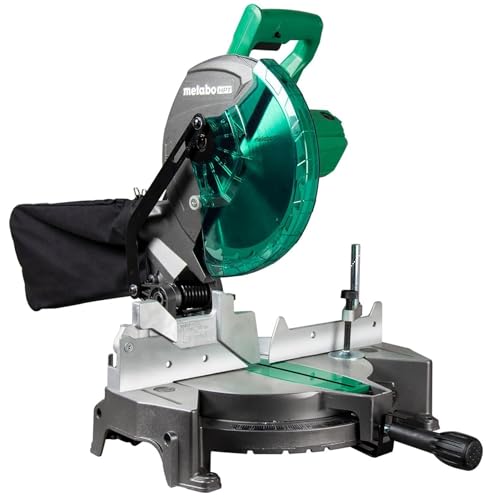
The C10FCGS is the fixed-head entry in this group and by far the lightest, at 24.2 pounds. Its 15 amp motor spins a 10-inch blade at up to 5,000 RPM, the fastest no-load speed listed here, and the miter table swings 0 to 52 degrees left and right with thumb-actuated positive stops at 0, 15, 22.5, 31.6, and 45 degrees. The single bevel head tilts 0 to 45 degrees to the left only, so opposing bevels require flipping the workpiece. Crosscut capacity at 90 degrees is 2-5/16 x 5-21/32 inches, covering 2×6 lumber and most trim profiles, and an extended flip fence rises to 4 inches for taller workpieces. An electric brake stops the blade quickly between cuts. It suits woodworkers who move the saw often and whose stock fits a fixed head.
Specs:
– Blade diameter: 10 inches
– Motor: 15 amp, up to 5,000 RPM
– Bevel range: 0 to 45 degrees, left only (single bevel)
– Miter range: 0 to 52 degrees, left and right
– Crosscut capacity at 90 degrees: 2-5/16 x 5-21/32 inches
– Weight: 24.2 pounds
– Includes: 24-tooth TCT blade, dust bag, vise assembly, hex bar wrench
Which Miter Saw Should You Pick
For a fixed bench station handling everything from framing lumber to wide crown, the DEWALT DWS780 pairs the widest capacity in this group with a shadow line that shows both edges of the kerf. The Bosch GCM12SD answers the same brief where bench depth is tight, trading the rail slide for a glide arm and upfront controls, at the expense of some weight. The DEWALT DWS779 covers the same cutting envelope for shops that align cuts without a light guide. The Makita LS1019L fits a wall-side bench and delivers 12-inch crosscuts from a 10-inch blade. The Metabo HPT C10FCGS is the pick when the saw travels between rooms or sites and the stock is trim-sized, since its fixed head and low weight make it the easiest to carry and set up.
Frequently Asked Questions
What size miter saw works best for general woodworking?
A 10-inch saw covers trim, flooring, and most furniture stock, and the sliding Makita here reaches a 12-inch crosscut despite its smaller blade. A 12-inch saw adds depth for thick beams and taller baseboard and crown, which suits mixed trim and framing work. The deciding figures are crosscut width and vertical capacity, matched against the largest stock in regular use.
What is the difference between single bevel and dual bevel miter saws?
A single bevel saw tilts its head in one direction only, as the Metabo HPT does to the left, so a bevel facing the other way requires turning the workpiece around. A dual bevel saw tilts both ways, which keeps long or fragile trim in one orientation and speeds up paired cuts such as crown molding returns.
Can a miter saw crosscut wide boards for furniture work?
A sliding model can, within its rated width: the 12-inch sliders here crosscut 2×14 lumber at 90 degrees, and the 10-inch Makita reaches 12 inches of width. A fixed-head saw is limited to roughly the blade’s usable width, around 5-1/2 inches on the Metabo HPT. Boards wider than the saw’s capacity are better handled on a table saw or with a track saw, since a second pass rarely keeps both halves of the cut aligned.
Which blade tooth count suits trim compared with framing?
Framing and general construction cuts favor lower tooth counts, such as the 24-tooth blade supplied with the Metabo HPT, which clears material quickly. Finish and trim work favors finer blades, such as the 60-tooth blades supplied with the Bosch and Makita saws, which leave a smoother edge on molding and veneered stock. Matching the blade to the material matters more than motor power.
Conclusion
The right miter saw for woodworking is the one whose capacity matches the stock on the bench and whose bevel and miter ranges cover the joints in regular rotation. The 12-inch DEWALT and Bosch sliders handle the widest material and largest moldings, the Makita compresses similar reach into a wall-friendly 10-inch design, and the Metabo HPT stays light and simple for trim-sized work. Settle the blade size first, and the rest usually falls into place.
Related guides
More from Amazon
Programs that pair well with the guide above. Offers and eligibility are set by Amazon and may change.
A free business account with business pricing and bulk-buying tools for work, shop or home office.
Create a business accountFree shipping on eligible items, Prime Video and more. Eligible new members can start with a free trial.
Start a Prime free trialAudiobooks and podcasts to listen to on the go. Eligible new members can start with a free trial.
Try Audible freeAd-free music streaming. Eligible new subscribers can start with a free trial.
Try Music Unlimited freeAs an Amazon Associate we earn from qualifying purchases.

Write Your Review
No reviews yet. Be the first to share your experience!