
What's inside
- Top Picks at a Glance
- Pressure Washer Nozzle Color Chart
- Pressure Washer Nozzle Color Degrees Chart Guide: How to Choose a Tip
- The Nozzles Worth Buying
- Foam Cannon Basics: How to Use a Foam Cannon with a Pressure Washer
- How to Use Soap in a Pressure Washer
- Is a Pressure Washer on a Car Safe?
- Also Consider
- How We Chose
- Buying Guide
- Quick Reference: Surface, Tip, Distance and Soap
- Where to Store Nozzles and Accessories
- Common Mistakes
- Frequently Asked Questions
- Which One Should You Buy?
- Sources
As an Amazon Associate I earn from qualifying purchases. This post may contain affiliate links at no extra cost to you.
A pressure washer nozzle color chart is simple once you know the rule: the smaller the degree number, the narrower and harder the spray. Red (0 degrees) is a pinpoint jet, yellow (15) strips, green (25) is the everyday cleaning tip, white (40) is the gentle wide fan, and black (65, sometimes called the soap tip) lowers pressure so detergent can flow. For most home jobs, the green 25-degree tip and the white 40-degree tip do 80 percent of the work. This guide gives the chart, explains which tip to use on which surface, then covers how to use a foam cannon, how to use soap in a pressure washer, and whether a pressure washer is safe on a car.
Method note: this guide is research-based. We did not personally use the products named here. Product details come from store listings and manufacturer descriptions, and anything not stated is marked “not listed”. Prices are shown as tiers only.
As an Amazon Associate we earn from qualifying purchases at no extra cost to you.


Our Top Picks
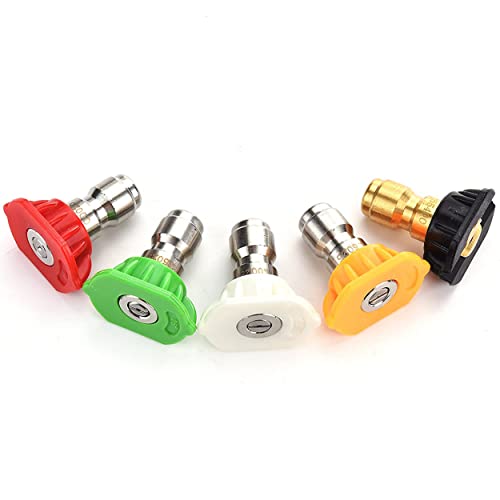 Tool Daily Pressure Washer Nozzle Tips Multiple DegreesOrifice 2.5-5 pack4.6 x 3.2 x 0.5 inchesCheck on Amazon

Top Picks at a Glance
If you only want to know what to buy to use your washer properly, this short list covers the add-ons that matter most.
- Best Nozzle Set (all-round): SEPLY 7-piece pressure washer tip set with holder – 1/4 inch quick connect, rated up to 4000 PSI.
- Best Turbo Nozzle: Simpson 4500 PSI 1/4 inch quick connect turbo nozzle – rotating jet for concrete.
- Best Foam Cannon for Value: Westinghouse foam cannon – 3600 max PSI, 1/4 inch connector, for gas and electric washers.
- Best Foam Cannon Bundle: Tool Daily foam cannon, 1 liter, with five nozzle tips.
- Best All-Purpose Soap: Simpson Multi-Purpose Cleaner concentrate, 1 gallon – for cars, siding, concrete and decks.
- Best Vehicle Soap: Krud Kutter Vehicle and Boat pressure washer concentrate.
- Best for Wood: Karcher Wood and Fence Cleaner for pressure washers.
Pressure Washer Nozzle Color Chart
| Color | Degree | Spray shape | Typical use | Caution |
|---|---|---|---|---|
| Red | 0 | Narrow pencil jet | Very stubborn spots on hard, unpainted surfaces | Can cut wood, strip paint and damage concrete and skin |
| Yellow | 15 | Narrow fan | Stripping paint or rust, tough concrete stains | Hold farther away; can etch soft materials |
| Green | 25 | Medium fan | General cleaning: patios, driveways, fences, siding | Keep the wand moving |
| White | 40 | Wide fan | Cars, windows (with care), decks, outdoor furniture | Still strong at close range |
| Black | 65 | Widest, low pressure | Applying soap or detergent | Will not rinse or clean hard stains |
| Turbo (rotating) | 0 (spinning) | Cone of rotating jet | Concrete and heavy grime over wide area | Same risk as red at close range |
Color codes are an industry convention, not a law. Some budget sets use slightly different shades, so read the degree number printed on the tip before using it. The degree number is the real information.
Pressure Washer Nozzle Color Degrees Chart Guide: How to Choose a Tip
Choosing a tip is a three-step decision: surface, stain and distance.
Step 1: Name the Surface
- Hard and unpainted (concrete, brick pavers): 25-degree or turbo. Start at 12-18 inches from the surface.
- Wood (deck, fence): 25- or 40-degree, held farther away and moved along the grain. Wood fibers can fuzz or gouge if the spray is too tight.
- Vinyl or painted siding: 40-degree, working from the bottom up with detergent, then rinsing from the top down. Do not aim up under lap seams.
- Cars and boats: 40-degree only, with additional distance.
- Glass and screens: 40-degree from a good distance, or skip and use a hose for delicate screens.
Step 2: Name the Stain
Loose dirt and pollen respond to a wide fan. Mildew and algae respond to detergent with dwell time, not more pressure. Oil on concrete needs a degreaser before rinsing. Rust and old paint may justify a narrower tip, but only on materials that tolerate it.
Step 3: Set the Distance
A good rule is to begin with the wand farther away than you think you need, spray a hidden patch, and move closer by a few inches until the surface cleans without marking. Distance changes the force on the surface more than most people expect, so it is the most useful adjustment you have after changing the tip.
The Nozzles Worth Buying
1. SEPLY 7-Piece Tip Set with Holder: Best Complete Set
- Seven tips with a nozzle holder
- 1/4 inch quick connect
- Rated up to 4000 PSI (as stated)
- Flow rating (GPM) and orifice size: not listed in the title
Best for: anyone who lost the stock nozzles or wants the full range of degrees. Skip if: your washer uses a different connector such as 3/8 inch quick connect or threaded tips.
A tip set is the cheapest upgrade in pressure washing. The holder keeps tips from vanishing, and having the full range means you can match the tip to the job instead of making the one tip on the wand do everything. Before buying, check two compatibility points: the connector size (1/4 inch quick connect is most common on home washers) and the orifice size, which must match your washer’s GPM and PSI. A wrong orifice makes the washer run at the wrong pressure.
Pros:
- Covers the full color range
- Holder keeps tips organised
- Budget price tier
Cons:
- Orifice sizing may not match every washer
- Plastic or light metal parts can wear over time
2. Simpson 4500 PSI Turbo Nozzle: Best Turbo Tip
- 4500 PSI rated, 1/4 inch quick connect
- Rotating (oscillating) jet, described by the listing as cleaning up to 50 percent faster
- Compatible washers: check the listing for GPM and orifice size
Best for: concrete driveways and walkways with heavy grime. Skip if: you mainly clean wood, siding or vehicles.
A turbo nozzle spins a narrow jet in a cone, so it covers a wider area than a red tip while keeping much of the intensity. That is useful on concrete but risky anywhere else. Do not use it on wood, soft stone, siding, painted metal or cars. Keep the tip moving and avoid lingering, which can leave lighter streaks on concrete.
Pros:
- Faster on big flat areas
- Name-brand listing with stated rating
Cons:
- Aggressive; easy to mark soft surfaces
- Premium-tier price for a single tip
Foam Cannon Basics: How to Use a Foam Cannon with a Pressure Washer
A foam cannon is a bottle-and-nozzle attachment that mixes soap, water and air into a thick foam. The foam clings to the surface, so the soap has more dwell time to loosen grime before you rinse it off. It connects to the wand end, usually with a 1/4 inch quick connector.
Foam Cannons Worth Considering
1. Westinghouse Foam Cannon: Best Match for Westinghouse Washers
- 3600 max PSI
- 1/4 inch connector
- Stated as fitting gas and electric pressure washers
- Bottle capacity: not listed in the title
Best for: general car and house washing with a Westinghouse or another 1/4 inch quick-connect washer. Skip if: your washer maxes out above 3600 PSI.
The key spec to check on any foam cannon is its rated maximum PSI. Using one on a washer that exceeds the rating can stress the fittings. Foam cannons also work best with washers that provide enough flow. Low-GPM electric units can make thinner foam than a gas washer, so adjust the dial and soap ratio rather than assuming the cannon is faulty.
Pros:
- Clear PSI rating
- Fits both gas and electric washers with 1/4 inch quick connect
Cons:
- Fewer extras than bundle kits
2. Tool Daily Foam Cannon: Best Bundle
- 1 liter bottle
- 1/4 inch quick connector
- Includes five nozzle tips, according to the listing
- Brass or plastic parts: not listed
Best for: beginners who want a foam cannon plus extra nozzles in one purchase. Skip if: you want a stainless internal build and confirmed warranty details.
This kit is a value pick because it includes both the cannon and extra tips. The 1 liter bottle gives enough capacity for a full car wash or a few siding sections, and the wide-mouth design makes refilling easier, though the listing does not say this.
Pros:
- Includes extra nozzles
- Budget price tier
Cons:
- Build materials not detailed
Step-by-Step: Using a Foam Cannon
- Rinse the surface first with a 40-degree tip to remove loose grit.
- Fill the foam cannon bottle with water first, then add the soap, so the mix does not froth in the bottle. A common starting ratio is 1 to 3 ounces of soap per liter. Follow the soap label.
- Attach the cannon to the wand using the quick connector. Make sure it clicks.
- Adjust the top knob (more soap versus more water) and the front nozzle (fan versus cone). Spray a trial patch on a hidden area and adjust until the foam is thick but not dripping instantly.
- Coat the surface from the bottom up so the foam does not streak.
- Let the foam sit for about 5 minutes, but never let it dry on the surface.
- Remove the cannon, snap on a 25- or 40-degree tip and rinse from the top down.
How to Use Soap in a Pressure Washer
There are three ways to apply soap, and they differ in effectiveness.
- Onboard soap tank or siphon tube: Many home washers have a detergent tank. It requires the black 65-degree soap tip to engage the siphon. Convenient, but the soap is heavily diluted.
- Foam cannon: The best method for dwell time and coverage.
- Pump sprayer or brush: Useful for pre-treating oil stains or small areas before rinsing.
Whichever method you choose, use detergent made for pressure washers. Household soap can leave residue or damage pump seals. Dish soap is often suggested online, but it may foam excessively and is not designed for pressure washers; check your owner’s manual before using anything other than a recommended detergent. Never run bleach or harsh chemicals through your pump unless the manual explicitly allows it.
Soaps Worth Considering
1. Simpson Multi-Purpose Cleaner: Best All-Purpose Soap
- 1 gallon concentrate
- For cars, siding, concrete, decks and grills, according to the listing
- Dilution ratio: check the label
Best for: households with a mix of surfaces and one washer. Skip if: you need a dedicated degreaser for oily concrete.
A single multi-purpose concentrate lowers cost per wash because it is diluted, not used straight. The label will give the ratio for foam cannon, siphon and manual use; use the label rather than guessing, because too little soap does not clean and too much leaves residue that is hard to rinse.
Pros:
- One bottle for many tasks
- Concentrate stretches further
Cons:
- Not specialised for oil, rust or wood
2. Krud Kutter Vehicle and Boat Pressure Washer Concentrate: Best for Cars
- Concentrate for pressure washers and manual use
- Marketed for tar, bugs and road film on vehicles and boats
- Wax or ceramic coating compatibility: not listed; check the label
Best for: vehicles and boats. Skip if: your priority is a wood or fence cleaner.
Vehicle-specific soaps are formulated for painted surfaces, which is the main reason to prefer one over a general siding cleaner. If your car has a ceramic coating or wax you care about, read the maker’s care instructions for approved soaps.
Pros:
- Made for vehicle surfaces
- Works in foam cannon or by hand
Cons:
- Not intended for decks or concrete
3. Karcher Wood and Fence Cleaner: Best for Wood
- Makes up to 40 gallons, per the listing
- For dirt and grime on wood and composite
- Sealer or stain compatibility: not listed
Best for: fences and decks before sealing. Skip if: you only wash cars.
Wood is where tip choice and detergent matter most. A wood cleaner plus a wide tip held at a safe distance is less likely to leave furrows than a narrow tip on its own. Follow the label for dwell time and rinse thoroughly before staining.
Pros:
- Targeted at wood and composite
- Concentrate yields many gallons
Cons:
- Narrow use
Is a Pressure Washer on a Car Safe?
A pressure washer can be used on a car, but only with care. Safe use is mostly about nozzle, distance and what you spray at. We are not offering a guarantee, because paint condition, previous repairs and washer power vary.
- Use only the 40-degree (white) tip, or a foam cannon, never the red, yellow or turbo tip.
- Start at a distance of roughly 2-3 feet and do not go closer than about 12 inches.
- Keep the spray away from peeling paint, chips, rust spots and loose trim, because pressure can lift them.
- Avoid direct spray into door seals, window seals, exposed electrical connectors, the engine bay, wheel bearings and the underside of mirrors.
- Rinse top to bottom. Use soap made for cars.
- Follow your vehicle maker’s recommended maximum pressure if the manual lists one.
- Use lower-pressure electric washers (about 1,300-2,000 PSI) if you are nervous. Higher-PSI gas washers need extra distance.
Also Consider
Tool Daily Short Pressure Washer Gun with Foam Cannon
A shorter gun that includes a foam cannon and multiple nozzle tips, aimed at easier handling when washing cars. Spec details such as flow rating are not listed.
Simpson Green Formula Cleaner
A concentrated, biodegradable soap solution in a 1 gallon size, positioned as a lower-harshness option. Check the label for surface suitability.
Raincovo or AstroAI Foam Cannons
Alternatives in the 1 liter class with 1/4 inch quick connectors. Compare listing details on fittings and bottle shape.
Zep All-In-1 Pressure Wash Cleaner
A concentrate sold in a four-bottle case, claimed to make up to 28 gallons. Best for those who wash often.
How We Chose
This is a research-based guide, and we did not personally use these products. We chose items actually sold in the store that fix common pressure-washer problems: tip sets, a turbo tip, foam cannons and detergents for different surfaces. We checked listing text for connector sizes and PSI ratings, and read manufacturer care guidance for general rules on tips, distance and soap. We avoided giving fixed time or pressure guarantees, because results depend on the washer, surface and stain.
Buying Guide
1. Match Connector Size
Most home washers use a 1/4 inch quick connect at the end of the wand. Some use 3/8 inch quick connect and some have threaded tips. Confirm yours before buying nozzles or a foam cannon.
2. Check the Orifice Size
Nozzles have an orifice number such as 3.0 or 4.0 that must match the washer’s flow. A mismatch gives incorrect pressure. Check your manual for the recommended size.
3. Check the PSI Rating
Every nozzle and foam cannon has a maximum PSI. Choose one at or above your washer’s rating, which matters for gas washers above 3,000 PSI.
4. Pick Detergent for the Surface
Vehicle soap for cars, wood cleaner for fences, degreaser for oil. A multi-purpose concentrate is the economical middle ground. Always follow the label dilution.
5. Consider the Whole Setup
If you wash weekly, a foam cannon and a full tip set are worth buying. If you wash twice a year, the stock nozzles and a bottle of detergent are enough.
6. Look After the Tips
Nozzle orifices wear with use, especially on gritty water, and a worn tip delivers lower pressure and a distorted fan. If a familiar tip suddenly cleans more weakly than it used to, compare it with a spare from the set before blaming the pump. Rinse tips after soap use, keep them in the holder so grit does not enter the orifice, and clear blockages with the small cleaning needle that comes with many sets, never with a nail or drill bit, which can enlarge the hole.
Quick Reference: Surface, Tip, Distance and Soap
| Surface | Starting tip | Starting distance | Soap method | Extra care |
|---|---|---|---|---|
| Concrete driveway | 25-degree or turbo | 12-18 inches | Degreaser on oil spots, then rinse | Keep passes even to avoid stripes |
| Wood deck or fence | 25- or 40-degree | 18-24 inches, with the grain | Wood cleaner, low pressure | Do not linger; fibers fuzz easily |
| Vinyl siding | 40-degree | 3-4 feet | Foam cannon, bottom to top | Never spray upward under seams |
| Car or boat | 40-degree or foam cannon | 2-3 feet | Vehicle soap in foam cannon | Avoid chips, seals and electrics |
| Patio furniture | 40-degree | 18-24 inches | Multi-purpose cleaner | Check the maker’s care label |
These starting points are conservative defaults, not guarantees. Always adjust on a hidden patch and follow the guidance from your washer and surface manufacturers.
Where to Store Nozzles and Accessories
Keep the nozzle holder, cleaning pin and foam cannon together in one labelled box with the washer. After each use, run clean water through the foam cannon so soap does not dry inside the orifice or the small filter screen, and let it air-dry with the bottle open. Wipe the O-rings on the quick connectors and add a drop of silicone-based lubricant if they feel dry. Stored this way, tips and cannons stay accurate and the quick connects keep sealing, which saves you from the frustrating combination of weak foam and leaking couplings the next time you wash.
Common Mistakes
- Using the red or turbo tip on wood, siding or cars.
- Letting soap dry on a surface in direct sun.
- Pouring soap into the pump or tank in a way the manual does not allow.
- Pointing the spray at yourself, pets or others, which can cause serious injury.
- Skipping a hidden-area patch check before cleaning in the open.
Frequently Asked Questions
What do the pressure washer nozzle colors mean?
Each color marks a spray angle: red is 0 degrees, yellow 15, green 25, white 40 and black 65. A smaller angle means a narrower, harder spray.
Which nozzle should I use on a car?
Use the white 40-degree tip, or a foam cannon, from a safe distance. Avoid red, yellow and turbo tips on vehicles.
How do I use a foam cannon with a pressure washer?
Fill the bottle with water and soap, connect it to the wand, set the foam and spray dials, coat the surface bottom to top, let it dwell without drying, then rinse top to bottom.
How do I use soap in a pressure washer?
Use the black soap tip with the onboard tank, a foam cannon, or a separate sprayer, using detergent made for pressure washers and the label dilution.
Is a pressure washer on a car safe?
It can be when you use a wide tip, stay at a safe distance, avoid damaged paint and seals, and follow your vehicle’s guidance. It is not safe with narrow or turbo tips.
Can I use dish soap in a pressure washer?
It is not recommended as a routine choice. Use pressure-washer detergent and check your manual, because incompatible soap can foam excessively or affect seals.
Why does my soap not come out?
The siphon system usually needs the black soap tip, a fully attached hose and a clear inlet. If it still fails, check the manual and inspect the tube and filter for clogs.
Which One Should You Buy?
If you only want to improve your results, start with the SEPLY tip set, since tip choice is the biggest lever. Add a foam cannon (Westinghouse for a plain fit, Tool Daily for a bundle with extra tips) if you wash vehicles or siding. Choose Simpson Multi-Purpose Cleaner as the all-round soap, Krud Kutter for vehicles and Karcher for wood. Buy the Simpson turbo nozzle only if you have large concrete areas to clean.
Sources
- Manufacturer product pages: Simpson, Westinghouse, Karcher, Krud Kutter
- Pressure Washer Manufacturers Association (PWMA) nozzle and safety guidance
- Washer owner’s manuals for tip, orifice and detergent guidance
- Car-care and home-improvement guides from established publications (general guidance only)
Last updated: October 2026
Related guides
More from Amazon
Programs that pair well with the guide above. Offers and eligibility are set by Amazon and may change.
A free business account with business pricing and bulk-buying tools for work, shop or home office.
Create a business accountFree shipping on eligible items, Prime Video and more. Eligible new members can start with a free trial.
Start a Prime free trialAudiobooks and podcasts to listen to on the go. Eligible new members can start with a free trial.
Try Audible freeAd-free music streaming. Eligible new subscribers can start with a free trial.
Try Music Unlimited freeAs an Amazon Associate we earn from qualifying purchases.

Write Your Review
No reviews yet. Be the first to share your experience!