Best Budget Power Tool Brand
Our Top Picks
 Power Drill Cordless: DEKOPRO Cordless Drill 20V Electric20v drill2 x 2 x 2 inches2.5 poundsCheck on Amazon



What's inside
As an Amazon Associate I earn from qualifying purchases. This post may contain affiliate links at no extra cost to you.
Ask which is the best budget power tool brand and you will get five answers, all of them wrong, because almost nobody accounts for the part that costs the most money: batteries. A bare drill can look like a steal until you learn that the two packs it needs cost more than the tool. That is where budget brands make their margin back, and it is where most shoppers lose the savings they thought they were getting.
So this is not a popularity contest. It is a spending decision. The question is not which brand feels cheap on the shelf, it is which battery platform gives you the lowest total cost across the next five or six tools you buy, and which brands run discount cycles deep enough to be worth waiting for. Some do. Some run permanent “sales” that are just the real price with a bigger number crossed out next to it.
As an Amazon Associate we earn from qualifying purchases at no extra cost to you.


Below is how the main value platforms actually stack up on the things that decide your bill.
| Platform tier | Typical entry point | Battery cost pressure | Best fit |
|---|---|---|---|
| Store-brand value lines (Ryobi ONE+, Craftsman V20) | Lowest bare-tool and combo pricing | Low, huge pack selection, frequent kit bundles | Homeowners, occasional DIY, wide tool count |
| Pro-adjacent value (DeWalt 20V MAX standard, Milwaukee M18 non-FUEL) | Mid, but heavy holiday discounting | Medium, packs are pricier but hold value | DIYers who want upgrade room |
| Import direct (Hercules, Bauer and similar house brands) | Very low, often cheapest per tool | Low, but platform locked to one retailer | Budget builds, second sets, garage duty |
| Premium brushless (FUEL, XR, LXT) | Highest sticker, deepest seasonal cuts | High per pack, best runtime per dollar | Heavy or daily use, resale matters |
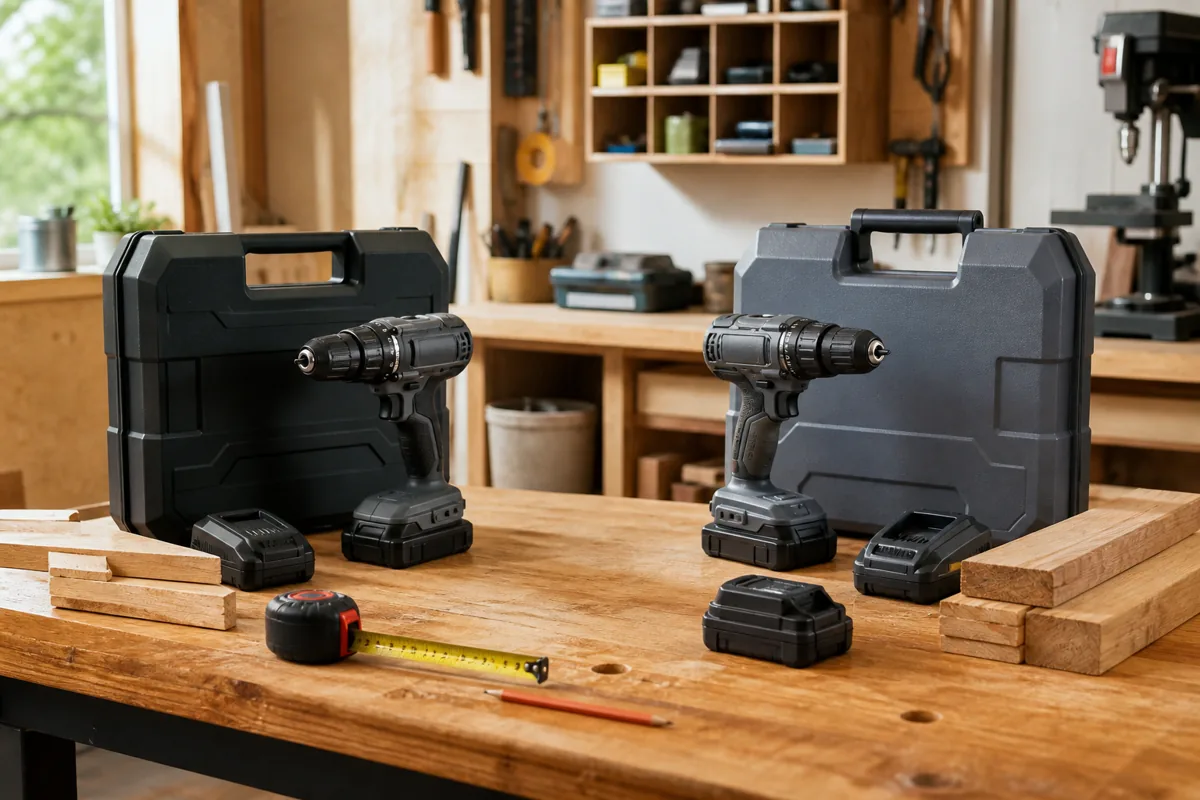
The best budget power tool brand depends on how many tools you will own
This is the single variable that decides it. If your total lifetime kit is a drill, an impact driver, and maybe a circular saw, brand barely matters and you should simply buy whichever reputable combo kit is deepest in its discount cycle. Three tools is not enough volume for platform lock-in to hurt you.
Once you cross roughly six tools, the math flips hard. Now you are buying bare tools and reusing packs, so the value of the platform is the size of its catalog and the price of its batteries, not the price of the drill. Ryobi’s ONE+ line wins on sheer breadth, with a tool count that runs into the hundreds and includes oddball items like fans, glue guns, and inflators that competitors either skip or price like professional gear. Craftsman V20 undercuts on kit pricing and shows up discounted at big-box and club stores more aggressively than most people expect.
The pro-adjacent option deserves real consideration for a value shopper: standard, non-brushless DeWalt 20V MAX and Milwaukee M18 tools land in a similar band to premium store brands, and they put you on a platform you will never outgrow. You pay a modest premium per tool for the option to buy a brushless version later without stranding your batteries.
The battery downgrade trick, and how to spot it in ten seconds
Here is the most common way a “great deal” becomes an average one. A combo kit gets advertised at a price that looks 30 to 40 percent below the familiar version, and the difference is not the tools. It is the packs. The kit ships with compact 1.3Ah or 1.5Ah batteries instead of the 4.0Ah or 5.0Ah cells in the standard configuration, and sometimes with a slow “charger” that is really a trickle unit taking several hours.
Compact packs are not junk. They are genuinely nice on a drill for overhead work. They are miserable on a circular saw, a reciprocating saw, or anything with a motor that pulls hard, and they sag under load in cold weather. If a kit includes a saw and ships only compact packs, price in a larger battery immediately and re-evaluate whether the deal is still a deal. Frequently it is not.
Second trick: bare tools sold in packaging nearly identical to the kit. Read the bullet line for “tool only” or “battery and charger sold separately.” Third trick: the inflated was-price. Many house brands and even major names carry a list price that the product has not sold at in months. Judge a discount against the street price you have seen repeatedly over the last few weeks, not the crossed-out number.
Value combo kits: drill and impact driver
The two-tool kit is where budget platforms are most competitive, and where the battery downgrade trick shows up most often. Filter for kits that include at least one mid-size pack rather than two compacts, and treat any kit with two 1.5Ah batteries as a bare-tool purchase with a bonus. Buy in a discount window, not on impulse.
What a real discount looks like, by season
Cordless tool pricing is cyclical and predictable enough to plan around. Broad patterns worth knowing:
Spring, roughly March through May. Outdoor power equipment and lawn tools take the deepest cuts, and battery bundles get thrown in as spring promos. Good window for a string trimmer or blower on a platform you already own.
Father’s Day through early summer. Reliable discount block on combo kits and drills. Cuts are moderate rather than spectacular, but selection is at its widest, so this is the season for the specific kit you want rather than whatever happens to be cheap.
Black Friday into December. The deepest reductions of the year on kits, and the only time free-battery promotions get genuinely generous. It is also the season most polluted by downgraded configurations built specifically for holiday price points, so read specs harder than usual.
Rules of thumb for judging a number: anything in the 10 to 15 percent band off street price is routine and not worth waiting for if you need the tool. The 20 to 30 percent band is a legitimate buy signal. Beyond 30 to 40 percent on a current-generation kit, check whether you are looking at a discontinued model or a stripped configuration before you celebrate. Reconditioned and factory-blemished units from authorized sellers often sit in that deeper band legitimately, with a shorter warranty as the tradeoff.
Where budget brands are genuinely fine, and where they are not
Budget cordless has gotten good enough that the honest answer is “it depends on the tool category,” not “it depends on the brand.” Low-demand tools are largely solved. High-demand tools are where the cheap platform shows its limits, mostly through heat, battery sag, and worn-out gearboxes rather than dramatic failure.
- ✔ Drills, drivers, inflators, lights, and glue guns from value platforms are hard to justify upgrading
- ✔ Battery packs cost meaningfully less, so a six-tool kit is cheaper to assemble
- ✔ Huge catalogs mean niche tools exist at a price premium brands never match
- ✔ Kit discounts are deeper and run more often than on pro lines
- ✘ Sustained-load tools like circular saws, grinders, and rotary hammers run hot and drain packs fast
- ✘ Resale value is poor, so a platform switch later is close to a total loss
- ✘ Service network is thinner, and repairs often mean replacement
- ✘ Torque and runtime specs are frequently measured generously
If your work is intermittent, a value platform is the correct financial answer and the premium brands are selling you capability you will not use. If you are running a tool for hours at a stretch, or earning money with it, buy into a premium brushless line during a holiday window and skip the intermediate step. The expensive mistake is not buying cheap tools, it is buying cheap tools twice and then buying good ones anyway.
Bare tools for an existing platform
Once you own three or four batteries, bare tools are the best value in cordless and the discounts on them are less advertised than kit deals. Confirm the voltage and pack family before ordering, and check that the seller is authorized so the warranty stands.
How to decide in five minutes
Count the tools you realistically expect to own in three years. Under four, buy the deepest-discounted reputable kit and stop researching. Four to eight, pick the platform with the cheapest mid-size battery packs and the widest catalog, because that is where your money goes. More than eight, or any daily use, go premium brushless and buy only in seasonal windows.
Then check the pack sizes in the box, compare the discount against the street price rather than the list price, and verify the seller is authorized. Those three checks catch nearly every bad cordless deal.
FAQ
Is Ryobi actually good, or just cheap? Genuinely good for intermittent DIY use, and the ONE+ catalog breadth is unmatched at that price. The weak spots are sustained high-load tools and resale value. For a homeowner who uses tools on weekends, it is difficult to argue against on cost.
Should I buy a cheap kit now or wait for a holiday sale? If the current discount is under about 15 percent off street price and you do not need the tool this month, wait. Holiday windows regularly reach the 20 to 30 percent band on kits, sometimes with a battery bundled in. If you need it for a project already underway, the waiting cost exceeds the savings.
Are off-brand replacement batteries worth the savings? They are the most common way people damage tools and void warranties. Cell quality, protection circuitry, and charger communication all vary widely, and thermal management is where the cheap ones cut corners. Buy first-party packs when they go on promotion, or buy authorized reconditioned units instead.
Pick the platform, then wait for the window. That order saves more money than any brand choice.
Check prices on Amazon →