Best Affordable Laser Level for Hanging Cabinets and Shelves
What's inside
As an Amazon Associate I earn from qualifying purchases. This post may contain affiliate links at no extra cost to you.
A laser level does not need to be expensive to line up cabinet runs or shelf brackets. For most home projects, a basic self-leveling cross-line model is enough: it projects a horizontal line for cabinet heights and a vertical line for checking alignment. The useful differences are working range, visibility, mounting options, and whether the level stays accurate—not how many extra laser patterns it advertises.
As an Amazon Associate we earn from qualifying purchases at no extra cost to you.



What you need for cabinets and shelves
For wall-mounted cabinets, a horizontal line gives you a reference for the bottom edge, top edge, or a temporary ledger board. A vertical line helps check where cabinet ends meet and whether a tall pantry cabinet is plumb. For shelves, the horizontal beam makes it easier to mark several brackets at the same height without measuring from the floor each time.
A self-leveling cross-line level is the sensible budget choice. Most models settle within a few seconds when placed on a reasonably level surface. Check the manual for the self-leveling range; a common range is about ±4 degrees. If the tool is tilted farther than that, it may flash or otherwise indicate that the line is not level. Do not ignore the warning and assume the beam is accurate.
Look for a tripod thread, magnetic mount, or both. A 1/4-inch tripod thread is common, but a mount that attaches to a cabinet rail or metal stud can be more convenient. A laser that sits only on the floor may put its line too low for comfortable marking, so plan how you will position it before buying.
Best affordable options by job
For a single kitchen or a few shelves, a basic self-leveling cross-line laser level is usually the best value. It covers the two lines most people need without charging extra for a 360-degree projection they may rarely use. Confirm that the listing includes the mounting hardware you expect; a low price can be less attractive if it requires a separate bracket.
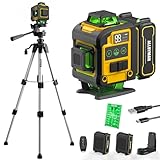
If you need a line around more than one wall, consider a 3×360 laser level. These project horizontal and vertical planes around a room, which can speed up a long cabinet installation. They cost more, and the full-circle lines are not essential for a short shelf run. Compare the complete kit price, including the battery, charger, mount, and case.
For bright rooms or occasional outdoor work, a green-beam self-leveling laser can be easier to see than a red beam. That does not automatically make it the better buy: green models may cost more and can use batteries faster. If you work indoors at normal distances, a red beam is often adequate, especially when you can dim overhead lights.
Compare the practical trade-offs
| Type | Best fit | Trade-off |
|---|---|---|
| Basic red cross-line | Short cabinet runs and shelves indoors | Lowest cost; line can be hard to see in bright conditions |
| Green cross-line | Brighter rooms or longer indoor sightlines | Better visibility for many users, but often costs more |
| Three-plane 360-degree | Several walls, long runs, or frequent installation work | More coverage and convenience; higher purchase price |
| Manual bubble level | One shelf or a small job with a tight budget | Cheap and reliable, but repeated transfers can accumulate measuring errors |
Accuracy, range, and the limits of low-cost tools
Check the stated accuracy before buying. Many consumer levels list accuracy in millimeters per meter; for example, 3 mm per 10 m is equivalent to about 0.3 mm per meter. A small error can become noticeable across a long cabinet run, particularly where two lines meet or where a countertop will later sit. Treat the published figure as a specification, not proof that every unit is perfectly calibrated.
Working range is also easy to misread. A claimed range may assume ideal lighting or a detector, and the beam can become difficult to see well before it reaches the maximum distance. For a typical kitchen, a 5–10 m visible working distance is generally ample, but room lighting and wall color matter. White paint usually makes a red line easier to spot than a dark or strongly colored surface.
Before trusting a new level, do a simple check. Set it several meters from a wall, mark the beam, rotate the tool 180 degrees without changing its position, and compare the new line with the mark. A large mismatch is a reason to consult the manual, return the unit, or have it checked. Do not use a questionable level to set every cabinet in a room.
Use it without adding expensive accessories
Set the laser on a stable surface or mount it securely, then give the pendulum time to settle. Keep the beam away from direct sunlight and switch off nearby lights if visibility is poor. A clamp or small tripod can help position the line at cabinet height, but a stack of boxes is a less stable substitute and can shift while you mark.
For a cabinet run, first find and mark the intended height at both ends of the wall. Project the line between those marks and confirm that it meets them. Then install a temporary ledger board or mark the mounting points according to the cabinet instructions. The laser provides a reference; it does not locate studs, check the wall for hidden pipes, or ensure that the cabinets are fastened safely.
For shelves, mark bracket positions from the laser line and verify the spacing with a tape measure. A perfectly level line will not correct brackets mounted into weak drywall. Use suitable anchors or, preferably, fasten into studs where the load and layout allow. For heavy shelves, follow the hardware maker’s load limits rather than relying on the laser or anchor packaging alone.
When spending more is worth it
Pay more for 360-degree coverage if you install cabinets repeatedly, work across multiple walls, or want fewer tool repositionings. Consider a detector only if you need to find a beam in bright conditions or over longer distances; it is unnecessary for most indoor shelf jobs. Extra laser points and elaborate cases are poor value unless they solve a task you actually do.
Seasonal sales can make higher-feature kits competitive with basic models, but compare the included battery, charger, mount, and warranty—not just the headline discount. For a one-off project, a well-reviewed basic cross-line tool or even a good bubble level may be enough. For regular cabinet work, spend first on reliable mounting and usable visibility, then on wider coverage.