How to Check Whether Replacement Parts Make a Tool Worth Buying
What's inside
As an Amazon Associate I earn from qualifying purchases. This post may contain affiliate links at no extra cost to you.
A low purchase price can hide an expensive problem: a battery, switch, chuck, gear, or guard that is hard to find—or costs nearly as much as the tool. Before buying, check the likely repair parts, their prices, and how easy the tool is to service. This is especially useful for cordless tools, where a failed battery can leave the rest of the kit unusable.
As an Amazon Associate we earn from qualifying purchases at no extra cost to you.


Start with the parts most likely to fail
Focus on wear items and common failure points, not every screw in the parts diagram. For a drill or impact driver, check batteries, chargers, chucks, switches, and gear assemblies. For a circular saw, look for blades, guards, base plates, and switches. A sander’s pads and dust bags are routine replacements; a broken gear case is a less frequent but more consequential repair.
Also check what the tool needs to run. A bare cordless tool may look cheap until you add a compatible battery and charger. If you already own batteries in that platform, the bare tool may be good value. If not, compare the cost of a complete kit with the cost of a tool plus the parts needed to use it.
Check availability before the sale ends
Search the manufacturer’s support site for the exact model number, then look for a parts diagram and authorized parts sellers. Confirm that the diagram applies to the exact model and revision; similar-looking tools can use different switches, housings, or battery connections. Search the part number as well as the tool name. Listings that say “fits most” deserve extra scrutiny.
Availability matters as much as price. If the manufacturer lists a part as discontinued and only one unfamiliar seller has it, treat that part as unavailable for practical purposes. Check whether the seller has it in stock, whether the part is new or used, and whether returns are allowed. For a tool you depend on daily, a week-long repair delay may cost more than paying extra for a better-supported brand.
Calculate the repair cost, not just the part price
Add the part, shipping, and any tools or consumables you would need. Then consider labor. A battery swap or bolt-on shoe is usually simple; replacing a switch may require opening the housing, sorting several wires, and reassembling the tool safely. A motor or gear assembly can be costly and time-consuming even when the part itself is available.
Use a practical threshold: if a likely repair costs more than about half the price of a comparable new tool, replacement often makes sense for a budget model. That is not a hard rule. A repair may still be worthwhile if the tool is otherwise solid, the replacement is easy, or you already own compatible batteries. Conversely, a cheap part may not be a bargain if the repair takes hours or creates a safety risk.
| Part or issue | What to check | Typical buying implication |
|---|---|---|
| Battery | Correct platform, availability, warranty, and price of a genuine replacement | High priority for cordless tools; a battery can erase the savings on a low-cost bare tool |
| Switch or cord | Exact part number, wiring complexity, and service instructions | Often repairable, but account for labor and safe reassembly |
| Chuck, pad, blade, or guard | Whether standard replacements fit and are sold widely | Usually manageable if the part is common and inexpensive |
| Motor or gear assembly | Part price, stock status, and whether the assembly is sold separately | A high cost or discontinued part can make replacement more sensible |
Compare platform costs across brands
For cordless tools, price the whole platform you expect to use over the next few years: tool, batteries, charger, and likely replacements. A sale kit with two batteries may be better value than a cheaper bare tool, especially if you are starting from scratch. If you already have batteries, sticking with that platform may save more than choosing a tool with cheaper individual parts.
Brand reputation alone does not settle the question. Check whether parts are documented and sold to consumers, how long the brand has supported the platform, and whether batteries are easy to obtain. For occasional home use, an inexpensive tool can be a sensible choice if its standard wear items are available and you can replace the whole unit without much disruption. For daily work, downtime and battery replacement usually deserve more weight.
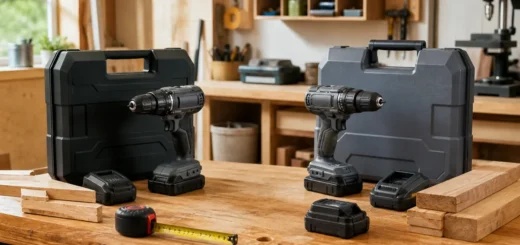
If you need a general-purpose drill and do not own batteries yet, compare complete cordless drill kits with a battery and charger, not just bare-tool prices. For repeat use across several jobs, a battery-platform starter kit may be a better comparison.
Check whether you can actually do the repair
A parts diagram proves that a part exists; it does not prove the repair is straightforward. Look for a service manual or clear repair instructions. Check whether the job requires a special puller, soldering, or work near a spring-loaded assembly. If a damaged guard, brake, or electrical component affects safety, do not improvise with a generic substitute. Use the correct part or replace the tool.
When judging a used tool, test it under load if possible. Listen for grinding, watch for excessive heat or sparking, and check for a loose chuck, cracked housing, missing guard, or battery that cuts out. A worn battery may be a predictable expense; intermittent power can signal a failing switch, damaged wiring, or a battery connection problem that is harder to diagnose.
Time the purchase around parts and sales
Seasonal discounts are useful, but compare the sale price with the cost of a complete, supported setup. A deeply discounted tool with an unavailable battery is not a bargain. Before buying, save the part numbers for the battery, charger, and one or two likely wear items. If those parts are stocked by multiple reputable sellers, you have more options later.
For a one-off weekend project, renting or buying an inexpensive corded tool may be reasonable when battery-platform costs do not pay back. For frequent work, choose the tool whose consumables and replacement parts are easy to source—not necessarily the one with the lowest sticker price. The best value is the tool you can keep working at a cost and effort that make sense for how often you use it.