Best Affordable Jigsaw for Curved Cuts in Plywood and Thin Boards
What's inside
As an Amazon Associate I earn from qualifying purchases. This post may contain affiliate links at no extra cost to you.
A jigsaw can make smooth curves in plywood and thin boards without the cost or bulk of a bandsaw. For occasional shelves, templates, signs, and cutouts, a basic corded saw is usually enough. The difference between a clean curve and a ragged one is less about spending big and more about blade choice, speed control, and keeping the base flat on the work.
As an Amazon Associate we earn from qualifying purchases at no extra cost to you.


What to buy for curved cuts
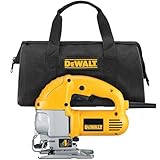
For most buyers, the value pick is a corded jigsaw with variable speed, an orbital-action setting you can turn off, and a shoe that tilts for bevel cuts. Aim for a roughly 4–6 amp motor and a tool that accepts common T-shank blades. That combination is widely available at budget prices and avoids batteries, chargers, and proprietary blade hassles.
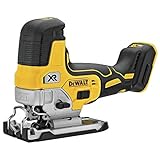
Start with a corded variable-speed T-shank jigsaw if you cut curves only now and then. A battery model makes sense if you already own compatible batteries or need to work away from an outlet; otherwise, the bare tool price can be misleading once a battery and charger are included.
Pay for the features that help you control the cut, not for a high maximum cutting depth you will rarely use. A low-cost saw may have more vibration, a less rigid shoe, or a weaker dust port than a pricier one. Those shortcomings matter more on tight curves and long, visible cuts than on rough utility work.
Budget jigsaw choices
| Type | Typical cost range | Best for | Main trade-off |
|---|---|---|---|
| Basic corded jigsaw | $30–$60 | Occasional DIY curves in plywood and boards | More vibration; fewer comfort and dust-control features |
| Better-equipped corded jigsaw | $60–$120 | Frequent cuts, more speed control, improved handling | Costs more without making a poor blade cut well |
| Budget cordless jigsaw | $50–$120 bare tool, often more as a kit | Convenience and use with an existing battery platform | Battery expense; runtime and balance vary by platform |
Prices shift with sales, kits, and included accessories, so treat these as broad shopping ranges rather than guarantees. A basic corded saw is fine for a few projects a year. Consider spending more if you expect regular use, need a comfortable grip for long sessions, or find that a budget shoe flexes or shifts under pressure.
Choose the blade for the material
For a tight curve, use a narrow blade intended for curve cutting; its slimmer body turns more easily than a wide, fast-cutting blade. Check the blade packaging for the material and curve guidance. A fine-tooth wood blade is a sensible starting point for plywood and thin boards. More teeth generally leave a cleaner edge but cut more slowly; aggressive, widely spaced teeth remove material quickly and are more likely to chip veneer.
Blade length matters too. It must extend below the work through the full stroke without being so long that it wanders or catches. A dull blade takes more force, heats the edge, and encourages the operator to push sideways. That sideways pressure bends the blade, which can make the cut drift even when the line looks straight from above.
For a small kit, compare T-shank wood and curve-cutting blades rather than buying a large mixed pack full of metal-cutting blades you may not use. Replace a blade when it burns the wood, takes noticeably more effort, or leaves a rougher edge than it did at the start.
Set up for a controlled curve
Support the plywood or board close to the cut so it cannot bounce. Clamp it securely, but keep clamps clear of the saw’s path. Draw the curve clearly, then make a test cut in scrap of the same material. For clean curves, switch orbital action off or use its lowest setting. Orbital action moves the blade forward on the upstroke to speed rough cuts, but it can make the saw harder to steer and tear the top veneer.
Use a moderate speed as a starting point and adjust if the blade chatters, burns, or struggles to follow the line. Feed steadily; let the teeth cut rather than forcing the saw around a tight bend. For a particularly sharp turn, stop before the blade binds, back out carefully, or make relief cuts from the waste edge toward the curve. Relief cuts let the waste fall away instead of pinching the blade.
Keep the shoe flat against the board. Lifting the back of the saw or twisting the handle can tilt the blade, leaving a bevel even though the shoe is set to zero. On thin stock, a sacrificial backer beneath the work can reduce splintering on the underside. Masking tape along the line may also help, but it is not a substitute for a sharp blade and controlled feed.
Where cheap saws fall short
Budget models can vibrate enough to make a slow, tight curve tiring to follow. Their dust blowers or ports may also leave the pencil line obscured. If visibility is poor, pause and clear the dust rather than steering by guesswork. A better-lit work area, vacuum connection where supported, and a fresh blade can improve results more than replacing the saw.
Do not expect a jigsaw to produce a perfectly square edge through thick stock: the blade can deflect, especially when pushed hard. For thin plywood and boards, this is less of a problem, but check the edge with a square before relying on it for a fitted joint. If every edge must be straight and square, a guide, a different saw, or careful sanding may be necessary.
When to spend more—and when to wait
If you already own batteries from a major tool brand, a compatible cordless saw can be good value. Search for a cordless jigsaw bare tool and compare its price with a complete kit; the bare tool is not a bargain if you still need the battery and charger. For a first tool, corded usually wins on upfront cost and uninterrupted runtime.
Jigsaws are often discounted during major holiday sales, spring DIY promotions, and tool-brand events. Compare the actual tool or kit contents, not just the percentage off. A package with useful blades or a case may be worthwhile; a large accessory bundle is not a saving if the blades do not suit your work. Buy when the right saw reaches a fair price, and put some of the budget toward good blades and clamps. Those are the parts that most directly affect a clean, controlled curve.