Benchtop vs Floor-Standing Drill Presses: Which Offers Better Value?
What's inside
As an Amazon Associate I earn from qualifying purchases. This post may contain affiliate links at no extra cost to you.
Benchtop vs Floor-Standing Drill Presses: Which Offers Better Value?
A benchtop drill press is usually the better value for occasional drilling, small workshops, and anyone working mostly with wood, plastic, or light-gauge metal. A floor-standing press costs more and occupies far more space, but it earns that price through greater capacity, a taller column, stronger motors, and a more useful work envelope.
The important distinction is not simply power. A cheap floor-standing drill press can have more height than you need but still suffer from a flexible column, a poorly machined table, or excessive runout. Likewise, a compact benchtop machine can make accurate holes if it is mounted to a rigid bench and used within its limits.
As an Amazon Associate we earn from qualifying purchases at no extra cost to you.
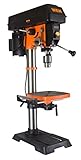


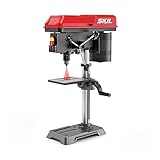
Quick comparison
| Factor | Benchtop drill press | Floor-standing drill press |
|---|---|---|
| Typical price | $150–$450 | $400–$1,200 or more |
| Typical swing | 8–12 inches | 13–20 inches |
| Typical motor | 1/3–3/4 horsepower | 3/4–1-1/2 horsepower |
| Spindle travel | 2–3-1/2 inches | 3–6 inches |
| Best use | Small parts, joinery, hardware, light metal | Large workpieces, deep holes, repeated drilling |
| Main drawback | Limited height and capacity | Cost, weight, and floor space |
When a benchtop press is better value
Choose a benchtop machine when most of your work fits on a 12-inch square or smaller work surface. It is well suited to drilling shelf-pin holes, hinge cups, dowel holes, electrical-box openings, and metal parts made from aluminum or mild steel. For many home shops, those jobs represent nearly all actual drill-press use.
The lower purchase price is only part of the saving. A benchtop press can share an existing workbench, uses less power, and is easier to move when the bench needs to be cleared. A machine in the $200–$300 range is often enough for a homeowner, especially if it has a 10-inch swing, at least 2-1/2 inches of spindle travel, a 1/2-inch chuck, and a mechanical speed range suited to both wood and metal.
For a first machine, compare 10-inch benchtop drill presses rather than buying strictly by horsepower. Published horsepower figures are not standardized and may describe peak rather than continuous output. A rigid column and a table that locks firmly matter more than a large number on the motor label.
The main failure mode is flex. If you push a large bit aggressively, the column or quill can deflect, causing an oversized or angled hole. Cheap chucks may also grip unevenly, producing visible wobble. Expect better results with brad-point bits in wood, a pilot hole before large twist drills, and slower speeds for metal. A benchtop press is not a sensible choice for regularly drilling 1-inch holes through steel or boring through thick hardwood beams.
When a floor-standing press is worth the extra money
A floor-standing press makes sense when the workpiece is too tall, too wide, or too heavy for a benchtop setup. Its larger swing lets you drill farther from the edge of a part, while the longer column gives you more room between the chuck and table. That capacity is useful for furniture components, stair parts, large plates, and fabrication work.
Floor models also tend to have stronger tables, larger motors, and more speed choices. Many offer roughly 12 to 16 speeds, while budget benchtop models may provide five or six. That matters when switching between a 1/8-inch bit and a 1-inch hole saw. Small bits need higher speeds; large bits and metal need lower speeds. Always follow the bit maker’s recommendation rather than assuming the highest setting is best.
Look at floor-standing drill presses with multiple speed settings if you drill metal frequently. A floor model is also more comfortable for repeated work because the table can be set at a useful height without stacking blocks or raising the entire machine on a platform.
However, a floor press is not automatically more accurate. In the budget range, poor assembly, a bent spindle, or a loose rack-and-pinion table can erase the advantage of the larger frame. Check that the table locks without shifting, the quill returns smoothly, and the chuck does not visibly wobble. A machine weighing 150 pounds is difficult to return or repair, so inspect it early and keep the packaging until it passes basic tests.
Costs beyond the sticker price
Plan on another $50–$150 for a decent drill-press vise, clamps, brad-point or metal drill bits, a center finder, and a sacrificial board. A floor-standing machine may also need delivery because many weigh between 100 and 250 pounds. Assembly can take an hour or more, and the base must be bolted down if the machine rocks or if you work with large, awkward stock.
Electricity is not the deciding cost for most users. The bigger issue is shop space. A floor model may occupy a footprint around 24 by 24 inches, but you need additional clearance to feed long boards and rotate workpieces. If it ends up buried behind storage, its extra capacity has no value.
Brand value and seasonal buying advice
At the budget end, brand value usually shows up in parts availability, warranty support, and better quality control rather than dramatic drilling performance. Established woodworking and tool brands often cost more, but replacement switches, belts, chucks, and quill parts are easier to find. An inexpensive machine from an unknown seller can be a bargain only if the table is square and replacement parts are not a concern.
Buy during late-fall and holiday promotions, when retailers commonly discount workshop tools, or during spring garage and workshop sales. Compare the final delivered price, not just the advertised discount. A slightly more expensive machine with free delivery and a better chuck may cost less than a sale-priced unit that needs upgrades immediately.
For a practical starting point, shop drill-press accessory bundles alongside the machine. If your projects are mostly small and occasional, buy the better benchtop press you can comfortably mount. If you regularly work on large parts, drill deep holes, or need sustained low-speed torque, pay for a floor-standing model. The cheaper option is fine when its physical limits match the work; otherwise, the initial saving becomes an expensive restriction.