Best Affordable Drill-Driver for Installing Hardware in Older Homes
What's inside
As an Amazon Associate I earn from qualifying purchases. This post may contain affiliate links at no extra cost to you.
What the job demands
Installing cabinet pulls, hinges, curtain brackets, hooks, and other hardware usually calls for a drill-driver, not an impact driver. You need controlled speed, a clutch that can limit screw torque, and a chuck that accepts both drill bits and screwdriver bits. For occasional household work, a basic 12-volt drill is often enough. Spending more makes sense if you expect to drill many holes, work in dense framing, or use the tool regularly.
Older homes add a few complications. Plaster can crack around a hole, old framing may be hard or uneven, and previous repairs can leave unexpected voids or brittle material behind a finish. A drill cannot diagnose what is behind the wall. Check for wires and pipes before drilling, and use a suitable detector where needed. For plaster, avoid leaning hard on the tool: drill slowly, keep the bit straight, and let the cutting edge do the work.
As an Amazon Associate we earn from qualifying purchases at no extra cost to you.


Best value: a basic 12-volt drill-driver
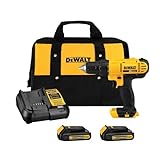
For installing a modest number of handles, brackets, or hooks, a 12-volt cordless drill-driver kit is usually the sensible starting point. Look for a two-speed gearbox, variable-speed trigger, adjustable clutch, keyless chuck, and at least one battery and charger. A kit with two batteries is more convenient, but not essential for a few rooms of hardware.
These drills are lighter and easier to control than many 18- or 20-volt models. That matters when you are working overhead or trying to keep a small bit centered on a narrow cabinet stile. Their limitation is sustained work: a small battery and lower power can slow down when drilling large holes or driving long screws into dense wood. For short screws and holes around 1/8 to 1/4 inch, that is rarely a problem.
Do not judge a kit by voltage alone. Check what is included, whether replacement batteries are available, and whether the tool is part of a battery platform you might use again. A low-priced bare tool can become poor value if the battery and charger must be bought separately.
When an 18- or 20-volt drill is worth it
Choose a compact 18-volt cordless drill-driver kit if the job includes repeated holes in hardwood, long screws, or other renovation work beyond light hardware installation. The extra power and larger batteries provide more reserve, but the tool is typically heavier and may be harder to maneuver inside a cabinet. For occasional use, a sale-priced 12-volt kit can be the better buy.
An impact driver is not an automatic upgrade. It can drive screws quickly, but its hammering action makes it easier to overdrive small hardware screws, strip their heads, or damage soft wood. A drill-driver’s clutch gives you more control. If you already own an impact driver, it can handle larger construction screws; buy a drill-driver when you need controlled drilling and delicate fastening.
Compare the practical choices
| Option | Best for | Main trade-off | Value test |
|---|---|---|---|
| 12-volt drill-driver kit | Handles, hinges, light brackets, short screws | Less reserve for large bits and long sessions | Good buy if battery and charger are included |
| Compact 18- or 20-volt kit | Mixed household repairs and repeated drilling | More weight and often higher cost | Worth it if you will use the platform for other tools |
| Older corded drill | Occasional work near an outlet | Cord can snag; clutch and low-speed control may be limited | Fine if already owned and the task is straightforward |
| Impact driver | Driving larger screws quickly | Less gentle control for small hardware fasteners | Use one you own; do not buy it as the only drill |
Features that prevent avoidable mistakes
A clutch is useful only if it has settings low enough for small screws. Start low, test on scrap wood or an inconspicuous spot, and increase the setting if the screw stops before the head seats. Finish the last fraction of a turn by hand when the hardware is visible or easy to damage. A clutch is not a substitute for a correctly sized pilot hole.
For wood screws, choose a pilot bit sized to the screw’s core rather than its outer thread diameter, especially in hardwood or near an edge. A pilot hole that is too small can split wood or snap a screw; one that is too large can leave weak threads. For plaster, drill the finish carefully and use an anchor or fastener suited to the wall and expected load. Do not assume a decorative hook can support a heavy object just because the screw feels tight.
A comfortable grip, low-speed control, and a chuck that holds bits securely matter more for this job than a long list of accessories. A belt hook or work light is convenient, but neither is worth a large price premium for occasional installation work.
Buy and use for value
Compare kit prices during major holiday sales and spring home-improvement promotions, but check the normal price of replacement batteries first. A discounted kit from a brand with costly or hard-to-find batteries may be a worse long-term deal than a slightly pricier platform you can expand. Avoid paying extra for high-capacity batteries if you only expect to install a few dozen screws; they add weight and may sit unused.
Use a sharp bit, clamp or steady the work when practical, and keep the drill square to the surface. If a screw stalls, do not keep pulling the trigger: back it out, check the pilot hole and bit fit, then try again at a lower speed. If the drill repeatedly struggles with ordinary hardware screws, the battery may be low, the bit may be wrong, or the material may need a larger pilot hole.
For most homeowners doing one or two rooms of hardware, an entry-level 12-volt kit with a clutch and a usable battery is enough. Choose a compact 18- or 20-volt kit only when heavier work is part of the plan. Buying the lightest tool that handles the actual job is often better value than paying for power you will rarely use.