Best Affordable Infrared Thermometer for Home Maintenance Checks
What's inside
As an Amazon Associate I earn from qualifying purchases. This post may contain affiliate links at no extra cost to you.
An infrared thermometer is a useful home-maintenance tool for finding temperature differences quickly. It can reveal an overloaded electrical connection, a poorly insulated wall, a blocked radiator, an overheating appliance, or a failing HVAC vent without touching the surface. The best affordable infrared thermometer is not necessarily the one with the widest temperature range. For most homeowners, a reliable sensor, a usable distance-to-spot ratio, and simple controls matter more than laboratory-level specifications.
As an Amazon Associate we earn from qualifying purchases at no extra cost to you.


What to Look For in an Affordable Infrared Thermometer
Start with the distance-to-spot ratio, usually written as D:S. A 12:1 thermometer measures a spot about 1 inch wide from 12 inches away. A basic 8:1 unit measures a 1-inch spot from only 8 inches. This matters when checking a circuit breaker, pipe joint, or small area of missing insulation. If the target is smaller than the measurement spot, the thermometer averages the target with its surroundings and can hide a hot spot.
Emissivity is another important specification. Most affordable units have fixed emissivity around 0.95, which works well on painted walls, wood, rubber, fabric, food, and other dull, non-reflective surfaces. Shiny metal, polished tile, glass, and stainless steel can give misleading readings because they reflect infrared energy from nearby objects. A model with adjustable emissivity is more versatile, but it costs more and still requires correct settings.
For general maintenance, a stated range of roughly -50 to 750 degrees Fahrenheit is more than enough. Household surfaces rarely need the upper end. Accuracy claims around plus or minus 2 degrees Fahrenheit are typical in the useful middle of the range, but they may be less precise near the thermometer’s limits. A backlit display, an automatic shutoff, a low-battery indicator, and a trigger lock are practical features worth having.
Best Budget Choice: Fixed-Emissivity Infrared Thermometer
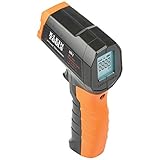
For checking drafts, heating vents, refrigerator seals, hot-water pipes, and appliance surfaces, a simple fixed-emissivity thermometer is usually the best value. Look for an 8:1 or 12:1 D:S ratio, a clear display, and a published accuracy specification rather than an exaggerated maximum temperature.
A budget 12:1 infrared thermometer for home maintenance is generally fine when you measure large, matte surfaces from a short distance. It is also the sensible choice for occasional seasonal checks. The main limitation is that fixed emissivity makes it unreliable on bare copper, aluminum, chrome, and glossy black surfaces.
Use this category by holding the thermometer perpendicular to the target and moving close enough that the measurement circle stays entirely on the surface. Do not assume the laser dot shows the full measurement area; on many models it marks only the center.
Affordable Infrared Thermometer Types Compared
| Type | Typical price | Best use | Main limitation |
|---|---|---|---|
| Basic fixed-emissivity | $15–$25 | HVAC vents, walls, appliances, pipes | Weak results on shiny metal |
| 12:1 or 16:1 general-purpose | $25–$45 | Electrical panels, small fittings, insulation checks | Still averages mixed surfaces |
| Adjustable-emissivity | $40–$80 | Metalwork, mechanical parts, maintenance troubleshooting | Requires correct emissivity settings |
| Infrared thermometer with probe | $25–$60 | Food, liquids, contact measurements | More features than needed for walls and equipment |
Best Upgrade: Adjustable Emissivity and a Narrower Spot
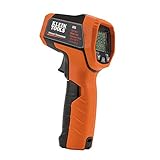
Spend more when you regularly inspect mechanical equipment, electrical components, or exposed metal. An adjustable-emissivity model lets you compensate for different materials, while a 16:1 ratio helps isolate smaller targets. These features do not make reflective surfaces automatically accurate, but they give you more control.
For this work, compare adjustable-emissivity infrared thermometers by their instructions and repeatability, not just temperature range. A thermometer that gives the same reading repeatedly is more useful than one claiming 1,472 degrees Fahrenheit but offering no guidance for shiny surfaces.
A practical workaround is to place a small piece of matte black electrical tape on a clean metal surface, let it reach the same temperature as the metal, and measure the tape. This often produces a more useful reading than aiming directly at polished metal. Never place tape on energized electrical parts where it could interfere with safe servicing.
Useful Home-Maintenance Tests
For insulation checks, measure the wall in several places on the same day. A cold stripe along a ceiling, baseboard, or window frame is more informative than one isolated reading. Indoor-outdoor temperature differences should be substantial; a mild spring day may not reveal much.
For HVAC checks, measure the air temperature at the return and supply registers, but remember that an infrared thermometer reads the grille or duct surface, not the air itself. A probe thermometer is better for actual air temperature. Large differences between nearby vents can point to duct leakage, blocked airflow, or an unbalanced system, but they do not prove which problem is present.
For electrical troubleshooting, compare similar breakers, terminals, or connections under the same load. A connection that is 20 to 30 degrees Fahrenheit hotter than comparable ones deserves attention. An infrared thermometer cannot see inside a panel, and removing the cover exposes you to shock and arc-flash hazards. If a breaker or wire is hot, discolored, buzzing, or smells burned, shut down safely and call a qualified electrician.
When to Buy and What to Avoid
Prices are often lowest during spring tool promotions, summer home-improvement sales, and November holiday events. Infrared thermometers are also commonly discounted before winter, when shoppers are checking drafts, radiators, and heating systems. There is little reason to pay extra for a high-temperature industrial model unless you actually work around furnaces, kilns, engines, or hot metal.
A backlit infrared thermometer for home repair is a better buy than a bargain model with an enormous advertised range but no accuracy information. Avoid units that omit D:S ratio, emissivity, accuracy, or operating-temperature details. Also be skeptical of a laser pointer as a sign of precision; the laser only helps aim the instrument.
Before trusting any reading, test the thermometer on a known room-temperature surface and take several readings from the same distance. Replace weak batteries, clean the lens gently, and allow the tool to acclimate after moving it between a cold garage and a warm house. Used correctly, a $20 thermometer can answer many useful maintenance questions. The extra cost of a better model is justified mainly when you need to measure small targets, compare metal components, or obtain repeatable results in less forgiving conditions.