Best Affordable Ratcheting Wrench Set for Tight Engine Bays
What's inside
As an Amazon Associate I earn from qualifying purchases. This post may contain affiliate links at no extra cost to you.
What matters in a tight engine bay
The best affordable ratcheting wrench set is not necessarily the one with the most pieces. For engine work, you need slim heads, a useful range of sizes, and a ratcheting mechanism that does not skip when a fastener is tight. A 72-tooth mechanism is a practical target because it needs about 5 degrees of movement to engage. A cheaper 36-tooth wrench may need 10 degrees or more, which is frustrating around brackets, pulleys, and intake manifolds.
Look for a set covering 8mm through 19mm. Those sizes handle many battery terminals, hose clamps, brackets, accessory hardware, and common metric fasteners. A 10-piece set in that range is often a better buy than a 20-piece set padded with duplicate SAE sizes you rarely use. If you work on older American vehicles, a second set covering 1/4 inch through 3/4 inch may be worthwhile, but do not pay for both systems until your vehicles require them.
As an Amazon Associate we earn from qualifying purchases at no extra cost to you.

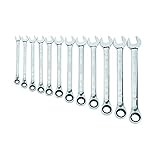


Head thickness matters as much as tooth count. Some low-cost ratcheting wrenches have bulky selector mechanisms that will not fit over a recessed nut. Fixed, non-switching heads are usually slimmer and more dependable. Open-end ratcheting designs are convenient for fuel, brake, and other lines, but their open ends are weaker than the box ends and should not be your first choice for heavily seized fasteners.
The best value set types
| Set type | Typical price | Best use | Main compromise |
|---|---|---|---|
| Basic 8-piece metric | $20–$35 | Occasional repairs and light engine work | Usually stops at 15mm or uses a coarse ratchet |
| Metric 10- or 12-piece set | $35–$70 | Most home mechanics and daily-driver repairs | Finish and case quality vary by brand |
| Professional 10-piece set | $90–$180 | Frequent shop use and high fastener loads | Higher cost with diminishing returns for occasional users |
| Flex-head metric set | $45–$120 | Fasteners hidden behind pulleys or brackets | Joint adds thickness and another failure point |
For most people, a mid-priced 10- or 12-piece metric set is the sweet spot. A set such as these metric ratcheting wrench sets from 8mm to 19mm typically gives better coverage than the cheapest kits without reaching professional-tool pricing.
What to expect from a budget pick
A $20 to $35 set can be perfectly adequate for battery replacement, alternator brackets, thermostat housings, and routine accessory work. The cheaper option is fine when you use the box end for moderate loads, have room to swing the wrench, and do not expect the tool to remove rusted fasteners. Wipe the tools clean after use and keep them dry; inexpensive chrome finishes can spot or peel faster when left wet.
The common failure modes are predictable. The ratchet can slip under load, the open end can spread, or the direction lever can loosen. A wrench that skips can round a fastener and injure your knuckles, so stop using it if the mechanism feels gritty or fails to lock. Do not use a ratcheting wrench as a hammer, cheater bar, or substitute for a torque wrench. If a fastener needs a breaker bar, use one to break it loose, then switch to the ratcheting wrench for removal.
Before buying, check whether the set includes 16mm, 18mm, and 19mm. Those sizes are frequently missing from bargain kits despite being useful on suspension and engine hardware. Also check the actual head dimensions in the listing photos or specifications. “Slim profile” is not a standardized measurement.
When flex-heads are worth the extra money
A flex-head wrench can reach a nut hidden below an intake runner or tucked beside a belt tensioner. The joint commonly pivots through roughly 180 degrees, giving you more positioning options than a fixed head. That convenience is real in a tight engine bay, but the joint makes the head thicker and can fail if you apply excessive side load.
Choose a flex-head set if access is your main problem, not simply because it sounds more advanced. For occasional work, a fixed-head set plus one or two individual flex wrenches in 13mm, 15mm, and 18mm can cost less and leave fewer tools unused. A metric flex-head ratcheting wrench set makes more sense for someone regularly servicing multiple vehicles.
Brand value and warranty
Brand reputation matters most in the ratchet head, not the chrome. Established professional brands generally offer smoother mechanisms, tighter tolerances, and better warranty support, but a $120 set is not automatically three times as capable as a $40 set. For a home mechanic doing a few repairs each year, a reputable midrange brand is usually the sensible compromise.
Check the warranty terms before paying extra. A simple hand-tool replacement warranty is useful, but shipping costs and proof-of-purchase requirements vary. Avoid anonymous marketplace brands with identical product photos and no clear company contact information. A low price is not a bargain if one failed wrench leaves you waiting weeks for a replacement.
When to buy and what to check
Tool sets are commonly discounted during Black Friday, Amazon Prime events, Father’s Day promotions, and year-end clearance periods. Compare the current price with the previous normal price rather than trusting a large “percent off” label. A good target is 15% to 25% below the usual street price. Sets also get discounted when a new package replaces an older one, even though the tools themselves have not changed.
Before placing an order, confirm the size range, tooth count, head profile, warranty, and whether the case holds each wrench securely. Read recent reviews for reports of slipping under load, loose direction levers, and jaws spreading. If your work is mostly tight engine bays, prioritize slim fixed heads and complete metric coverage. Add flex-head or reversible models only where access justifies their extra cost. For a broader alternative, compare slim-profile metric and SAE ratcheting wrench sets if you maintain both newer imports and older domestic vehicles.