Best Hand Held Electric Jigsaws for DIY and Workshop Projects
What's inside
As an Amazon Associate I earn from qualifying purchases. This post may contain affiliate links at no extra cost to you.
The best hand held electric jigsaw for most DIY and workshop projects is a corded 6.5–7.2 amp model with a 10–12 foot cord, variable speed, four-position orbital action, and at least 3-1/2 inches of wood capacity; the Bosch JS470E is a strong all-round choice, while the Makita 4350FCT is better for quieter, more controlled curved cuts.
As an Amazon Associate we earn from qualifying purchases at no extra cost to you.

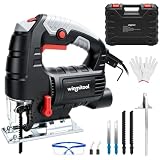


Quick comparison of capable corded jigsaws
A corded saw remains the practical choice when you make long cuts, work in a shop, or do not want to manage battery packs. The models below are established examples of the features and capacities available in the current market. Specifications can vary slightly by regional version, so confirm the manufacturer’s data before buying.
| Model | Motor | Wood cut depth | Steel cut depth | Speed range | Cord | Approx. weight |
|---|---|---|---|---|---|---|
| Bosch JS470E | 7.0 amp | 5-7/8 in. | 3/8 in. | 500–3,100 SPM | 10 ft. | 5.9 lb. |
| Makita 4350FCT | 6.3 amp | 5-5/16 in. | 3/8 in. | 800–2,800 SPM | 8 ft. | 5.3 lb. |
| DEWALT DW331K | 6.5 amp | 4 in. at 90 degrees | 3/8 in. | 500–3,100 SPM | 8 ft. | 6.4 lb. |
| Milwaukee 6268-21 | 6.5 amp | 4 in. | 3/8 in. | 500–3,000 SPM | 12 ft. | 6.2 lb. |
These are corded orbital jigsaws using common T-shank blades. Their stated capacities describe the maximum material the tool may cut under favorable conditions, not a promise of fast or clean cutting through every board. A thick hardwood blank, laminated countertop, or metal sheet demands the correct blade, slower feed pressure, and realistic expectations.
Best choices by project and working situation
- For a general DIY toolbox: Bosch JS470E. Its 7.0-amp motor, long cord, substantial wood capacity, and tool-less blade changing make it a versatile hand held jigsaw for shelves, flooring, plywood, and occasional metal work.
- For controlled curves and finish-sensitive work: Makita 4350FCT. The lower vibration feel, built-in light, and smooth variable-speed control are useful when following templates or cutting visible edges. Its slightly shorter cord is the main compromise.
- For frequent remodeling and jobsite use: DEWALT DW331K. It has strong cutting performance and a firm shoe, but its higher weight is more noticeable during overhead work or long curved cuts.
- For maximum reach around a workshop: Milwaukee 6268-21. The 12-foot cord reduces the need for an extension cord, which is convenient around a bench, assembly table, or large sheet goods.
- For occasional, low-cost use: a reputable 5–6 amp corded jigsaw. Expect a lower wood capacity and more vibration, but it can be sufficient for 1/2-inch plywood, pine boards, craft panels, and simple cutouts.
What matters more than peak motor power
Cord length and workspace reach
An 8-foot cord is workable at a small bench but often requires an extension cord when cutting a full sheet of plywood on sawhorses. A 10- or 12-foot cord gives more freedom and keeps the extension connection away from the cutting area. For a simple planning estimate, a 4-by-8-foot sheet can require roughly 10–12 feet of movement around its perimeter, so a longer factory cord can eliminate one connection and reduce snagging.
Motor power and cut depth
Amperage is a useful indicator of sustained capacity, but it is not the only measure of performance. A 6.5-amp saw with a sharp, appropriate blade can outperform a more powerful saw fitted with a worn blade. For most home projects, 5/8-inch plywood, 3/4-inch softwood, and thin flooring are comfortable targets. Cutting 1-1/2-inch hardwood or thick countertop material is possible with a deep-capacity model, but the cut will be slower and blade deflection becomes more likely.
Metal capacity needs separate attention. Thin sheet metal is commonly within the 3/8-inch rated range, but the appropriate blade and secure support are essential. Use a fine-tooth bi-metal blade, clamp the work securely, reduce speed, and apply cutting lubricant where suitable. Do not treat a wood blade’s capacity as a metal-cutting specification.
Speed control and orbital action
Variable speed controls how aggressively the teeth enter the material. High speed suits softwood and fast rough cuts. Medium speed is safer for hardwood and many plastics, while slower settings reduce heat and tooth damage in metal. Orbital action moves the blade forward during part of its stroke, increasing cutting speed but also producing a rougher edge. Use little or no orbital action for tight curves, laminate, metal, and finish edges; use higher orbital settings for fast cuts in construction lumber.
Comfort during curved cuts
Curves expose poor ergonomics quickly. A comfortable saw should balance over the shoe, have a trigger or lock that does not force your wrist into an awkward angle, and produce limited vibration. Weight matters because a 6.3-pound tool held at arm’s length feels substantially more tiring than a 5.3-pound tool. However, an overly light body can transmit more vibration, so balance is more important than the number on the box.
For a tight curve, let the blade do the work and rotate the saw gradually. Forcing the shoe sideways can bend the blade, causing the cut to wander even when the motor has plenty of power. A narrow scrolling blade is usually more useful than a higher amp rating when the pattern contains small radii.
A practical buying matrix
| Your situation | Prioritize | Suitable specification | Reasonable choice |
|---|---|---|---|
| Beginner with limited storage | Simple controls and moderate weight | 5–6.5 amps, 8–10 ft. cord, tool-less blade change | Compact corded model |
| Weekly DIY remodeling | Capacity and durability | 6.5–7.2 amps, 4 in. or more wood capacity | Bosch JS470E or DEWALT DW331K |
| Fine curves and visible edges | Low vibration and speed control | Variable speed, low orbital setting, work light | Makita 4350FCT |
| Large workshop or jobsite | Reach and continuous runtime | 10–12 ft. cord, 6.5 amps or more | Milwaukee 6268-21 or similar |
| Mostly sheet metal | Fine control, not maximum speed | Variable speed, metal-rated capacity, low vibration | Any suitable model with bi-metal blades |
How to get a cleaner, straighter cut
- Choose the blade first. Use coarse blades for fast wood cuts, fine teeth for plywood and cleaner edges, and bi-metal blades for steel. A blade with too few teeth can tear thin sheet goods; one with too many can overheat in thick wood.
- Support the work on both sides. Place sacrificial boards beneath sheet material and keep the waste section supported so it does not snap off and splinter the exit edge.
- Set speed and orbital action before starting. Begin conservatively on unfamiliar material. Increase speed only if the blade is cutting smoothly without burning or excessive vibration.
- Keep the shoe flat. The shoe is the reference surface. Lifting or rocking it causes angled cuts and makes the blade appear to wander.
- Finish without forcing the last inch. Near the end of a cut, slow down and support the offcut. Sudden breakaway is a common cause of chipped laminate and damaged teeth.
Ownership costs and maintenance realities
Blades are the consumable that wears first. For regular DIY use, budget roughly $10–$25 for a useful assortment of wood, laminate, scrolling, and metal blades rather than relying on the blade supplied with the saw. A dull blade increases motor load, worsens the cut, and encourages excessive pressure. Replacing it is cheaper than repairing a burned motor or damaged shoe.
After dusty work, unplug the tool and brush or blow debris from the shoe, blade area, and ventilation openings. Do not pack dust deeper into the housing with high-pressure air held close to the vents. Check the cord for cuts, inspect the shoe for bending, and confirm that the blade clamp releases fully. Common mistakes include using orbital action for a finish curve, cutting metal at wood-cutting speed, starting with the blade pressed against the work, and trying to turn a straight-cut blade through a radius that is too tight.
For most buyers, choose the Bosch JS470E when capacity and all-around versatility matter most. Choose the Makita 4350FCT when comfort and controlled curved cuts take priority. Whichever hand held jigsaw you select, a quality blade matched to the material will have more effect on the finished cut than a small difference in motor amperage.