Best Value Tap and Die Set for Repairing Damaged Threads
What's inside
As an Amazon Associate I earn from qualifying purchases. This post may contain affiliate links at no extra cost to you.
A damaged thread does not always call for a new bolt or a machine shop. For light repairs and routine workshop use, a budget tap and die set can be good value—provided it covers the right thread sizes and includes taps that cut cleanly. The cheapest sets often save money by including more pieces, not better steel, so count the sizes you will actually use before comparing the price.
As an Amazon Associate we earn from qualifying purchases at no extra cost to you.


What a tap and die set can—and cannot—do
A tap cuts or cleans internal threads, such as those in a nut or threaded hole. A die cuts or restores external threads on a bolt, rod, or stud. For a thread that is merely dirty, lightly burred, or partly damaged, a matching tool may bring it back. For stripped threads, a tap generally cannot restore missing material; the hole may need a thread insert or a larger thread size. A badly bent or deeply galled bolt is usually better replaced.
Match the tool to the thread standard and size. Metric and SAE (inch) threads are different, and coarse and fine pitches of the same diameter are not interchangeable. Check the fastener markings or measure it, then confirm the pitch with a thread-pitch gauge. For example, an M8 × 1.25 tap will not properly repair an M8 × 1.0 hole. Forcing the wrong pitch can ruin the part faster than the original damage.
Best value: a focused carbon-steel set
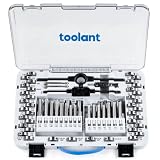
For occasional home, bicycle, lawn-equipment, and general repair work, a small carbon-steel set is often the sensible buy. Look for the thread sizes you encounter, a tap wrench and die stock that grip securely, and a clear case that keeps each tool labeled. If most of your work is metric, a metric-only set can offer better coverage per dollar than a large kit split between metric and SAE. The same logic applies if you mainly work on inch-threaded hardware.
Compare a metric carbon-steel tap and die set with an SAE set before choosing. Carbon steel is adequate for occasional hand use on common materials, but it wears more quickly than higher-grade options and is less suited to repeated cutting in tough steel. It is also more vulnerable to damage if a tap is twisted sideways or driven through a hard, dirty hole.
Compare the main options
| Set type | Best for | Value trade-off |
|---|---|---|
| Small carbon-steel set | Occasional repairs in common sizes | Low cost; fewer sizes and shorter service life under heavy use |
| HSS set | Frequent repairs and tougher work materials | Costs more; better wear resistance when used correctly |
| Thread-restorer kit | Cleaning and reshaping existing threads | Less aggressive than cutting taps; not a fix for missing thread material |
| Single replacement tap or die | One known size used repeatedly | Often cheaper than buying a full kit with unused tools |
High-speed steel (HSS) is worth considering if you expect regular use, especially on steel. It does not make a tap immune to breakage: poor alignment, chips packed in the flutes, or excessive force can still snap it. A metric and SAE HSS tap and die set costs more upfront, so it is better value only if you need both standards or will use the tools enough to benefit from the upgrade.
When a thread-restorer kit is the better buy
If the threads are flattened by corrosion, paint, or minor cross-threading, a restorer is often a safer first choice than a cutting tap or die. Restoring tools follow the existing thread and remove less material. That matters on older fasteners and parts where you want to preserve as much original metal as possible. A compact metric and SAE thread-restorer kit can be more useful than a broad cutting set if your main job is cleaning bolt threads before reassembly.
Restorers cannot replace missing metal or correct a thread that has been cut to the wrong pitch. If a fastener will not turn in by hand for several turns after cleaning, stop and check the size, pitch, and alignment. Do not use a wrench to force it. On a safety-critical part—such as a brake component, suspension fastener, or pressure fitting—replace the damaged hardware or get qualified repair advice rather than relying on a marginal thread.
Use the tool in a way that protects the threads
Start with the part clean and supported. For an internal thread, align the tap square to the hole; for an external thread, start the die square to the end of the rod or bolt. A small chamfer on a damaged bolt end can help the die start, but do not grind away so much material that the thread diameter is reduced. Apply cutting fluid suitable for the material. Turn a hand tap gently, backing off periodically to break chips, and clear the flutes if resistance rises. A small tap can snap suddenly, leaving a hard fragment that is difficult to remove.
For a through-hole, chips can exit the far side, but a blind hole needs extra care: chips collect at the bottom and can jam the tap or damage the hole. Do not drive a standard tap to the bottom expecting it to cut full threads there. Use an appropriate bottoming tap only when you need threads close to the base, and verify that there is room for chips. Afterward, clean the hole and test with the correct fastener by hand.
What to check before paying
Count usable sizes, not pieces in the box. Some kits inflate their piece count with handles, gauges, and duplicates while omitting sizes you need. Check that the case identifies each tap and die, that the wrench fits the smaller tools securely, and that replacements are available for common sizes. A tap-and-die set is poor value if one broken tap means replacing the whole kit.
Buy the smallest set that covers your actual repairs, then add individual taps or dies as needed. A large mixed-standard kit makes sense for a shared workshop or varied equipment; for a single project, a matching tap, die, or restorer may cost less and leave fewer unused tools. Prices often dip around major shopping events and year-end sales, but do not trade away clear size markings or the correct thread standard for a small discount.