Best Value Tools for a Homeowner Who Has Limited Storage
What's inside
As an Amazon Associate I earn from qualifying purchases. This post may contain affiliate links at no extra cost to you.
Limited storage changes the value calculation. A bargain tool that needs a dedicated case, battery platform, and matching accessories can take up more room—and cost more—than a slightly pricier tool that handles several jobs. For most homeowners, the best buys are compact, commonly used tools with replaceable parts and accessories that store together.
As an Amazon Associate we earn from qualifying purchases at no extra cost to you.



Buy for jobs, not aisles
Start with the work you expect to do over the next year: hanging shelves, assembling furniture, pruning shrubs, or fixing a loose gate. Buy for those jobs, not for a hypothetical renovation that may never happen. A drill, a small hand-tool set, and a step ladder cover a surprising amount of routine home maintenance.
Before buying, measure the space you can spare. A shelf that is 12 inches deep may fit a compact drill and its case but not a bulky kit. Check the packed dimensions and whether the case has room for the accessories you will actually use. A tool without a practical storage spot is more likely to get misplaced or left with a drained battery.
Compact tools that earn their space
A cordless drill/driver is usually the best first power tool. For basic household work, a 12-volt drill is lighter and smaller than a typical 18- or 20-volt model, while still handling pilot holes, cabinet screws, and furniture assembly. Choose a model with a clutch, two speed settings, and a battery that can be replaced. If you regularly drill large holes or work in dense lumber, a stronger 18- or 20-volt drill is worth the extra bulk.
Compare the complete cost, not just the tool’s headline price. A bare tool may look like a bargain but needs a compatible battery and charger. If you own no tools from that brand, a starter kit can be cheaper than buying those pieces separately. If you already have batteries on a platform, a bare tool often makes more sense.
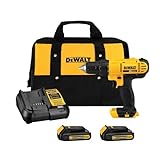
For occasional home projects, a compact 12-volt drill/driver kit is a sensible starting point. The trade-off is limited power and runtime compared with larger tools; it is not the right choice for repeated work in thick framing lumber.
A compact hand-tool kit is another efficient use of space. Look for a tape measure, utility knife, combination pliers, adjustable wrench, screwdrivers or bits, and a small level. A 30-piece kit with useful sizes is often better than a 100-piece set padded with duplicate bits and obscure sockets. The cheap option is fine for light, occasional use, but soft driver bits can round off quickly under high torque.
Choose a battery platform carefully
Battery compatibility can save storage space as well as money: one charger and two batteries are easier to manage than several unrelated systems. But do not buy a large platform on the promise of future savings unless you expect to add tools. Batteries age even when they sit unused, and a platform with many products is not automatically good value if each bare tool costs more than a corded alternative you would use once.
For homeowners who want to add an occasional saw, sander, or yard tool, an established 18- or 20-volt platform offers more choices. Compare kit prices, battery warranty, and the cost of replacement batteries. “20V max” and “18V” are often different ways of describing the same nominal battery class; the label alone does not tell you which tool is more powerful.
| Tool or purchase | Storage footprint | Good value when | Watch out for |
|---|---|---|---|
| 12-volt drill kit | Small | Most jobs are assembly, hardware, and light drilling | Slower work in large holes or dense lumber |
| 18- or 20-volt drill kit | Medium | You expect frequent drilling or plan to add compatible tools | Higher kit and replacement-battery costs |
| Small hand-tool set | Small | You need basic repair tools in one case | Filler pieces and weak bits in oversized sets |
| Corded tool | Tool plus cord | You need sustained power for a single task | Outlet access and cord management |
Rent or buy occasional tools
A circular saw, tile saw, floor sander, and drain auger can be expensive to own and awkward to store. If you expect to use one for only a weekend project, check local rental rates before buying. Include travel, blades or bits, and the rental period in the calculation. Buying is more attractive if you will use the tool several times or if rental pickup and return would cost a day of work.
For occasional cutting of trim or plywood, a hand saw may be cheaper and easier to store than a power saw, though it takes more effort and is slower. A corded tool can also be the better value for a one-off job: it avoids battery cost and charging, but only if you can work safely near an outlet and manage the cord.
Time sales around real needs
Tool kits often see discounts during major shopping periods, but a sale is only a saving if the kit has the right battery capacity and accessories. Compare the price with the same kit at other retailers, and check whether a low-priced bundle includes one small battery rather than two useful ones. A 1.5- or 2-amp-hour battery is compact and adequate for light jobs; longer work benefits from a higher-capacity battery, which adds weight and cost.
For yard work, look at end-of-season clearance, but check warranty start dates and return rules. Do not buy an extra battery just because it is bundled if you have no planned use for it. A compact folding household step ladder can also be better value than a taller extension ladder for changing bulbs and reaching shelves, provided it safely reaches the heights you need. Never stand on the top cap or use a ladder beyond its rated load.
Keep the kit useful
Store batteries indoors, away from damp basements and hot garages, and keep bits in a labeled box rather than loose in a tool case. A few organized pieces are easier to find than a large, mixed kit. Replace worn bits when they begin slipping; continuing to use them can damage screw heads and turn a quick repair into a frustrating one.
Spend more where failure creates a safety risk: ladders, eye protection, and cutting accessories deserve careful selection. Save on tools used rarely or lightly, and avoid paying for a professional-grade feature you cannot name a job for. In a small home, the best-value tool is often the one that does a common task reliably, fits its storage spot, and does not require a second system of chargers and cases.

