How to Evaluate Tool Promotions During Back-to-School Home Improvement Sales
What's inside
- How to Evaluate Tool Promotions During Back-to-School Home Improvement Sales
- Start With the Job, Not the Discount
- Calculate the Real Price of a Promotion
- Compare Battery Platforms Before Choosing a Brand
- Judge Performance and Build Quality
- Spot False Savings and Timing Traps
- A Practical Back-to-School Buying Strategy
- How to Evaluate Tool Promotions During Back-to-School Home Improvement Sales
- Start With the Job, Not the Discount
- Calculate the Real Price of a Promotion
- Compare Battery Platforms Before Choosing a Brand
- Judge Performance and Build Quality
- Spot False Savings and Timing Traps
- A Practical Back-to-School Buying Strategy
As an Amazon Associate I earn from qualifying purchases. This post may contain affiliate links at no extra cost to you.
How to Evaluate Tool Promotions During Back-to-School Home Improvement Sales
Back-to-school sales are not limited to notebooks and laptops. Hardware stores and online retailers often use late-summer promotions to clear older tool bundles, move seasonal inventory, and attract customers who are repairing rooms before the school year starts. Some offers are genuinely useful. Others turn a modest discount into a poor purchase through a weak battery, missing accessories, or an inflated “regular” price.
The right question is not “How much is this tool marked down?” It is “What will this complete setup cost, and will it handle the work I actually plan to do?” Compare the usable kit, not the large percentage printed on the sale tag.
Start With the Job, Not the Discount
Write down the projects you expect to complete in the next 12 months. Hanging shelves, assembling furniture, installing curtain rods, and driving cabinet screws do not require the same tool as building a deck or cutting sheet goods. A compact drill may be ideal for occasional indoor work but frustrating if you need to drill large holes through framing.
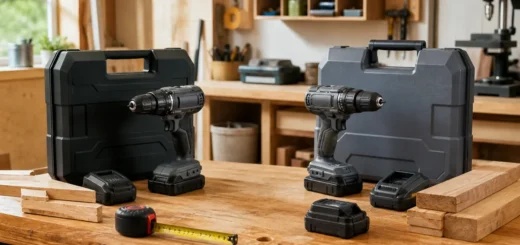
For basic household repairs, a cordless drill or drill-driver is usually the best first purchase. A driver with a clutch helps prevent stripped screws and damaged drywall. If you will drive many long screws, install decking, or work on automotive fasteners, an impact driver is more efficient, but it is less suitable for delicate hardware because it delivers sharp bursts of torque.
For cutting projects, a jigsaw handles curves and short cuts, while a circular saw is faster and straighter for plywood and lumber. Buying a saw because it is 40% off does not save money if you still need a battery, charger, blades, and a guide later. Start by comparing cordless drill-driver kits or another category that matches the first project.
Calculate the Real Price of a Promotion
Tool prices are often split across the tool, battery, charger, and accessories. A bare tool can look inexpensive because it includes none of the power system needed to use it. Conversely, a kit with two batteries may cost more now but be cheaper than buying a second battery six months later.
| Item to compare | What to check | Common problem |
|---|---|---|
| Tool body | Sale price, power, speed range, warranty | Older or low-performance model discounted from an unrealistic list price |
| Battery | Voltage, amp-hours, number included, replacement cost | Small battery included to make the package look complete |
| Charger | Included, charging time, compatibility | Bare tool requires a separate charger costing $30 to $80 |
| Accessories | Blade, bit, case, guide, or dust bag quality | Large accessory count made up of poor-quality consumables |
Add those costs before comparing brands. A $99 drill kit with one battery may be a better value than a $79 bare drill, even if the second price looks lower. Also check battery capacity. A 1.5Ah battery is light and fine for assembling furniture, but a 5.0Ah battery runs longer in demanding work and usually costs more.
Compare Battery Platforms Before Choosing a Brand
Battery compatibility is one of the most important long-term value factors. Once you own two or three batteries and a charger, additional bare tools in that platform can be inexpensive. This is useful if you expect to add a sander, light, reciprocating saw, or hedge trimmer later.
Major professional platforms generally offer more tools, stronger service networks, and better high-output batteries. They also cost more. For a homeowner who uses a drill five times a year, a budget platform can be perfectly adequate. The cheaper option is reasonable when the tool has a metal chuck, a usable clutch, readily available replacement batteries, and a warranty that is easy to claim.
Be cautious with batteries sold under unfamiliar brands. A low-priced tool may become uneconomical when its replacement battery costs nearly as much as a new kit or is unavailable after two years. Search the price of a replacement battery before buying. You can compare replacement cordless tool batteries while checking whether the platform has a stable product range.
Judge Performance and Build Quality
Specifications help, but they do not tell the whole story. Torque numbers are measured under different conditions and are not directly comparable between brands. Look for a two-speed gearbox, a variable-speed trigger, a firm clutch ring, and a chuck that grips bits without frequent slipping. On saws, check whether the base stays square, the depth adjustment locks securely, and the blade is easy to replace.
For occasional work, plastic housings and a brushed motor are not automatically deal breakers. They may add weight or reduce runtime, but they can still handle shelves, trim, and furniture assembly. Brushless motors usually offer better efficiency, longer runtime, and improved durability under repeated use. The premium is harder to justify if you only drive a few dozen screws per year.
Pay attention to included consumables. A drill kit with 100 bits may contain soft metal bits that dull after drilling a few holes. A saw with one low-quality blade may perform badly even though the saw itself is sound. Budget for proper bits and blades rather than judging the tool by the accessories in the box.
Spot False Savings and Timing Traps
Compare the sale price with the retailer’s price history or with at least two competing stores. A “regular” price can be inflated before a promotion, making a 35% discount worth only 10% in real terms. Also check whether the deal requires a mail-in rebate, a store card, or a multi-item purchase.
Bundles deserve special scrutiny. A drill, impact driver, flashlight, and two batteries can be a strong deal if you need most of the set. It is not a bargain if the flashlight and second tool would otherwise sit unused. For a single repair, buying a smaller kit may save $50 to $100 and leave less clutter.
Return policies matter for clearance tools. Confirm that the item is new rather than refurbished, that the battery is covered separately, and that the return window gives you enough time to test the charger and controls. A tool that overheats after five minutes, has a wobbling chuck, or will not hold a battery should go back immediately.
A Practical Back-to-School Buying Strategy
Buy the core tool you need first, then add accessories after testing it on the actual job. A cordless impact driver kit makes sense for repeated construction fastening, but a drill-driver is the more forgiving choice for general household use. If cutting plywood is on the list, compare cordless circular saw kits only after accounting for a quality blade and a straightedge guide.
Keep at least 10% to 20% of the tool budget for consumables, safety equipment, and a suitable case or storage solution. Eye protection, hearing protection, and the correct blade or bit prevent more failures than a small increase in motor power. The best seasonal promotion is the one that delivers a reliable tool for the work ahead without locking you into costs you did not count at checkout.