Random Orbital vs Sheet Sanders: Comparing Price and Usefulness for DIY Projects
What's inside
As an Amazon Associate I earn from qualifying purchases. This post may contain affiliate links at no extra cost to you.
Choosing between a random orbital sander and a sheet sander usually comes down to two questions: how much material you need to remove and how perfect the finished surface must look. Both are useful DIY tools, but they behave differently enough that buying the wrong one can mean extra sanding, visible swirl marks, or a frustratingly slow project.
As an Amazon Associate we earn from qualifying purchases at no extra cost to you.


Quick comparison
| Factor | Random orbital sander | Sheet sander |
|---|---|---|
| Typical price | $35–$100 corded; $80–$180 cordless | $25–$75 corded; fewer cordless choices |
| Best use | Removing finish, smoothing rough wood, preparing large surfaces | Light finish sanding, edges, trim, and final preparation |
| Abrasive cost | Hook-and-loop discs, usually more expensive per sheet | Standard sandpaper cut from inexpensive sheets |
| Finish quality | Fast, smooth results with low visible patterning | Very good on flat surfaces, but can leave linear scratches |
| Main risk | Swirl marks from holding it still or using excessive pressure | Rounding edges and sanding across the grain |
When a random orbital sander is the better buy
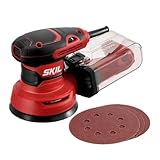
A random orbital sander uses a round disc that spins while moving in small, irregular orbits. That motion removes material quickly without creating the obvious straight scratch pattern produced by many traditional finishing sanders. For most homeowners, it is the more versatile first sander.
Choose a corded random orbital sander for furniture refinishing, deck boards, doors, tabletops, and general repair work. A 5-inch model is the common size, and replacement discs are widely available in grits from about 40 to 320. A 2.5- to 3-amp corded unit is usually sufficient for DIY use.
Random orbitals are especially useful when you need to remove paint, varnish, or damaged wood. Starting with 60- or 80-grit paper, you can make meaningful progress on a tabletop in minutes rather than spending an hour by hand. Move to 120 grit, then 180 grit for most painted or clear-coated projects. Going much finer than 220 grit is rarely necessary before applying paint, and can even reduce paint adhesion on some surfaces.
The trade-off is control. Pressing down hard slows the motor and can cause uneven sanding. Holding the tool in one place for only a few seconds may create a shallow dish in softwood. The most common failure is swirl marks caused by using too much pressure, skipping grits, or lifting the sander while the pad is still spinning. Keep it moving, use light pressure, and lift it only after switching it off.
Where sheet sanders still make sense
A sheet sander, often called a finishing or palm sander, uses a rectangular pad and quarter- or half-sheets of ordinary sandpaper. It is slower at stock removal, but the abrasive is cheap and easy to replace. If you already have a random orbital for heavy work, a sheet sander can be a sensible second tool for final smoothing.
Sheet sanders work well on cabinet faces, painted trim, plywood panels, and broad flat surfaces where you want a predictable finish. Their rectangular shape reaches closer to inside corners than a 5-inch round pad. They are also less aggressive, which is helpful when sanding between coats of paint or clear finish.
Buy a corded sheet finishing sander if your projects are mainly indoor furniture, doors, and trim. Standard sandpaper can cost roughly 10 to 30 cents per usable quarter-sheet when bought in multipacks, while quality hook-and-loop discs often cost more. The savings add up on a large cabinet or a multi-room repainting project.
Sheet sanders have their own failure modes. Sanding across the grain leaves scratches that may show through stain. Pressing on the front or sides can round an edge, despite the tool’s flat pad. Paper clips can loosen, and poorly secured paper may tear or wrinkle. Check the clamps before starting and keep the sander flat with steady, overlapping passes.
Price, power, and brand value
The cheapest sander is not automatically the best value. A $25 corded sheet sander can be perfectly adequate for occasional trim work, but its paper clamps, dust bag, or switch may be weak points. A bargain random orbital may remove material quickly yet vibrate enough to make long sessions unpleasant.
For most DIY buyers, a corded tool offers the best price-to-performance ratio. Cordless sanders are convenient for stairs, decks, and work away from an outlet, but the bare tool may cost $80 to $150 before adding a battery and charger. If you already own batteries from a major tool platform, cordless value improves substantially. Otherwise, a corded model often saves $50 or more.
Spend extra for variable speed, a comfortable grip, a reliable dust port, and a pad that accepts common abrasives. Brand reputation matters most for vibration control, replacement pads, and warranty support. It matters less for a tool used twice a year on a small shelf. Avoid paying for premium connectivity features unless you regularly sand for hours or already own that brand’s battery system.
The best time to buy
Sanders are commonly discounted during spring home-improvement promotions, Father’s Day sales, Black Friday, and holiday tool events. Corded models often receive smaller discounts because their normal prices are already low. Battery kits and combo bundles see deeper seasonal reductions, particularly when manufacturers update a cordless platform.
Compare the complete cost, not just the tool price: battery, charger, sanding discs or sheets, replacement pads, and a vacuum adapter. A $45 corded random orbital with a few starter discs may be cheaper to operate than a $90 cordless bare tool. For a single refinishing project, the cheaper corded option is usually fine.
Which sander should you choose?
Buy a random orbital first if you want one tool for the widest range of DIY jobs. It is the better choice for removing old finish, smoothing rough lumber, and preparing large surfaces. A 5-inch random orbital with dust collection is the practical all-around starting point.
Choose a sheet sander if low abrasive cost, flat finishing work, and inside-corner access matter more than speed. It is also a reasonable budget choice for occasional painting projects. If your budget allows only one tool, the random orbital generally covers more jobs; add a sheet sander later when you need gentler control and cheaper paper.