How to Build a Low-Cost Tool Kit for Basic Car Maintenance
What's inside
As an Amazon Associate I earn from qualifying purchases. This post may contain affiliate links at no extra cost to you.
A useful car-maintenance kit does not need to fill a garage or cost several hundred dollars. For basic jobs—changing oil, replacing a battery, tightening loose fasteners, checking tire pressure, and handling minor roadside problems—a carefully chosen kit can cost about $150 to $250. The goal is not to buy the biggest set. It is to cover the fastener sizes and safety equipment used on your car without paying for tools that will sit untouched.
Start With Safety and Access
Before buying sockets, buy the items that keep a simple repair from becoming an injury. A pair of wheel chocks, safety glasses, mechanic’s gloves, and a small LED work light are inexpensive and useful on nearly every job. Chocks matter whenever a vehicle is parked on a slope or lifted at one end. Gloves protect against sharp splash shields and hot, oily parts, but they do not make it safe to work on a hot engine.
A factory scissor jack is an emergency lifting device, not a good choice for routine maintenance. For home use, a 2-ton floor jack and jack-stand set is usually enough for a compact car or small crossover. Check the jack’s minimum height before buying; a tall SUV may need more lift, while a low sports car may not fit over a bargain jack. Never work under a vehicle supported only by a jack. Place stands at the manufacturer’s approved points and leave the jack lightly supporting the vehicle as a backup.
The Core Hand-Tool Set
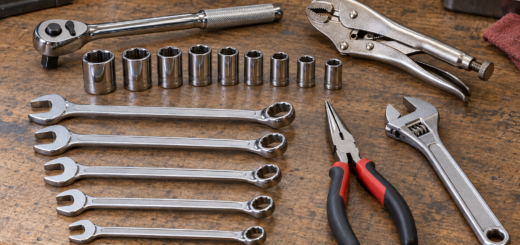
Most basic car work can be handled with a 3/8-inch-drive socket set, a ratchet, and a few extensions. Look for metric sockets from 8 mm through 19 mm, including both shallow and deep sockets if the price difference is small. Many modern vehicles use metric fasteners, while older American cars may also need common SAE sizes. A set containing 1/4-inch and 3/8-inch drives is more useful than a huge set with dozens of rarely used sizes.
Choose a ratchet with at least 72 teeth if you often work in cramped engine bays. It turns in roughly 5-degree increments, compared with about 10 degrees for a 36-tooth ratchet. That difference is noticeable around a battery tray or exhaust shield. A long-handled 3/8-inch ratchet provides more leverage, but it also makes it easier to strip a small bolt. Use a short ratchet for light fasteners and a breaker bar when a bolt is deliberately tight.
Include combination wrenches in 8–19 mm, a medium flat screwdriver, two Phillips screwdrivers, needle-nose pliers, slip-joint pliers, and locking pliers. Avoid using adjustable pliers on hex-head bolts; they round the corners and can turn a five-minute job into a drilling job. A basic metric 3/8-inch socket set is the best first purchase for most vehicles.
Tools Worth Paying More For
| Tool | Budget choice | When to spend more |
|---|---|---|
| Socket set | $25–$50 chrome set with a lifetime warranty | If you use it weekly or need smoother ratchet action |
| Torque wrench | $25–$45 click type, 20–150 lb-ft range | If you regularly service wheels, brakes, or suspension |
| Floor jack | $60–$100 steel 2-ton jack | If lifting frequently, choose better lowering control and stability |
| Battery tester | $15–$30 digital tester | If you diagnose starting problems often |
A torque wrench is one of the few tools that prevents expensive mistakes. Wheel lug nuts tightened too loosely can work free; overtightened nuts can distort brake rotors, damage studs, or make roadside removal nearly impossible. A 20–150 lb-ft click wrench covers many wheel lugs and common engine fasteners. Store it at its lowest marked setting after use, and do not use it as a breaker bar. Cheap torque wrenches can be acceptable for occasional work, but verify important settings against the vehicle manual and replace a wrench that has been dropped hard.
Brand-name tools are not automatically better. For occasional maintenance, a house-brand socket set with a lifetime replacement policy is often a better value than a premium set costing twice as much. Spend more on a jack, torque wrench, or diagnostic tool when poor quality could create a safety problem. For screwdrivers and pliers, mid-priced tools are generally sufficient; the cheapest versions tend to have soft tips, loose joints, or handles that split under pressure.
Fluids, Electrical, and Diagnostic Tools
Add an oil-filter wrench, drain pan holding at least 8 quarts, funnel, nitrile gloves, and a set of plastic trim tools. A drain pan that is too small causes a predictable mess when the oil stream shifts as the plug comes out. Check your owner’s manual for oil capacity and viscosity rather than relying on a parts-store lookup alone. Replace the drain-plug washer when the manufacturer calls for it, and never overtighten the plug to stop a leak; damaged oil-pan threads cost far more than a new washer.
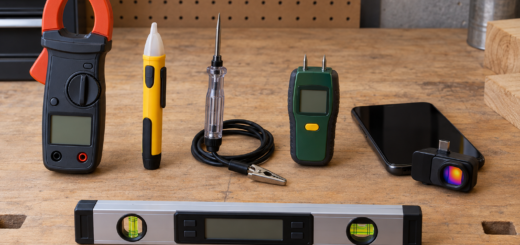
For electrical work, a basic digital multimeter is more useful than a cheap “battery gadget.” Look for voltage, resistance, and continuity functions, with insulated leads and a clear display. A healthy, rested 12-volt battery is commonly around 12.6 volts; about 12.2 volts indicates a partly discharged battery, though voltage alone cannot prove battery health. With the engine running, many charging systems measure roughly 13.7–14.7 volts. Follow the service information for your vehicle, especially on start-stop and hybrid systems.
A small code reader can identify engine fault codes, but it cannot diagnose every problem or clear the underlying fault. If you buy one, choose an OBD2 scanner with live data rather than the cheapest code-only reader. Live oxygen-sensor readings and coolant temperature can help distinguish a sensor issue from a wiring or fuel problem. Do not erase codes before recording them; clearing them can also reset emissions monitors and hide useful evidence.
Buy Seasonally and Store It Properly
Floor jacks, battery chargers, and emergency tools often see discounts before winter, while hand-tool sets are commonly marked down around Black Friday and year-end clearance. Buy a battery charger before freezing weather, not after a dead battery leaves you stranded. Tire gauges and portable inflators are most useful before road-trip season; choose an inflator rated for your tire size and expect a budget model to take several minutes per tire.
Keep sockets dry, wipe oily tools before storage, and return every tool to a marked tray or toolbox. Missing a 10 mm socket is a joke until it stops a repair. A modest kit that is organized and complete will outperform a 300-piece set buried in a damp cardboard case. Start with safety equipment, metric hand tools, lifting gear, and a torque wrench; add specialty tools only when a real repair requires them.