DeWalt vs Ridgid Table Saws: Comparing Prices for Home Workshops
What's inside
As an Amazon Associate I earn from qualifying purchases. This post may contain affiliate links at no extra cost to you.
Price snapshot for a home workshop
DeWalt and Ridgid both make capable jobsite table saws, but they target slightly different buyers. DeWalt usually charges more for a compact saw with a particularly good fence and more refined adjustments. Ridgid is often the value play: its saws commonly include a folding stand or rolling base for less money, although fit, finish, and long-term parts support can be less consistent.
Street prices change with promotions, but these are useful shopping ranges rather than fixed prices. Expect the lowest prices around spring tool sales, Father’s Day, Black Friday, and holiday bundles.
As an Amazon Associate we earn from qualifying purchases at no extra cost to you.


| Category | Typical DeWalt price | Typical Ridgid price | What you generally get |
|---|---|---|---|
| Compact 8-1/4-inch jobsite saw | $300–$400 | Limited direct equivalent | Portable saw for sheet goods and trim stock |
| 10-inch jobsite saw | $450–$650 | $350–$550 | Larger blade, better depth capacity, often a stand |
| Rolling stand or bundled package | Often $550–$750 | Often $400–$600 | More convenient setup, but a larger storage footprint |
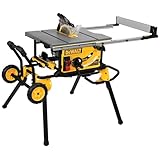
Before comparing sticker prices, check what is included. A saw that costs $75 less may need a $100 stand, a better blade, and a replacement throat plate. Search current DeWalt table saws and Ridgid table saws by package, not just by brand.
Where DeWalt earns its higher price
DeWalt’s strongest advantage is usually the rack-and-pinion fence system on its portable saws. The fence moves quickly, stays parallel more reliably, and is easier to adjust with one hand than the basic sliding fences found on many budget saws. That matters when you are making repeated rip cuts for cabinet parts, shelving, or flooring.
A compact DeWalt 8-1/4-inch saw is also easier to carry up stairs and store on a shelf. Its smaller blade is not automatically a limitation for a home workshop. It can cut typical 3/4-inch plywood and dimensional lumber without trouble. The trade-off is depth: at 90 degrees, an 8-1/4-inch blade usually cuts roughly 2-9/16 inches, while a 10-inch saw is closer to 3-1/8 inches. Cutting 4×4 posts in one pass is outside either saw’s normal capacity.
DeWalt’s 10-inch jobsite models are better suited to frequent ripping and thicker stock. They generally offer more table area and a stronger stand option, but they are heavier and take more room to roll or store. If your workshop is a garage shared with a car, the compact format may be worth more than the extra capacity.
Where Ridgid makes sense
Ridgid is often the sensible choice when the saw will stay in one workshop rather than travel to jobsites. A 10-inch Ridgid jobsite saw can provide useful capacity at a lower entry price, and store promotions sometimes make the gap substantial. If you find a complete saw-and-stand package around $400–$500, it can be a strong budget purchase for weekend furniture, shelving, and general remodeling work.
The cheaper option is fine when your cuts are occasional, your material is mostly plywood, and you are willing to check the setup before each project. A Ridgid fence may need more careful alignment than a DeWalt fence. That is not a dealbreaker: use a tape measure at the front and rear of the blade, lock the fence firmly, and make a test cut on scrap.
Ridgid’s main risks are less about cutting power and more about convenience. Some units have more plastic in the stand or adjustment components, and replacement parts can be less straightforward to locate years later. Also inspect the exact package. A low-priced saw without a stand may be a poor value if you need to buy or build a rolling base immediately.
Running costs and hidden expenses
Neither brand’s stock blade should be treated as a permanent solution. The included general-purpose blade is adequate for rough construction lumber, but plywood and hardwood usually benefit from a 40-tooth or 60-tooth finish blade. Budget $30–$70 for a decent replacement. A dull blade increases feed pressure, leaves burn marks, and makes kickback more likely.
Dust collection is another cost. Portable table saws produce a surprisingly large amount of fine dust even when connected to a shop vacuum. A basic vacuum and a better dust separator can add $100–$250. If you work indoors, that expense is more important than a small difference in motor wattage.
Allow room for a crosscut sled, push sticks, featherboards, and a stable outfeed surface. Do not use a table saw without the supplied blade guard and riving knife unless a specific operation requires removal and you fully understand the risk. The most common home-workshop failure is not a burned motor; it is a board pinching the blade because the fence, riving knife, or stock was misaligned.
Choosing by workshop and workload
Choose DeWalt if you regularly break down sheet goods, need fast fence adjustments, carry the saw between locations, or value a compact footprint. Its premium is easier to justify when setup time matters every week. A portable table saw stand is worth considering if you buy the saw body separately and need to move it often.
Choose Ridgid if the saw will live in a garage, your projects are intermittent, and the lower purchase price leaves money for a quality blade and dust control. The savings are real only if the fence locks squarely and the stand is stable. Test the unit in the store when possible: extend the fence, lock it, check for front-to-back movement, and inspect the tabletop for damage.
Best time to buy
Do not assume the largest discount is attached to the bare tool. Holiday bundles often include a stand or extra blade that saves more than a modest price cut. Compare the final package price, warranty terms, and return policy. If you can wait, watch prices for four to six weeks and set a target: roughly $350 for a compact DeWalt, $450–$550 for a well-equipped DeWalt 10-inch saw, or under $450 for a complete Ridgid package.
For a first home-workshop saw, the practical decision is simple: pay DeWalt’s premium for a better portable fence and compact handling, or put the savings from Ridgid toward blades, dust collection, and a solid outfeed table. Either brand can make accurate cuts. Neither will compensate for a crooked stand, a dull blade, or rushed feed pressure.