DeWalt vs Bosch Table Saws: Comparing Jobsite Features and Price
What's inside
As an Amazon Associate I earn from qualifying purchases. This post may contain affiliate links at no extra cost to you.
DeWalt and Bosch both make capable portable table saws, but they take different approaches. DeWalt puts more emphasis on compact jobsite machines and fast fence adjustments. Bosch leans toward stands, transport, and a slightly more refined setup experience. The best value depends on whether you carry the saw up stairs, cut sheet goods all day, or only need it for occasional remodeling.
As an Amazon Associate we earn from qualifying purchases at no extra cost to you.


Quick comparison
| Factor | DeWalt | Bosch |
|---|---|---|
| Typical jobsite focus | Compact saws, rack-and-pinion fences, strong rip capacity | Portable saws with useful folding stands and smooth transport |
| Common price range | About $400–$700, depending on stand and package | About $450–$800, depending on model and stand |
| Fence adjustment | Rack-and-pinion systems are fast and repeatable | Generally conventional locking fences with solid support |
| Portability | Excellent on compact models; rolling stands add bulk | Usually excellent when paired with the gravity-rise stand |
| Best value case | Frequent ripping, limited storage, or a need for broad fence capacity | Frequent loading and unloading, especially when a stand matters |
Where DeWalt makes more sense
DeWalt’s compact jobsite saws are popular because the fence adjustment is quick. A rack-and-pinion mechanism lets you turn a knob to move the fence, then lock it down. That is useful when switching between repeated cuts, and it reduces the small alignment corrections common with cheaper sliding fences.
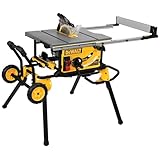
The compact DeWalt format is also easy to store. A saw in this class typically weighs around 45 to 50 pounds without a rolling stand, which is manageable for one person. The trade-off is a smaller table and less support for full 4-by-8-foot sheets. You can cut plywood on it, but you will want roller stands, an outfeed table, or a helper.
Larger DeWalt jobsite models offer roughly 32 inches of rip capacity to the right of the blade, depending on the exact version. That is enough for ripping a full sheet of plywood in half. The wider fence and table improve control, but they also make the saw harder to carry and take more space in a truck.
For buyers comparing packages, start with the DeWalt jobsite table saw selection. Check whether the listing includes a stand, extra blade, or only the bare saw. A lower advertised price can be misleading if you still need to buy a stand and a decent combination blade.
Where Bosch makes more sense
Bosch’s main advantage is transport. Its folding gravity-rise stand is designed to open and close without forcing you to lift the entire saw onto a separate base. Large wheels help on pavement and packed dirt, although they do not make stairs easy. If the saw will be loaded into a van every morning, the stand can justify Bosch’s higher price.
Bosch jobsite saws generally provide a stable table and a fence that locks securely when properly adjusted. They are a good fit for carpenters who value a solid setup over the smallest folded footprint. The stand, however, adds weight and can be awkward in a small workshop. For a homeowner who will set the saw on a bench and leave it there, that feature may be wasted money.
Look at the Bosch jobsite table saw options when a rolling stand is a priority. Bosch’s model names and package contents vary by retailer, so verify the included stand rather than assuming every listing has one.
Cutting performance and common failure points
Both brands use 15-amp corded motors in their mainstream jobsite saws. That is enough for framing lumber, trim stock, and plywood, but neither behaves like a 3-horsepower cabinet saw. Expect the blade to slow in thick hardwood, especially with a dull or overly aggressive blade. If the motor bogs, forcing the cut can trip the breaker, scorch the wood, or leave a rough edge.
Use a sharp 40-tooth combination blade for general work and a dedicated ripping blade for long cuts in solid lumber. Keep the stock moving at a steady rate. A $50 blade can improve results more than paying another $150 for a slightly more powerful jobsite saw.
Portable saws also have predictable weak points. Plastic table extensions can sag if overloaded. Fence rails can move out of alignment after rough transport. Dust collection is better with a shop vacuum attached, but fine dust still escapes around the blade guard and throat plate. Before trusting any saw, check that the blade is parallel to the miter slot and that the fence does not pinch the work against the rear of the blade.
Price, packages, and seasonal buying
A reasonable street-price target is about $400–$500 for a compact saw, $500–$650 for a larger saw or one with a basic stand, and $650–$800 for a premium rolling package. Prices move sharply during spring remodeling season, Father’s Day promotions, and Black Friday. Holiday bundles sometimes include a stand or extra blade, but the included blade is not always worth treating as a major discount.
If you already own a sturdy workbench, the cheaper saw-only package is often the better buy. A stand is valuable when you work outdoors or move the tool daily; it is unnecessary when the saw will live at a fixed bench. In that case, compare portable table saw stands separately and consider a wider aftermarket outfeed surface.
DeWalt is usually the stronger value for a compact saw and quick fence adjustments. Bosch can be worth the premium for its folding transport system and stable setup. Neither brand is automatically the bargain choice: the right package is the one that includes the features you will use, not the one with the lowest bare-tool price.
What to check before buying
Measure your storage space with the saw folded, confirm the maximum rip capacity, and check the cord length if you work away from outlets. Inspect the fence for straight travel and positive locking. If buying online, verify the exact included stand and return policy. Finally, budget for a quality blade, hearing protection, push sticks, and a dust-control connection. Those additions affect the real cost more than a small difference in motor specifications.