How to Find Value in Late-Summer Discounts on Outdoor Power Tools
What's inside
As an Amazon Associate I earn from qualifying purchases. This post may contain affiliate links at no extra cost to you.
Why late summer can be a good time to buy
By late summer, many homeowners have already handled the big spring cleanup and may be using mowers, trimmers, and blowers less often. Retailers sometimes discount seasonal stock to make room for fall and winter products. That can make this a sensible time to shop—but a markdown alone does not make a tool a good value.
Start with the work you still need to do. If the mower has several months of regular use left, a discounted model available now may be more useful than waiting for a deeper clearance price. If you only need a tool for occasional cleanup, a modest corded or battery-powered option may cost less over time than a high-powered model you rarely use.
Compare the whole kit, not just the tool
Check whether the listed price includes a battery and charger. A “bare tool” can look like a bargain, but a compatible battery and charger may add substantially to the cost. If you already own tools from a battery platform, a bare tool can be the better buy—provided the battery has enough capacity and the manufacturer still supports the platform.
Compare the same configuration across retailers: tool, battery capacity, charger, and included accessories. Also check the return window and warranty terms. A short clearance return period matters if you cannot test the tool promptly or discover a defective battery after the first charge.
| Tool type | Late-season value check | Cheaper option is usually fine when… |
|---|---|---|
| String trimmer | Included battery, line-loading method, and cutting width | You trim small areas and do not need to cut thick, woody growth |
| Leaf blower | Runtime at high speed, battery size, and air output claims | You clear a short driveway, patio, or small yard |
| Lawn mower | Deck size, bagging or mulching parts, and battery cost | Your lawn is small and a corded mower suits the layout |
| Chainsaw | Bar length, chain availability, and safety features | You are cutting small branches occasionally, not felling trees |
Match power to the job
Buying more power than you need can mean paying for a larger battery, heavier equipment, or a gas engine that takes more maintenance. Buying too little can be just as costly if the tool stalls, runs hot, or forces you to make several passes. Think about the hardest routine task, not the best-case task.
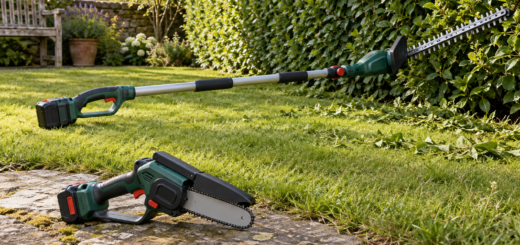
For a small yard with light edging, a basic cordless string trimmer kit may be enough. If you have thick weeds or a large lot, look for a brushless motor, a larger battery, and a shaft and cutting head suited to longer sessions. A low advertised price is less attractive if the tool only works comfortably on its lowest setting.
For leaves on a patio or short driveway, a compact cordless leaf blower kit is often easier to handle than a gas blower. Heavy, wet leaves are a different job: they demand more sustained airflow, and small batteries can lose runtime quickly at full power. Check whether a second battery is cheaper than buying a higher-capacity one, especially if you already own a charger.
Battery, corded, or gas?
Battery tools are convenient for short jobs and avoid fuel mixing and engine servicing. Their weak points are runtime, replacement-battery cost, and performance under continuous heavy load. A battery advertised at a particular voltage does not tell you how long it will run; capacity, tool design, temperature, and speed setting all matter. Treat runtime claims as estimates unless the manufacturer describes the test conditions.
Corded tools can be a strong value for a small property near outdoor outlets. They have no battery to age or replace, but the cord limits reach and creates a snag hazard. Use an outdoor-rated extension cord of the gauge and length specified in the manual, and keep it behind you while working.
Gas tools make sense for long, demanding work away from outlets, but include fuel, oil, maintenance, noise, and storage in the cost. A discounted gas mower or chainsaw is not a bargain if it needs carburetor work or parts that are hard to find. For seasonal use, stale fuel and neglected maintenance are common sources of no-start problems.
Check condition, parts, and coverage
Before buying clearance stock, confirm whether the tool is new, refurbished, or an open-box return. Inspect the packaging when possible, and look for missing safety guards, mower side-discharge parts, trimmer spools, or blower tubes. A missing accessory can erase the savings if replacements are sold only as a costly kit.
Look up replacement consumables before checkout: trimmer line, mower blades, chains, air filters, and batteries. Common sizes and widely available parts are usually easier to maintain than proprietary items with few sellers. For a chainsaw, check that replacement chains are readily available in the correct pitch, gauge, and drive-link count; the wrong chain will not fit safely.
Discounts are most useful when they apply to a tool you can test and support. Run a battery tool long enough to check for unusual vibration, trigger problems, or battery cutouts. On a mower, listen for blade or deck rattling and confirm that it starts consistently. If the price is final-sale and the tool cannot be inspected, a small saving may not justify taking on the risk.
Set a price target before shopping
Record the full kit price, not just the advertised percentage off. Compare it with the usual price for the same configuration and with the cost of a battery platform you already own. For example, a $30 saving on a bare tool is not meaningful if you need to spend $100 on a compatible battery and charger; it may be worthwhile if those are already in your shed.
Set a ceiling based on how often you will use the tool and what a repair or replacement would cost. If a cheaper blower handles your weekly patio cleanup, there is little value in paying extra for a model built for large properties. Spend more where the work is demanding—such as a large lawn, dense growth, or repeated heavy-duty cutting—and save where the lighter tool will do the job without strain.