Best Affordable Workbench Vise for Home Repairs
What's inside
As an Amazon Associate I earn from qualifying purchases. This post may contain affiliate links at no extra cost to you.
What Makes a Good Budget Vise for Home Repairs
The best affordable workbench vise is not necessarily the cheapest vise on the shelf. For home repairs, look for a vise with a 3- to 4-inch jaw width, at least a 3-inch jaw opening, replaceable serrated jaws, and a base that will not twist when you apply moderate force. A cast-iron body is common and inexpensive, while a steel body generally tolerates impacts and accidental overloading better.
Expect to spend roughly $35 to $60 for a basic 3-inch vise, $60 to $120 for a sturdier 4-inch bench vise, and $100 or more for a heavier tool with a swivel base and better machining. Prices move considerably during spring tool promotions, Black Friday, and holiday sales. A $45 vise discounted to $35 may be a better buy than a poorly finished $25 model that needs shimming before it can hold work squarely.
As an Amazon Associate we earn from qualifying purchases at no extra cost to you.


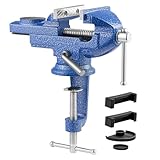

For most homeowners, a 4-inch bench vise is the practical middle ground. It is large enough for plumbing fittings, small brackets, hardware, and light metalwork without taking up the entire workbench.
Choose the Vise Type Before Comparing Brands
A fixed bench vise bolts permanently to the workbench and is the best choice for filing, drilling, bending light stock, and general repairs. It transfers force directly into the bench, so it feels more secure than a clamp-on design.
A swivel-base bench vise can rotate through 360 degrees, which is useful when you need to work on the side of a part. The trade-off is a little less rigidity and a higher price. On inexpensive models, the swivel may also slip unless both locking bolts are tightened evenly.
A clamp-on vise attaches to the edge of a table without drilling holes. It is convenient for renters or occasional projects, but it has clear limits. Clamps can loosen under twisting force, and a thin folding table can flex enough to make the vise frustrating to use. Do not use a clamp-on vise for heavy hammering or stuck fasteners.
For woodworking, a quick-release woodworker’s vise is more appropriate than a general-purpose metalworking vise. Its jaws are designed to accept wooden faces and avoid damaging finished boards. If you only need to hold small parts while gluing or sawing, a 3-inch bench vise for home workshops is usually enough.
Affordable Workbench Vise Comparison
| Vise type | Typical price | Best for | Main limitation |
|---|---|---|---|
| 3-inch fixed bench vise | $35–$60 | Small repairs, hardware, light filing | Limited jaw opening and clamping force |
| 4-inch fixed bench vise | $55–$100 | General household and garage work | Needs a solid, permanently mounted bench |
| 4-inch swivel-base vise | $75–$140 | Parts that need access from several angles | Can flex or slip if the base is poorly made |
| Clamp-on vise | $25–$70 | Renters and temporary workstations | Less stable under twisting and impact |
| Compact hobby vise | $20–$45 | Electronics, models, and small components | Not suitable for stuck bolts or heavy work |
Where Cheap Vises Usually Fail
The most common failure is not a broken casting; it is poor alignment. Close the jaws and check whether the top edges meet evenly. A small gap of 1 millimeter can allow a narrow part to tilt or fall when you file it. Some inexpensive vises also have jaws that rise noticeably as they tighten, a problem called jaw lift. You can reduce it by tightening near the center of the workpiece, but severe lift is a reason to return the vise.
Inspect the screw and handle before buying. The screw should turn smoothly without gritty spots, and the handle should have enough length to generate useful clamping force without requiring a pipe extension. Never add a cheater bar to a budget vise. Overloading can crack the body around the screw or mounting ears.
Another weak point is the swivel base. A thin base with small locking bolts may look attractive, but it can rotate when you try to loosen a seized nut. If you regularly work on metal parts, a fixed vise is often the better value. Spend the difference on stronger mounting hardware instead.
Brand Value Versus Features
Established tool brands usually provide better jaw fit, smoother screws, and more consistent castings. That matters when you use the vise weekly, but it does not automatically justify paying twice as much. For occasional household repairs, a basic vise from a reputable hardware or industrial-tool line is often sufficient.
Pay for replaceable jaws before paying for cosmetic features. Hardened, replaceable jaws can be renewed after years of filing and clamping. Pipe jaws are useful if you work on round stock, but they are not essential for most home repairs. An anvil surface is handy for tapping small parts flat, although it should not be treated as a forging anvil.
When shopping online, compare the actual jaw width, opening, throat depth, weight, and mounting-hole spacing rather than relying on “heavy duty” in the title. A 35-pound vise is generally more stable than a 12-pound model, but weight alone cannot correct a weak bench. Browse 4-inch bench vises with replaceable jaws and check customer photos for casting cracks, damaged threads, and uneven jaws.
Mounting and Using It Safely
Mount the vise over a bench leg or another reinforced area, not on a thin unsupported section of plywood. Use all available mounting holes with appropriately sized bolts, flat washers, and locknuts. For a typical 4-inch vise, 3/8-inch bolts are a reasonable starting point, but follow the vise’s hole size and your bench construction.
Keep the workpiece low in the jaws to reduce leverage. Use soft jaw covers made from aluminum, leather, or hardwood when clamping painted or finished parts. Tighten firmly by hand; do not strike the handle with a hammer. If a part will not move, use penetrating oil, heat where appropriate, or a larger properly supported tool instead of forcing the vise beyond its design.
When to Buy and When to Upgrade
Spring garage-sale season often brings discounts on vises, while November promotions can produce the best prices on new workshop tools. Used cast-iron vises can be excellent values if the jaws are square, the screw is not bent, and the body has no cracks around the mounting ears. Surface rust is usually manageable; a damaged screw or missing jaw inserts is less attractive unless replacement parts are available.
If your work is limited to assembling furniture, holding trim, or repairing bicycles, the cheaper 3-inch option is fine. Choose a heavier 4-inch fixed vise if you expect to remove seized bolts, drill steel, or bend flat bar. For occasional temporary use, a clamp-on 4-inch bench vise saves drilling and costs less, but only when the table underneath it is rigid enough to support the load.