Best Value OBD2 Scanner for Home Vehicle Diagnostics
What's inside
As an Amazon Associate I earn from qualifying purchases. This post may contain affiliate links at no extra cost to you.
What Makes an OBD2 Scanner a Good Value?
The best-value OBD2 scanner is not necessarily the cheapest one. For most home garages, value means a tool that reads and clears engine fault codes, shows live data, identifies the likely system at fault, and works reliably across several vehicles. Spending $20 instead of $50 is worthwhile only if the cheaper scanner does those jobs without disconnecting, mislabeling codes, or hiding useful information.
OBD2 coverage applies to most gasoline vehicles sold in the United States from 1996 onward. Diesel coverage varies by vehicle and model year. An OBD2 scanner can help diagnose a check-engine light, but it cannot automatically find the failed part. A P0420 code, for example, may involve a catalytic converter, an exhaust leak, a weak oxygen sensor, or an engine that is running too rich.
As an Amazon Associate we earn from qualifying purchases at no extra cost to you.
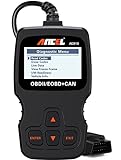


For basic home diagnostics, expect to spend about $25 to $60 for a corded handheld scanner, $20 to $50 for a Bluetooth adapter, and $80 to $180 for a more capable bidirectional or full-system tool. The last category can access ABS, airbag, transmission, and body-control modules, but it is unnecessary if your goal is only engine fault diagnosis.
Which Scanner Type Fits Your Garage?
| Scanner type | Typical price | Best for | Main compromise |
|---|---|---|---|
| Basic corded scanner | $20–$45 | Reading and clearing check-engine codes | Limited live data and little repair guidance |
| Enhanced handheld scanner | $45–$100 | Home mechanics comparing sensor readings | Usually limited to powertrain systems |
| Bluetooth adapter | $20–$60 | Owners comfortable using a phone app | App quality, permissions, and compatibility vary |
| Full-system scanner | $100–$250+ | ABS, airbag, transmission, and service functions | Higher cost and more complicated software |
A basic OBD2 scanner is fine for a vehicle that has occasional check-engine lights and for checking a used car before purchase. It should display stored, pending, and permanent codes, show freeze-frame data, and provide readiness-monitor status. “Permanent” codes cannot always be erased with a scanner; the vehicle must complete its self-tests and confirm that the problem is fixed.
Choose an enhanced handheld unit if you want to watch live data such as coolant temperature, short- and long-term fuel trim, engine speed, throttle position, and oxygen-sensor readings. A scanner that displays graphs is easier to use than one that shows a rapidly changing list of numbers. The extra $20 to $50 is often justified if you plan to diagnose more than one problem.
Corded Versus Bluetooth Scanners
Corded scanners are the simpler choice. They draw power from the vehicle’s diagnostic socket, require no charging, and generally work without a phone, account, or software subscription. Their weakness is the short cable and small screen. You may need to hold the scanner while watching data, which is inconvenient during a road test.
Bluetooth adapters are compact and can record data on a phone. That makes them useful for intermittent faults, when a sensor acts up only while driving. However, the adapter is only half the purchase. The app controls the experience. Some apps are free but limited; others charge monthly or yearly fees for enhanced functions. Check whether the app supports your phone before buying.
A Bluetooth OBD2 adapter is a good value for a technically confident owner who already has a suitable phone. It is less attractive for lending to family members or checking a car in a parking lot, where pairing problems and phone permissions can waste time.
Features Worth Paying For
Prioritize code definitions, freeze-frame data, live data, readiness monitors, and the ability to read pending codes. Pending codes can reveal a fault before the check-engine light turns on. Battery voltage is also useful: a vehicle sitting near 12.2 volts with the engine off may have a weak or partially discharged battery, while a running charging voltage commonly falls around 13.5 to 14.8 volts. Exact readings vary, so treat these as starting points rather than pass-or-fail rules.
Do not pay extra merely for a color screen, a large list of supported protocols, or a claim that the tool “resets any light.” Service-reset functions, such as oil-life resets, vary by vehicle. ABS and airbag access is also vehicle-dependent. Confirm support using the scanner manufacturer’s compatibility list, not just an Amazon product title.
Bidirectional controls are valuable when you need to command a cooling fan, fuel pump, purge valve, or other actuator during our research. They are not essential for reading codes and can cause problems if used carelessly. A homeowner who rarely repairs vehicles will usually get better value from a reliable enhanced scanner than from the cheapest bidirectional tool.
Common Problems With Cheap Scanners
The main failure mode is incomplete coverage. A low-cost tool may read engine codes but show “no codes” when the actual problem is in the ABS or airbag module. That does not mean the vehicle is fault-free. Another issue is poor translation. A tool may show a generic description while omitting manufacturer-specific details needed for diagnosis.
Cheap Bluetooth adapters can also disconnect when the phone locks, draw battery power if left plugged in, or use poorly secured wireless protocols. Remove the adapter after testing unless it has a clearly documented low-power standby mode. Avoid unknown devices that request unnecessary phone permissions.
Never clear codes before recording them. Clearing codes erases freeze-frame information and resets readiness monitors. Afterward, the car may need roughly 50 to 100 miles of mixed driving, sometimes more, before all monitors run. That matters before emissions testing and can hide an intermittent fault temporarily.
When to Buy and What to Choose
Scanner prices often drop during major shopping periods, especially around Memorial Day, July promotions, Black Friday, and the holiday season. Discounts of 10% to 25% are common, but compare the final price with the normal price and check whether a software subscription is included only briefly. A $30 scanner that requires a $100 annual renewal is not a budget purchase over several years.
For one vehicle and occasional check-engine-light work, buy a live-data OBD2 scanner in the $40 to $80 range. If you only need to read a code before visiting a repair shop, a $20 to $30 corded reader is sufficient. Choose a full-system OBD2 scanner only when ABS, airbag, transmission, or service-reset access justifies the extra cost.
Before ordering, verify the return policy, update method, vehicle coverage, and whether the tool works without a subscription. Those details matter more than screen size. The best value is the least expensive scanner that covers the systems you actually need and presents enough data to make the next repair decision safely.