Best Affordable Starter Kit for a Cordless Tool Platform
What's inside
As an Amazon Associate I earn from qualifying purchases. This post may contain affiliate links at no extra cost to you.
A cordless platform is a battery system shared by a brand’s drills, saws, lights, sanders, inflators, and outdoor tools. The first kit matters more than the first tool because batteries and chargers are expensive to replace later. For most homeowners, the best affordable starting point is a 18V or 20V platform with a drill, impact driver, two batteries, and a charger. That combination handles furniture, shelving, repairs, deck work, and routine maintenance without locking you into a costly professional system.
As an Amazon Associate we earn from qualifying purchases at no extra cost to you.


Best overall value: Ryobi ONE+
Ryobi ONE+ is usually the safest budget recommendation because the platform has a very large tool selection and frequent sales. A basic two-tool kit often sells for roughly $100 to $180, while larger kits with four or five tools commonly fall between $200 and $300 during promotions. The exact voltage label is less important than the battery ecosystem: Ryobi’s 18V ONE+ batteries fit its older and newer cordless tools.
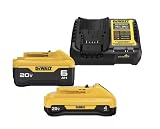
Look for a kit containing a drill/driver, impact driver, two batteries, and a charger. If the price is close, choose a package with one 4.0Ah battery rather than two very small 1.5Ah packs. The larger battery adds weight, but it runs a circular saw, vacuum, or blower noticeably longer. A small battery is still useful on a drill or light.
Ryobi’s weak point is consistency. Its inexpensive tools are fine for occasional household work, but some compact saws, sanders, and outdoor tools are slower or less refined than professional equivalents. That is an acceptable trade-off if you use them a few times a month rather than every day.
Shop Ryobi ONE+ starter kits when you want the broadest affordable platform and do not need commercial-grade durability.
Affordable platform comparison
| Platform | Typical kit value | Best for | Main compromise |
|---|---|---|---|
| Ryobi ONE+ 18V | $100–$300 | Largest selection and frequent sales | Entry-level tools vary in refinement |
| Craftsman V20 | $100–$250 | Basic home repair and occasional projects | Fewer compelling specialty tools |
| Kobalt 24V | $150–$300 | More power without jumping to premium pricing | Smaller ecosystem than Ryobi |
| HART 20V | $80–$220 | Lowest-cost light-duty ownership | Limited heavy-duty capability and availability |
When another platform makes more sense
Craftsman V20 is a reasonable alternative if a local sale makes a kit substantially cheaper than Ryobi. Its drills, impact drivers, lights, and small saws cover normal home tasks. Choose it when you can buy a two-battery kit for at least $30 to $50 less than an equivalent Ryobi package. Do not choose it solely because the box claims “20V”; battery voltage labels are not a useful measure of real-world performance.
Kobalt 24V is often the stronger value when you expect to use a circular saw, reciprocating saw, or larger outdoor tool. Its brushless kits can offer more power and better runtime than the cheapest 18V packages. The trade-off is a smaller selection and less frequent deep discounting. If your future list includes only a drill, driver, light, and inflator, the extra capability may not justify the higher initial cost.
HART 20V can be fine for hanging shelves, assembling furniture, drilling pilot holes, and occasional picture-frame work. It is the budget choice, not the best long-term platform. Battery availability and specialty-tool selection are weaker, and replacing a worn battery several years from now may be less convenient.
Compare Kobalt 24V brushless kits if you want a more powerful step up while staying below premium professional systems.
What the first kit should include
The drill/driver is the general-purpose tool. It drills wood and metal, drives screws, and accepts common bits. The impact driver is better for long screws, structural fasteners, and repeated driving because it transfers less twisting force to your wrist. It is not a substitute for a drill: its hammering action can snap small bits and overdrive cabinet screws.
Two batteries are important. With one battery, charging stops the job whenever the pack is empty. A practical starter setup is one 1.5Ah or 2.0Ah battery for the drill and one 4.0Ah or 5.0Ah battery for saws and outdoor equipment. Runtime depends heavily on the tool: a drill may complete dozens of small holes, while a circular saw can drain a small pack in minutes under continuous cutting.
A charger that fills a 2.0Ah battery in about 30 to 60 minutes is adequate for homeowners. Avoid kits that include a USB charging cable instead of a proper tool-battery charger unless the tools are genuinely light duty.
Brushless versus brushed tools
Brushless motors usually run cooler, use energy more efficiently, and last longer under heavy use. They are worth prioritizing in a circular saw, reciprocating saw, blower, or impact wrench. For a drill used for ten minutes a month, a brushed model is usually fine and can save $30 to $80 in a kit.
Do not pay extra for brushless versions of every tool automatically. A brushless upgrade makes the most sense when the tool will see long run times, high loads, or frequent use. For light repairs, battery size and a comfortable clutch can matter more than the motor type.
How to buy at the lowest useful price
Major holiday sales, spring outdoor-tool promotions, and end-of-year clearance are the best times to shop. Compare the kit’s contents rather than the advertised tool count. A package with a drill, flashlight, and two tiny batteries is not better than a two-tool kit with a 4.0Ah pack.
Watch for “free tool” promotions, but check the redemption rules. Some require buying a specific battery kit, and the free tool may be one you would not otherwise purchase. Batteries bought separately often cost $50 to $120, so a kit priced only $40 above a bare-tool package can be the better deal.
Check current drill and impact-driver combo pricing before buying bare tools. For most first-time buyers, Ryobi ONE+ is the sensible default; choose Craftsman or HART only for a clearly lower price, and Kobalt when extra power is worth a smaller platform.