Best T-Shank Jigsaw Blades for Precise Cuts
What's inside
As an Amazon Associate I earn from qualifying purchases. This post may contain affiliate links at no extra cost to you.
The best t shank jig saw blade is the one whose length, tooth pattern, and material match both the workpiece and the type of cut: use a 3–4 inch, fine-tooth blade for clean curves in thin wood, a longer progressive-tooth blade for thick stock, and a bi-metal blade when durability matters more than the absolute smoothest finish.
As an Amazon Associate we earn from qualifying purchases at no extra cost to you.
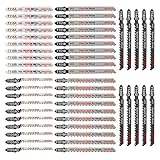

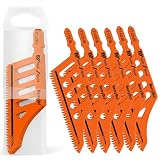

What to choose first: a practical buying decision
Most modern jigsaws accept T-shank blades, but “T-shank” only describes the mounting end. It does not tell you whether a blade will control a tight curve, resist splintering, or cut efficiently through hardwood. Start with these four decisions:
- Material: high-carbon steel is economical for ordinary wood; bi-metal lasts longer and handles occasional nails or mixed materials; carbide-grit blades suit abrasive laminates, cement board, or fiberglass.
- Tooth geometry: more teeth per inch generally produce a smoother edge, while fewer, larger teeth remove material faster and clear thick chips more effectively.
- Blade length: select a blade with enough cutting length to pass through the stock while leaving room for the jigsaw’s orbital movement. Excessive length can wander on curves.
- Cut direction: down-cut blades reduce top-surface splintering, while standard up-cut blades usually clear chips better and cut more aggressively.
Best blade types by project
Clean plywood, cabinet panels, and visible edges
Choose a ground-tooth or reverse-tooth wood blade with approximately 10–20 TPI. A narrow blade around 3–4 inches long gives better control around a curve than a very long blade. For a finished panel, place painter’s tape over the cut line, support the panel close to the cut, and let the blade do the work without forcing the saw.
A reverse-tooth pattern cuts on the downstroke and can leave a cleaner top face. It may cut more slowly and can push the saw upward, so keep the base firmly against the workpiece. This is useful when the visible surface faces upward and cannot be cut from the reverse side.
Fast cuts in framing lumber and construction wood
For softwood, dimensional lumber, and rough cutouts, use a milled-tooth blade in the range of 6–10 TPI. A 4–5 inch blade with a wider body is easier to keep straight in thick stock. Some fast-cut jig saw blades woodworkers use for rough work have extra-large gullets that remove chips quickly but leave a more ragged edge.
Do not use a fine 18–24 TPI blade for a deep, fast cut in pine. Its small gullets can clog with resin and heat the blade, increasing wandering and burning. Conversely, a coarse blade in thin plywood can tear out large chunks at the exit side.
Tight curves and scroll-like cutouts
Curve control depends as much on blade width and thickness as tooth count. A narrow, slim blade can turn more sharply, but it is also easier to twist. Use a slower feed rate, reduce orbital action, and rotate the saw gradually rather than bending the blade sideways.
For intricate shapes in 6–12 mm plywood or solid wood, look for a narrow T-shank blade with roughly 12–20 TPI. Forcing a blade around a curve is a common cause of bevelled edges: the teeth enter vertically, but sideways pressure bends the blade behind the cut.
Hardwood, laminate, and mixed materials
Hard maple, oak, bamboo, and abrasive laminates benefit from a sharper, more durable blade. Bi-metal construction combines a flexible steel body with a harder high-speed-steel tooth strip. It costs more than basic carbon steel but is less likely to lose its edge quickly in demanding work.
For laminate-covered panels, a fine-tooth reverse blade or a down-cut blade can reduce surface chipping. Carbide-grit blades have no conventional teeth and are intended for abrasive materials; they are useful for laminate, cement board, or fiberglass, but they are not the best choice for fast, clean ordinary wood cuts.
Head-to-head comparison of common T-shank blades
| Blade type | Typical length | Typical tooth range | Best use | Main compromise |
|---|---|---|---|---|
| Fine-tooth wood, high-carbon steel | 3–4 in (75–100 mm) | 10–20 TPI | Plywood, trim, clean visible edges | Slower cutting and faster wear in hardwood |
| Fast-cut wood, high-carbon steel | 4–5 in (100–125 mm) | 6–10 TPI | Softwood, rough openings, thick stock | More splintering and a rougher edge |
| Reverse-tooth wood blade | 3–4 in (75–100 mm) | 10–20 TPI | Top-surface cuts in plywood and veneered panels | Needs firm pressure and chip clearance is poorer |
| Bi-metal wood or multi-material blade | 3–5 in (75–125 mm) | 8–14 TPI | Hardwood, reclaimed wood, occasional embedded fasteners | Higher price and not always the cleanest finish |
| Carbide-grit blade | 3–4 in (75–100 mm) | Grit rather than TPI | Laminate, cement board, fiberglass | Slow in wood and unsuitable for tight fine curves |
How major blade choices compare
Diablo jig saw blades are widely available in wood, reverse-tooth, bi-metal, and specialty configurations, making them a convenient choice when you want clearly separated blade types. Bosch T-shank blades are also common and offer broad coverage for wood, metal, laminate, and specialty cutting. DEWALT and Makita likewise sell T-shank wood and multi-material assortments. The brand matters less than confirming the actual tooth pattern, usable cutting length, and intended material on the package.
When comparing assortments, do not count every blade as equally useful. A mixed pack containing 6, 10, 12, and 20 TPI blades is more versatile than a larger pack containing only one coarse pattern. If your work is mainly cabinet plywood, a smaller pack of fine and reverse-tooth jig saw blades for wood may outperform a large general-purpose set.
Fit, length, and setup details that affect accuracy
Insert the blade fully into the tool’s clamp and confirm that the T-shaped tang is locked before cutting. T-shank blades are not automatically compatible with every jigsaw: check the tool manual, especially on older models that use U-shank blades or a proprietary clamp. A blade that appears to fit but is not fully seated can wobble, cut at an angle, or release during use.
Usable cutting length is normally shorter than the blade’s overall length. As a practical rule, choose at least 12 mm (1/2 inch) more usable length than the material thickness, but avoid an unnecessarily long blade. For a 19 mm board, a blade with about 32–40 mm of usable cutting length is usually easier to control than a blade designed for very deep cuts.
Set orbital action according to the finish required. High orbital action moves the blade forward on the return stroke and speeds aggressive cuts, but it increases splintering. Use low or zero orbital action for tight curves, veneer, laminate, and visible edges. Begin at a moderate speed, then adjust if the blade chatters, burns, or struggles to clear chips.
A simple method for cleaner cuts
- Mark and support the work. Clamp the panel securely and support both sides of the cut. Vibration is a major source of splintering.
- Choose the visible face. Standard blades tend to tear the upper face less than the exit face; reverse-tooth or down-cut blades reverse this behavior.
- Make a test cut. Use a scrap of the same material to check edge quality, blade deflection, and whether the selected TPI is clogging.
- Start without forcing. Allow the blade to reach speed before entering the cut. Keep the shoe flat and advance only as quickly as the teeth can remove chips.
- Finish corners carefully. Stop before a marked corner and turn the saw gradually. Pivoting aggressively while the blade is moving can widen the kerf or bend the blade.
Durability and ownership realities
The teeth usually wear before the blade body fails. Resin, glue, paint, and abrasive coatings dull them quickly. A blade that begins cutting sideways, needs noticeably more pressure, leaves burn marks, or produces repeated chipping is due for replacement—not more orbital action.
Keep blades dry and separate sharp teeth from one another in a small case or divided container. Brush dust from the jigsaw shoe and blade area after use, and unplug or remove the battery before clearing chips near the clamp. Do not cool an overheated blade in water; allow it to cool naturally, then inspect it for discoloration, cracked teeth, or a bent body.
For occasional household work, a general-purpose assortment with fine, medium, and coarse wood blades is usually the best value. Frequent cabinetmaking justifies dedicated fine-tooth and reverse-tooth blades, while renovation work benefits from bi-metal options. The right T-shank jig saw blades are not the most aggressive ones; they are the blades that match the material, visible surface, thickness, and curve radius of the specific cut.