Best Jigsaw Blades for Wood: A Buyer’s Guide
What's inside
- Best Jigsaw Blades for Wood: A Buyer’s Guide
- Quick comparison: which wood blade should you choose?
- Tooth count: speed versus edge quality
- Tooth patterns that change the cut
- Choosing by wood type and cut finish
- Blade length and capacity: avoid buying too short
- A decision guide by budget and frequency
- How to get a cleaner cut from any wood blade
- Durability, maintenance, and replacement
- Related Guides
- Best Jigsaw Blades for Wood: A Buyer’s Guide
- Quick comparison: which wood blade should you choose?
- Tooth count: speed versus edge quality
- Tooth patterns that change the cut
- Choosing by wood type and cut finish
- Blade length and capacity: avoid buying too short
- A decision guide by budget and frequency
- How to get a cleaner cut from any wood blade
- Durability, maintenance, and replacement
- Related Guides
As an Amazon Associate I earn from qualifying purchases. This post may contain affiliate links at no extra cost to you.
Best Jigsaw Blades for Wood: A Buyer’s Guide
The best jigsaw blades for wood are usually 8–12 TPI progressive-tooth blades for general cutting, 10–20 TPI fine-tooth blades for plywood and laminate, and 6–8 TPI fast-cutting blades for thick softwood and rough work.
The right blade depends less on the jigsaw brand than on four specifications: tooth count, tooth pattern, blade length, and the finish you need. A premium blade cannot compensate for the wrong TPI or a cut that is too aggressive for the material. Before buying jigsaw blades for wood, check whether your tool accepts T-shank or U-shank blades; T-shank is the most common format on modern jigsaws, while some older tools require U-shank blades.
As an Amazon Associate we earn from qualifying purchases at no extra cost to you.
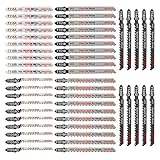


Quick comparison: which wood blade should you choose?
| Woodworking job | Recommended TPI | Typical length | Tooth pattern | Expected finish |
|---|---|---|---|---|
| Fast cuts in softwood | 6–8 TPI | 100–132 mm | Large, widely spaced teeth | Fast, moderate tear-out |
| General plywood and construction lumber | 8–12 TPI | 75–100 mm | Progressive or milled teeth | Balanced speed and finish |
| Hardwood, thin boards, and clean crosscuts | 10–15 TPI | 75–100 mm | Fine, evenly spaced teeth | Clean edge with slower feed |
| Laminate-faced plywood or melamine | 10–20 TPI | 75–100 mm | Reverse-tooth or down-cut teeth | Reduced top-surface chipping |
| Scroll work and tight curves | 12–20 TPI | 75–100 mm | Narrow, fine-tooth blade | Controlled curves, slower cutting |
Tooth count: speed versus edge quality
Tooth count is commonly expressed as teeth per inch, or TPI. Low-TPI jigsaw wood blades remove material quickly because their deep gullets carry sawdust away efficiently. They are useful for thick softwood, rough framing cuts, and situations where the edge will be hidden. Their disadvantages are more vibration, a greater chance of splintering, and less control in thin stock.
High-TPI blades have smaller teeth and produce a smoother edge, particularly in plywood, hardwood, veneer, and laminate. They cut more slowly and can overheat if you force the saw. A fine blade also clogs more readily in resinous softwood, so a moderate feed rate and occasional cleaning matter.
For most household woodworking, an 8-, 10-, and 12-TPI selection covers more jobs than a large assortment of nearly identical blades. If you regularly cut thin plywood, add a 15- to 20-TPI option. For beams or thick boards, add a 6-TPI blade rather than trying to make a fine blade do heavy work.
Tooth patterns that change the cut
Milled side-set teeth
These are economical, durable teeth formed by milling the steel and setting alternate teeth slightly left and right. They remove material aggressively and tolerate glue, dirty surfaces, and general construction work. The edge is usually rougher than one made by ground teeth, but they are a practical choice for softwood and hidden cuts.
Ground teeth
Ground teeth are sharper and generally leave a cleaner edge in hardwood, plywood, and finished panels. They are preferable when the cut will remain visible, although they can dull faster if pushed through nails, grit, or abrasive composite board.
Progressive-tooth blades
A progressive blade changes tooth size along its length, often combining smaller teeth near the tip with larger teeth toward the shank. This design gives a useful compromise: the tip starts a controlled cut while the larger upper teeth improve chip removal in thicker material. Progressive blades are among the most versatile jigsaw blades for wood.
Reverse-tooth and down-cut blades
Reverse-tooth blades cut on the upstroke near the lower part of the blade, helping protect the top face of veneered plywood, laminate, and melamine. They require a firm grip because the cutting action can increase vibration. A down-cut blade should not be your default choice for thick solid timber, since its gullets clear dust less effectively and its cutting action may be slower.
Choosing by wood type and cut finish
Plywood
For standard plywood, choose a 10–12 TPI ground or progressive blade. Use a reverse-tooth blade when the visible face is on top and surface chipping is the main concern. Support the sheet close to the cut line, because unsupported plywood can vibrate and splinter even with the correct blade.
Hardwood
Dense hardwood benefits from 10–15 TPI and a sharp, narrow blade. Select a blade with enough working length to pass through the stock without the teeth disappearing into the cut. Reduce pendulum-orbital action, if your jigsaw has that setting, for a cleaner edge. Feed steadily rather than pressing harder when the cut slows.
Softwood
Use 6–10 TPI for pine, spruce, fir, and similar softwoods. A wide-set blade removes wet or resinous sawdust better and is less likely to bind. For visible crosscuts, move toward 10–12 TPI and slow the feed. Very coarse blades can tear out the exit face, especially in thin boards.
Laminate and veneered panels
Choose a fine 10–20 TPI reverse-tooth or down-cut blade. Place painter’s tape over the cut line, score the line with a sharp knife, and use a zero-orbital setting where possible. These measures complement the blade; they do not replace support beneath the panel.
Scrolling and tight curves
For curves, blade width matters as much as TPI. A narrow blade turns more easily, while a wide blade tracks straighter on long cuts. Choose a narrow 12–20 TPI blade for small-radius curves, but expect slower progress and a greater risk of bending if you twist the saw. Let the blade turn the curve instead of rotating the entire tool forcibly.
Blade length and capacity: avoid buying too short
Manufacturers often list overall blade length, but the useful cutting length is shorter because part of the blade remains clamped in the tool and the shoe must clear the work. As a practical rule, select a blade with at least 20–25 mm more usable length than the material thickness. For a 25 mm hardwood board, a blade around 75–100 mm long is normally more suitable than a very short blade.
Longer is not automatically better. Excess blade exposed below the work can flex, wander, and vibrate. If you are cutting 18 mm plywood, an approximately 75–90 mm blade is often easier to control than a 130 mm blade designed for much thicker stock.
A decision guide by budget and frequency
| Your situation | Best blade approach | Why it fits |
|---|---|---|
| Occasional DIY, lowest cost | Mixed pack with 6, 10, and 12 TPI blades | Covers rough, general, and cleaner cuts without buying many specialized blades |
| Frequent furniture or cabinet work | Separate fine ground, progressive, and reverse-tooth blades | Better finish control and less compromise between materials |
| Mostly thick softwood | 6–8 TPI, 100–132 mm blades | Fast chip removal and less clogging |
| Mostly curves and cutouts | Narrow 12–20 TPI scrolling blades | Improves turning control and reduces oversize curves |
| Visible laminate or veneer | Reverse-tooth 10–20 TPI blades plus tape | Reduces chipping on the finished face |
How to get a cleaner cut from any wood blade
- Mark the cut on the face that will be most visible, then choose a tooth direction that protects that face.
- Clamp the work securely and support both sides of the cut. Vibration is a major cause of splintering.
- Use the lowest orbital setting for laminate, veneer, and fine hardwood cuts; increase it for fast cuts in softwood.
- Keep the shoe flat on the work and allow the blade to reach full speed before entering the material.
- Do not force a slowing blade. Excess pressure bends the blade and can make the cut wander away from the line.
- For a plunge cut, drill a starter hole when possible. It is safer and more accurate than twisting the blade into solid material.
Durability, maintenance, and replacement
The teeth usually wear first, but heat buildup can weaken the blade before it looks visibly dull. Resin from pine, adhesive in plywood, paint, grit, and hidden fasteners all shorten blade life. A blade that begins wandering, needs noticeably more pressure, burns the wood, or produces repeated tear-out should be replaced rather than sharpened; most small jigsaw blades are not economical to resharpen.
After use, brush sawdust from the blade and store different TPI types where their teeth cannot strike one another. Keep blades dry, and inspect the shank for distortion before installation. Never use a wood blade to cut metal, masonry, or materials containing fasteners unless the blade is specifically rated for that purpose. A single nail can destroy fine wood jigsaw blades and may cause the tool to kick or bind.
For general woodworking, start with a 10–12 TPI progressive blade, then add a 6–8 TPI blade for fast softwood cuts and a 12–20 TPI reverse-tooth or narrow blade for clean panels and curves. That small, purpose-based collection is more useful than choosing one “universal” wood blade for every cut.