Best Jigsaw Cutter Blades for Wood, Metal, and More
What's inside
As an Amazon Associate I earn from qualifying purchases. This post may contain affiliate links at no extra cost to you.
The best jigsaw cutter blade for most woodwork is a T-shank, high-carbon steel blade with 10–12 teeth per inch, but the right choice shifts quickly once you cut metal, laminate, or curves — so the sections below map each common task to the blade spec that handles it cleanly.
As an Amazon Associate we earn from qualifying purchases at no extra cost to you.
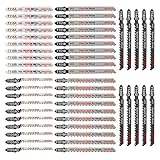


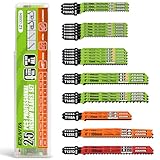
How Jigsaw Blades Differ: The Four Variables That Matter
Every jigsaw cutter blade is defined by four things: shank style, blade material, tooth configuration (TPI and grind), and length/thickness. Getting these right matters more than brand.
Shank Style: T-Shank vs U-Shank
T-shank blades are the current standard. They lock into tool-free clamps on virtually all modern jigsaws from Bosch, DeWalt, Makita, Milwaukee, and Festool. U-shank blades only remain relevant for older saws and a few compact models — check your saw’s clamp before buying anything.
Blade Material
- High-carbon steel (HCS): Flexible, cheap, ideal for softwood, plywood, and curves. Dulls fast on hardwoods and burns on metal.
- High-speed steel (HSS): Harder and more heat-resistant; the minimum for cutting metal.
- Bi-metal (BIM): HSS teeth welded to a flexible HCS body. The most versatile and durable option — roughly 10x the life of HCS in demanding cuts, at about 2–3x the price.
- Carbide-tooth / carbide-grit: For abrasive materials: tile backer board, stainless, fiberglass, cast iron. Expensive per blade but economical per cut.
Teeth Per Inch (TPI) and Tooth Grind
Low TPI (6–8) clears sawdust fast for ripping and rough work; high TPI (18–24) slows the cut but leaves a smoother edge, essential for metal and laminate. Grind matters too: ground teeth (like Bosch’s Clean for Wood line) cut smoother than milled teeth, and taper-ground reverse-tooth blades reduce splintering on the show face of veneered sheet goods.
Length and Thickness
Blade length should exceed material thickness by at least 1 inch (25 mm) so teeth clear the kerf on the upstroke. Thicker blades (1.6 mm+) track straighter on deep cuts in 2x lumber; thin scroll blades (around 1 mm) turn tighter radii but deflect more easily.
Quick Spec Comparison: Common Blade Types
| Blade Type | Material | TPI | Best For | Typical Pack Price (2026) |
|---|---|---|---|---|
| Fine wood cutter (e.g., Bosch T101BR) | HCS | 10, down-cut | Laminate, melamine, splinter-free tops | $8–12 / 5-pack |
| Fast wood blade (e.g., Bosch T144D) | HCS | 6 | Softwood, plywood, rough framing cuts | $6–10 / 5-pack |
| Hardwood blade (e.g., Bosch T345XF) | BIM | Progressive 5–10 | Oak, ipe, thick hardwood to 2″ | $14–20 / 5-pack |
| Metal cutter (e.g., T118A-style) | HSS or BIM | 18–24 | Sheet metal, aluminum, thin steel | $7–14 / 5-pack |
| Thick metal (e.g., T118G-style) | HSS wavy-set | 36 wave | Sheet metal under 1/16″ | $8–13 / 5-pack |
| Carbide grit blade | Carbide edge | N/A (grit) | Tile, fiberglass, cast iron, brick | $10–18 / blade |
| Scroll blade (e.g., T119BO) | HCS | 12, narrow | Tight curves in wood to 5/8″ | $7–11 / 5-pack |
Decision Matrix: Match Your Task to a Blade
| Your Situation | Choose | Why |
|---|---|---|
| Weekend DIYer, mostly plywood and pine | HCS 10–12 TPI multipurpose | Cheap, forgiving, covers 80% of household cuts |
| Cutting laminate countertop or melamine shelving | Reverse-tooth HCS, 10 TPI | Teeth cut downward, protecting the finished top face |
| Trimming hardwood flooring or stair treads | BIM progressive-tooth, 4″ length | Bi-metal survives dense grain; progressive teeth handle variable thickness |
| Cutting aluminum angle or steel studs occasionally | BIM 18 TPI | Flexible body resists snapping when the blade binds |
| Cutting stainless or hardened fasteners | Carbide-tooth metal blade | HSS overheats and dulls in minutes on stainless |
| Intricate curves, coping saw work | Narrow scroll blade, 12 TPI | Slim blade turns a ~1/4″ radius a standard blade can’t |
| Flush-cutting protruding screws/dowels | Flush-cut blade (offset teeth) | Teeth extend past blade spine to reach surfaces flat |
Ownership Realities: What Actually Wears Out
Blade life varies more by technique than by brand. The common failures, in order:
- Dulled teeth — the normal end of life. HCS blades cutting plywood with glue lines may dull within 20–30 linear feet; the same blade in clean pine lasts several times longer.
- Heat failure on metal — running a wood TPI on steel cooks the teeth in under a minute. Use low speed, high TPI, and cutting oil or wax.
- Snapped blades — usually caused by binding on tight curves with a wide blade, or forcing the cut. Let the blade do the work; orbital action on high speeds the cut but increases tear-out and heat.
- Bent/wandered blades — pushing sideways in a curve. If your cuts drift off the line, the blade is likely dull or the wrong width, not the saw.
Workshop math on value: a $16 five-pack of bi-metal blades cutting hardwood will typically outlast three or four equivalent HCS packs, making BIM cheaper per linear foot despite the higher sticker price. For occasional softwood-only use, HCS is still the better buy — bi-metal’s extra cost buys durability you won’t use.
Common Mistakes to Avoid
- Using a 24 TPI metal blade on wood — it clogs instantly and scorches the edge.
- Cutting laminate face-up with a standard up-cut blade — always use reverse-tooth or score the cut line first.
- Leaving orbital action engaged for finish cuts — turn it off for visible edges.
- Assuming all “multi-material” blades cut all materials well — they compromise on both.
FAQ
Are jigsaw blades universal?
T-shank blades fit nearly all modern jigsaws regardless of brand — a Bosch blade works in a DeWalt saw. U-shank saws are the exception.
How do I know when a blade is dull?
The saw needs more feed pressure, the cut wanders, and the blade runs hot or burns the wood. Replace it — forcing a dull blade is the main cause of snapped blades and motor strain.
Can a jigsaw cutter blade cut a 2×4?
Yes, with a long (4″+), thick bi-metal or HCS blade at 6–8 TPI and a steady feed. Expect slower, less square results than a circular saw.