Best Affordable Bench Grinder for Sharpening Workshop Tools
What's inside
As an Amazon Associate I earn from qualifying purchases. This post may contain affiliate links at no extra cost to you.
A bench grinder is useful for touching up chisels, mower blades, drill bits and other workshop tools, but a low price alone does not make one a good buy. For sharpening, wheel quality, a steady tool rest and manageable vibration matter more than a big motor rating. Most home workshops can get by with a 6-inch grinder; an 8-inch model is worth paying for if you sharpen often or work on wider tools.
As an Amazon Associate we earn from qualifying purchases at no extra cost to you.


What to look for in an affordable grinder
A typical 6-inch grinder runs at about 3,450 rpm and suits occasional sharpening and small parts. An 8-inch grinder commonly runs at about 1,750 rpm. Its slower wheel speed can reduce heat buildup and the larger wheel has a gentler curve, useful when shaping a wide chisel or plane iron. The trade-off is a larger machine, higher cost and more space on the bench.
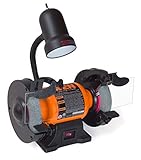
Check the wheel size, arbor bore, maximum speed and included accessories before buying replacement wheels. A grinder’s manual sets the permitted wheel specifications; never fit a wheel with a lower speed rating than the grinder. Look for adjustable, reasonably solid tool rests and eye shields that don’t obstruct the work. A built-in work light is convenient, but it is not a substitute for a stable rest or good lighting.
For a budget general-purpose option, compare 6-inch bench grinders with adjustable tool rests. If you sharpen frequently or want less aggressive stock removal, compare 8-inch slow-speed bench grinders. These searches are a starting point, not a guarantee that every listing includes suitable wheels or a well-made rest.
6-inch versus 8-inch
| Feature | 6-inch grinder | 8-inch grinder |
|---|---|---|
| Typical speed | About 3,450 rpm | About 1,750 rpm on slow-speed models; check the listing |
| Best fit | Occasional sharpening, small tools, limited bench space | Frequent sharpening, wider edges, more controlled shaping |
| Trade-off | Often cheaper and compact; removes metal quickly | Costs more and takes up more room; wheels are larger |
| Watch for | Heat buildup and small, flimsy tool rests | Wheel compatibility, footprint and replacement-wheel cost |
These are typical configurations, not rules: some 8-inch grinders run faster, and some 6-inch units have variable-speed controls. Check the actual specifications rather than relying on the size printed in the product title.
Where the value is
A basic 6-inch grinder is often the best-value choice for a homeowner who sharpens a few times a year. The cheaper option is fine if its wheels run true, its rests can be set close to the wheel, and the machine can be bolted securely to a bench. A simple grinder with decent replacement wheels can outperform a pricier unit whose supplied wheels are rough or poorly balanced.
Spend more when you will use it regularly, need an 8-inch wheel, or want a more solid frame and less vibration. A grinder that walks across the bench or shakes hard enough to blur the work is frustrating and makes precise contact harder. Some vibration comes from an uneven wheel, so dressing or replacing it may help; persistent vibration can indicate poor balance or a machine that needs returning.
Wheel upgrades are a real part of the purchase price. For general sharpening, a common starting point is a medium aluminum-oxide wheel around 60 grit for shaping and a finer wheel around 80 grit for lighter work. Confirm the grinder’s manual permits the wheel type, bore, diameter and speed. A coarse wheel removes material quickly but can leave a rough edge; a very fine wheel is slower for restoring a damaged bevel.
Sharpen without ruining the tool
Grinding heat is the main failure mode when sharpening carbon-steel tools. If the edge turns blue, you have overheated it and may have softened the steel near the edge. Use light pressure, move the tool across the wheel and dip it in water often—before it becomes uncomfortably hot, not after it glows. Don’t quench a wheel; cool the tool only. A grinder is for controlled material removal, not leaning hard until the job is done.
Before switching on, inspect the wheel for cracks and follow the manufacturer’s wheel-check procedure. Keep guards installed, stand out of the wheel’s plane at startup, and let the grinder reach full speed before touching the work. A tool rest should be set close to the wheel, with the gap within the grinder maker’s stated limit. Keep fingers clear of the pinch point, wear eye protection and avoid loose clothing.
Grind the bevel at a consistent angle, then remove the burr with a honing stone if the tool needs a fine working edge. The grinder can restore a badly nicked edge faster than hand stones, but it does not replace honing. For drill bits, a basic grinder is usable with practice, though a dedicated jig is easier for repeatable angles. If you sharpen only a chisel or two each year, a bench stone may be cheaper, quieter and less likely to remove too much steel.
When to shop
Bench grinders are commonly discounted during major shopping events, holiday sales and spring workshop promotions, but seasonal timing matters less than the delivered price and included accessories. Compare the cost of the grinder, a stable mounting method and any replacement wheels you will need. A low-priced listing with missing shields, unsuitable wheels or expensive shipping can lose its advantage.
For occasional home use, choose a stable 6-inch grinder and put any savings toward a good wheel and safe setup. Choose an 8-inch slow-speed grinder when frequent sharpening, wider tools or better heat control justify the extra size and cost. In either case, verify the wheel specifications and return policy before ordering; a grinder that arrives with a damaged wheel or excessive vibration is not a bargain.