Best Affordable Bench Grinder for Sharpening Chisels and Blades
What's inside
As an Amazon Associate I earn from qualifying purchases. This post may contain affiliate links at no extra cost to you.
A bench grinder can sharpen chisels and many plain-edged blades without much expense, but the cheapest machine is not automatically the best value. Wheel condition, speed control, and how easily you can set the tool rest matter more than a few extra watts. For ordinary home-shop use, a basic 6-inch grinder is usually enough; spend more only if you need easier angle control, less heat buildup, or quieter operation.
As an Amazon Associate we earn from qualifying purchases at no extra cost to you.


What to buy for sharpening
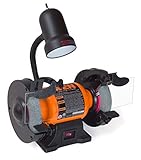
Look for a grinder with two 6-inch wheels, a published speed near 3,450 RPM, adjustable tool rests, and eye shields. A common budget setup pairs a coarse wheel with a finer one, often around 36 and 60 grit. Those wheels are useful for general grinding, but they remove metal quickly and are not ideal for final sharpening. A finer wheel or a separate honing step will leave a cleaner edge.
For chisels and plane irons, many woodworkers replace one factory wheel with a friable aluminum-oxide wheel in a finer grit, commonly 80 or 100. That type of wheel is designed to shed dull abrasive and expose fresh cutting particles. Check the grinder’s manual for the wheel’s maximum speed and permitted dimensions; never fit a wheel that is cracked, damaged, or rated below the machine’s RPM.
If you want the lowest-cost route, compare basic 6-inch bench grinders. A roughly $50–$90 grinder can be a reasonable choice for occasional sharpening if its rests are sturdy and you are comfortable making small adjustments. Prices change with sales and season, so treat that range as a budget target, not a fixed quote.
Compare the main options
| Type | Typical price range | Best use | Main trade-off |
|---|---|---|---|
| Basic 6-inch, single-speed | $50–$90 | Occasional chisel and blade work | Small rests and vibration can make control harder |
| Better-built 6-inch grinder | $90–$160 | Regular home-shop use | Costs more without necessarily sharpening faster |
| Variable-speed 8-inch grinder | $150–$300 or more | Frequent sharpening and heat-sensitive work | Higher cost, larger footprint, and wheels may cost more |
These are broad US street-price ranges, not promises. A sale can bring a midrange grinder close to entry-level pricing, while bundled stands or upgraded wheels can push the price up. Compare the machine itself, wheel specifications, warranty, and return terms rather than judging by the sticker price alone.
Features worth paying for
Prioritize a stable tool rest. Many inexpensive rests are small, stamped metal pieces that flex or sit at an awkward angle. You can still sharpen on them, but a rest that shifts under hand pressure makes it harder to hold a consistent bevel. Check that each rest can be adjusted close to the wheel and locked firmly. An aftermarket rest can improve a cheap grinder, but its cost may erase the savings.
Variable speed is useful, not essential. Slower wheel speed gives you more time to notice heat and can make careful work less intimidating. It does not guarantee a cool edge: pushing hard or lingering in one spot can still overheat steel. For occasional chisel work, a single-speed grinder is fine if you use light pressure, dip the tool in water frequently, and finish the edge by honing.
An 8-inch grinder has a larger wheel diameter, which can be helpful if you grind often, but it is not automatically better for sharpening. Some models run at the same 3,450 RPM as 6-inch units, and larger wheels can be more expensive to replace. If slow, controlled grinding is the priority, compare a variable-speed 8-inch grinder with a well-equipped 6-inch model before paying extra.
Sharpen without ruining the edge
Start by checking the tool’s bevel and deciding whether you need to reshape it or just restore the edge. A bench grinder is useful for removing a nick or correcting a badly rounded bevel, but it is easy to remove too much metal. For a small amount of dullness, a sharpening stone or honing system may be a better purchase than a grinder.
Before switching on, inspect the wheel and make sure the grinder is mounted securely. Stand to one side when starting a newly installed wheel, and let it run for about a minute. Keep the tool moving across the wheel and use light pressure. Touch the bevel briefly, then cool the tool in water. If the steel turns blue or straw-colored near the edge, it has overheated; that area may have lost hardness and usually needs to be ground back beyond the discolored section.
Use the tool rest rather than holding a chisel freehand against the wheel. Match the existing bevel as closely as you can, and avoid pressing the thin cutting edge into the wheel. Grinder sparks and fine abrasive dust are normal hazards, so wear eye protection and keep flammable materials away. Follow the manual’s guidance on guards and wheel clearance; do not remove protective parts to make the work easier.
A grinder does not usually produce a ready-to-use woodworking edge by itself. After grinding, remove the burr and refine the bevel with a stone, diamond plate, or other honing method. A low-cost adjustable grinder sharpening rest can help maintain a repeatable angle, but check that it fits your grinder before ordering.
Where the value is
For a homeowner who sharpens a few chisels or lawn-tool blades several times a year, the least expensive sound 6-inch grinder is often enough. Put the difference toward a better wheel, a stable mounting surface, or honing supplies. For weekly use, a sturdier machine with better rests is worth considering because vibration and awkward adjustments become more frustrating over time.
Buy in late fall or during major holiday sales if you can wait; grinders and sharpening accessories are often discounted alongside general workshop tools. Do not buy a questionable machine just because it is marked down. Confirm that replacement wheels in the correct size are easy to find, that the tool rests lock securely, and that the grinder’s rated speed matches its wheels. Those details determine whether a cheap grinder stays useful after the first sharpening session.