Best Value Drill Press for Repetitive Holes in a Garage Shop
What's inside
As an Amazon Associate I earn from qualifying purchases. This post may contain affiliate links at no extra cost to you.
A garage drill press earns its keep when the same hole must be drilled dozens or hundreds of times. It gives you consistent depth, a square entry, and better control than a handheld drill. For most home shops, the best value is not the cheapest machine on the shelf. It is a 10-inch benchtop press with a usable depth stop, a reasonably rigid column, and enough speed range for wood, plastic, and common metals.
As an Amazon Associate we earn from qualifying purchases at no extra cost to you.
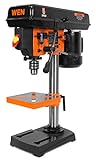

What matters for repetitive holes
Repetitive drilling exposes weaknesses that are easy to overlook during a five-minute test. A loose quill or flexible table may be tolerable for one hole, but it produces visibly different results by the twentieth. Look for a chuck that runs smoothly, a quill with minimal side play, and a table that locks firmly without shifting as you tighten it.
A mechanical depth stop is essential. A simple threaded rod with a pair of stop nuts is usually more useful than a digital depth readout, because it stays set when the machine is switched off. A depth range of roughly 2 to 3 inches covers most hardware, dowel, and small metalworking jobs. If the stop slips, the bit can punch through a workpiece, damage the table, or change the fit of every part in a batch.
Speed adjustment matters too. Wood generally benefits from higher speeds, while larger bits and metal require slower speeds. A five- or six-speed pulley system is adequate and usually more durable than a low-cost electronic controller. Variable-speed models are convenient, but inexpensive controllers can produce weak low-speed torque or fail under continuous use.
The best-value size and price
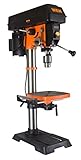
For a garage shop, a 10-inch benchtop drill press is the value sweet spot. The “10-inch” figure is the swing, or twice the distance from the bit to the column. In practical terms, it gives you about 5 inches from the bit center to the column. That is enough for most brackets, cabinet parts, plates, and small furniture components.
| Drill press type | Typical street price | Best use | Main compromise |
|---|---|---|---|
| 8-inch benchtop | $120–$200 | Small wood and light metal work | Shorter travel and less workspace |
| 10-inch benchtop | $180–$350 | Repeated garage-shop drilling | Usually needs a solid bench and better clamping |
| 12-inch benchtop | $300–$550 | Larger parts and deeper reach | Higher cost without better accuracy by itself |
| Floor-standing press | $450–$900+ | Long stock, frequent use, and larger bits | Uses more floor space and costs more to equip |
A cheap 8-inch press is fine when your holes are small and close to the edge of compact parts. It becomes frustrating when you need a larger Forstner bit, a long clamp, or a workpiece that will not fit between the column and spindle. Spending another $60 to $120 on a better 10-inch machine is often money well spent.
Current pricing changes frequently, so compare the delivered price of 10-inch benchtop drill presses rather than relying on the manufacturer’s suggested price. A unit discounted from $300 to $220 may be a good buy; a $220 machine that is always sold at $220 is simply a $220 machine.
Brand value and trade-offs
Entry-level brands often share similar motors, pulley assemblies, and castings. The differences tend to show up in quality control, warranty support, instructions, and replacement parts. A budget machine from a widely sold brand can be a sensible choice if it has many recent reviews mentioning successful assembly and accurate drilling—not just quiet operation.
Pay attention to complaints about bent spindles, missing hardware, pulleys that wobble, and tables that will not stay locked. These are not cosmetic issues. A pulley wobble can create vibration at every speed, while a table that moves during a batch can ruin hole spacing.
Mid-priced brands usually offer better fit and finish, but they are not automatically more accurate. A poorly assembled premium press can drill worse than a budget press that has been carefully squared and bolted down. Buy the better brand when the price difference includes a stronger warranty, parts availability, or a noticeably heavier column and base—not merely a nicer paint finish.
Features worth paying for
Prioritize a keyed or keyless chuck with a stated capacity of at least 1/2 inch. A 5/8-inch chuck is useful for larger shank bits, but it adds cost and does not make the machine more powerful. Check the spindle taper and chuck quality if you plan to use sanding drums or larger hole saws; cheap chucks can release accessories as vibration builds.
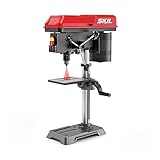
A work light is convenient but not a deciding feature. A laser guide is even less important for repetitive work. It can help locate a hole, but it does not correct a crooked setup or compensate for a wandering bit. Spend that money on a cross-slide vise, a solid hold-down clamp, or a sacrificial plywood table.
For batch drilling, a fence and stop block are more valuable than most built-in accessories. A fence controls lateral position, and a stop block controls length. Add a drill press table fence and stop block when making repeated parts. Do not rely on hand pressure alone; a bit can grab and spin a workpiece violently, especially with hole saws and large Forstner bits.
When to buy and how to set it up
Prices commonly soften during November promotions, spring garage-tool sales, and around major holiday weekends. Compare the final price with shipping, because a heavy press can carry a $20–$60 delivery charge. Used machines are worth considering when the quill has no noticeable wobble, the column is straight, and all depth-stop hardware is present. Missing proprietary parts can erase the savings.
After purchase, bolt the press to a heavy bench. Check table squareness with a machinist’s square, tension the belts correctly, and test runout with a dial indicator if you have one. For general garage work, a few thousandths of an inch of runout is usable; visibly wandering bits or a chuck that shakes at low speed indicates a problem. Use a center punch for metal, clamp every workpiece, and clear chips with a brush rather than your fingers.
If your work is mostly small wood holes, the cheaper 8-inch option is fine. If you routinely drill repeat batches, choose a solid 10-inch benchtop model and spend the remaining budget on clamps, a fence, and sharp bits. That combination produces more consistent results than paying extra for a taller machine with weak accessories.