Best Affordable Pole Saw for Trimming Low Branches
What's inside
As an Amazon Associate I earn from qualifying purchases. This post may contain affiliate links at no extra cost to you.
For a few low branches each year, you rarely need a professional-grade pole saw. A manual saw is the cheapest, simplest choice for occasional cuts; a corded electric model makes repeated trimming easier if you have an outdoor outlet. Battery models cost more once you include the battery and charger, but avoid a cord and are easier to move around the yard.
As an Amazon Associate we earn from qualifying purchases at no extra cost to you.



Choose by the job, not the longest reach
Start with branch thickness and how many cuts you expect to make. A manual pole saw is adequate for a handful of branches up to roughly 2–3 inches thick, provided the blade is sharp and you can work without forcing it. For regular pruning or branches around 3–6 inches, a powered saw saves effort, though capacity varies by tool and wood. Do not assume a saw’s advertised cutting capacity means it will cut that size quickly or cleanly.
Measure the height of the lowest branches you need to reach, then add your standing height and the pole length. That gives only a rough estimate: overhead reach is not a safe working position if you cannot control the head comfortably. Longer poles add weight and make the cutting head harder to steer. For low branches, a shorter, manageable tool is usually a better buy than extra reach you will rarely use.
If your branches are above shoulder height, tangled, near power lines, or large enough that they could fall unpredictably, do not try to solve the problem with a longer pole saw. Hire a qualified tree professional. Keep any pole saw well clear of power lines; never assume a branch or tool is insulated.
Best value by type
| Type | Typical cost | Best for | Main trade-off |
|---|---|---|---|
| Manual pole saw | About $25–$60 | Occasional cuts on smaller branches | Slow and tiring on thick or dry wood |
| Corded electric pole saw | About $60–$130 | Repeated trimming close to an outlet | Cord limits movement and needs careful routing |
| Battery pole saw | About $100–$250 or more | Mobile yard work without a nearby outlet | Battery and charger can raise the real cost |
Prices are broad U.S. retail ranges, not a promise of current sale pricing. Compare what is included: some battery tools are sold bare, while others include a battery and charger. A low advertised price can be poor value if you must buy both separately.
When a manual pole saw is the affordable choice
For light, infrequent trimming, a manual saw is hard to beat on total cost. There is no battery to replace, motor to maintain, or extension cord to manage. Look for a rigid pole, a secure locking adjustment, and a replaceable, curved pruning blade with teeth intended for cutting on the pull stroke. A flimsy pole flexes under pressure, making the blade wander and wasting effort.
Its limit is not just cutting speed. Pulling a saw overhead can tire your shoulders quickly, and thick branches may bind the blade. If you need more than a few cuts, or the branches are consistently over about 3 inches, the time and fatigue can outweigh the savings. For a basic manual pole saw, compare blade replacement availability as well as price.
Corded or battery powered?
A corded electric pole saw is often the value pick for a small yard with accessible outdoor power. It delivers steady power without battery-runtime concerns. Its main failure mode is the cord: it can snag on shrubs, limit your cutting angle, or end up in the saw’s path. Use an outdoor-rated extension cord of the gauge specified in the manual, plug it into a protected outdoor outlet, and keep the cord behind you and away from the cutting head. Never cut with a cord that is damaged or wet at its connections.
Battery models make more sense when you move around the property or do not have a convenient outlet. Check whether the tool shares batteries with equipment you already own from the same platform. That can make a mid-priced bare tool a better deal than a cheaper kit from a new battery system. Runtime depends on battery capacity, branch size, chain condition, and how much you stop and restart; treat claims in the product listing as best-case guidance, not a guaranteed number of cuts.
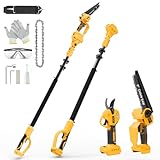
For a compact yard where a cord is inconvenient, compare battery pole saw kits by included battery size, charger, weight, and warranty. For trimming within reach of an outlet, a corded electric pole saw may cost less to own.
Features worth paying for
Prioritize a secure pole lock, a comfortable grip, a cutting head you can angle and keep steady, and clear instructions for chain tension and lubrication. A shoulder strap can reduce fatigue, but it does not make an unbalanced saw safe. Compare complete operating weight, including battery if applicable, rather than the bare-tool figure. Even a difference of 1–2 pounds matters when the tool is held overhead.
Low-cost powered saws can disappoint when their chain is dull, tension is wrong, or oil has run out. Before buying, check whether replacement chains and bars are easy to find. After each use, inspect chain tension and bar oil according to the manual. A chain that repeatedly loosens, oil that fails to reach the bar, a cracked pole lock, or a saw that overheats during light work are reasons to stop using the tool rather than push through.
Cut safely and avoid damaged branches
Wear eye protection, gloves, sturdy footwear, and hearing protection for powered models. Stand on firm, level ground; do not use a pole saw from a ladder. Keep people and pets outside the drop zone, and avoid cutting directly above yourself. A branch can spring, swing, or split before it falls.
For a heavier branch, use a small undercut first, then make the main cut farther out to reduce bark tearing. Do not cut beyond the tool’s stated capacity or force the chain through a binding cut. If the head is hard to control, the branch does not fall freely, or the cut would put you under the branch, stop and call an arborist.
When to buy
Prices often soften during late fall and winter, when yard equipment is less in demand, and during major spring sales. Compare the same kit contents and warranty before calling a discount a bargain. If you only need to trim one or two small branches, renting a powered saw or buying a manual one may cost less than owning a battery platform. For recurring work, choosing a tool that shares batteries with equipment you already use is often the most practical way to keep the total cost down.