Best Value Mechanic Tool Kit for Basic Motorcycle Maintenance
What's inside
As an Amazon Associate I earn from qualifying purchases. This post may contain affiliate links at no extra cost to you.
A basic motorcycle service does not require a professional shop’s worth of tools. For oil changes, battery work, chain adjustment, and routine checks, a carefully chosen metric kit can cost less and work better than a bulky set full of sockets you will rarely use. The key is avoiding the weak points: rounded fasteners, missing sizes, and tools that do not fit the bike.
As an Amazon Associate we earn from qualifying purchases at no extra cost to you.


What basic maintenance needs
Most Japanese and European motorcycles use metric fasteners. A practical starter kit should cover roughly 8–19 mm sockets and combination wrenches, with 8, 10, 12, 14, and 17 mm among the sizes you are most likely to reach for. Some bikes use 22 mm or larger axle hardware, but check your owner’s manual before buying a kit just for that job.
For home maintenance, prioritize a 3/8-inch-drive ratchet and sockets, a 1/4-inch drive for small fasteners, combination wrenches, hex keys, and a screwdriver with interchangeable bits. Add a torque wrench for work with specified tightening values. A 3/8-inch torque wrench covering about 10–80 ft-lb handles many common motorcycle tasks, but it may not accurately cover low-torque controls or engine fasteners; those can call for a separate inch-pound wrench.
Before purchasing, check the bike’s service manual for fastener sizes and torque ranges. A tool set can be excellent value in general and still leave you without the one socket needed for your motorcycle.
Kit types compared
| Option | Typical use | Value and trade-off |
|---|---|---|
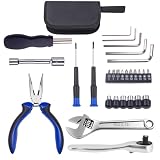
| Compact metric socket-and-wrench set | Oil service, body panels, general adjustments | Good starting value if it includes the common metric sizes. Usually lacks torque measurement and bike-specific tools. |
| Mechanic set with two drive sizes | Broader maintenance and occasional repairs | More versatile, but avoid paying extra for a large number of duplicate or rarely used pieces. |
| Basic kit plus separate torque wrench | Routine work involving specified torque values | Often the best balance: spend on accurate torque control rather than a huge assortment of low-use tools. |
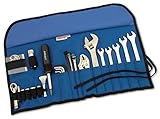
| Motorcycle-specific tool roll | Roadside adjustments and compact carry | Useful away from home, but often too limited to replace a garage socket set. |
Best-value buying strategy
For a first kit, look for a metric mechanic tool set with 3/8- and 1/4-inch drives. The smaller drive is handy for cramped spaces and small fasteners; the 3/8-inch drive covers much of the ordinary work. A 1/2-inch drive can be useful for larger axle nuts, but it does not guarantee the kit contains the correct socket size or that the included ratchet is appropriate for high torque.
A lower-priced set is fine if its sockets fit cleanly, its ratchet engages reliably, and the case keeps pieces organized. For basic maintenance, polished chrome-vanadium tools from a reputable budget line are generally adequate. Spend more if you expect frequent use, need a warranty with straightforward replacement, or find that the cheap ratchet has excessive play. A loose socket can slip off a fastener; a poorly fitting one can round its corners, turning a quick adjustment into a parts-removal job.
Do not treat a large piece count as a measure of value. A set may advertise 150 pieces while counting bit tips, duplicate sockets, and accessories. Compare the actual metric socket and wrench sizes, whether the sockets are six-point or twelve-point, and whether the case includes useful hex bits. Six-point sockets grip the flat sides of many hex fasteners more securely and are a sensible choice for stubborn or previously damaged hardware.
Tools worth buying separately
A torque wrench is one of the more important separate purchases. Tightening by feel can work for noncritical hardware, but it is a poor substitute for a specified torque on brake, suspension, or engine fasteners. Too little torque can let a joint loosen; too much can stretch a bolt, strip aluminum threads, or damage a component. Choose a range that matches the manual, and avoid using a click-type wrench as a breaker bar.
Consider a 3/8-inch torque wrench in an appropriate range for your bike, then add a small inch-pound model if your manual calls for values below its accurate working range. Store a click wrench at its lowest marked setting, not wound beyond the scale, and follow the maker’s calibration guidance.
For chain adjustment, a ruler or chain-slack tool is inexpensive and more reliable than judging slack by eye. A metric hex-key set is also useful, but use the straight end—not the ball end—to loosen tight fasteners. Ball ends help reach angled screws; they are not the best choice for breaking one free.
Common costly mistakes
Using an adjustable wrench on a tight axle nut is a false economy. It can slip and round the nut, while a correctly sized socket gives a more secure grip. Likewise, avoid using a long pipe over a small ratchet handle to get extra leverage. That can break the ratchet or overload the fastener. Use a breaker bar when a fastener needs more force, and confirm the service procedure before applying it.
Motorcycle fasteners may look similar but have different thread pitches, lengths, or strength grades. Do not replace missing hardware with a random bolt from a general assortment. Match the part to the manual or an accurate parts listing. Also keep oil and grit off tool handles and fasteners; contamination makes slips more likely and can spoil torque readings.
When to buy
Tool prices commonly dip around major retail sales and seasonal promotions, but a discount matters only if the kit has the sizes you need. Make a short list from the owner’s manual, compare the listed contents rather than the headline piece count, and check the return policy. If you are preparing for spring riding, buying before the first service rush gives you time to notice a missing socket or incorrect bit before the bike is apart.
For occasional oil changes and adjustments, a modest metric set plus the right torque wrench is usually better value than a premium all-in-one chest. If a job calls for a specialty puller, large axle socket, or high-accuracy measuring tool you will use once, borrowing or renting it may be more sensible than buying the biggest kit on the shelf.