Best Value Tools for Small-Scale Copper Pipe Repairs
What's inside
As an Amazon Associate I earn from qualifying purchases. This post may contain affiliate links at no extra cost to you.
For one or two small copper-pipe repairs, the best value is usually a modest torch kit, a few correctly sized fittings and a way to shut off and drain the line—not a full plumbing tool collection. The main cost trap is buying a tool that cannot safely reach the joint, then paying for a second repair after a leak. First check whether the pipe is accessible, whether the water can be isolated, and whether local rules allow the repair method you plan to use.
As an Amazon Associate we earn from qualifying purchases at no extra cost to you.

Choose the repair method before buying tools
Soldering is economical for accessible copper joints, but it needs a clean, dry pipe and safe clearance around the flame. A push-to-connect fitting costs more per joint, yet can make sense where a torch is impractical or the repair is urgent. Either approach requires cutting out damaged or badly pitted pipe; solder will not reliably seal over a crack or corrosion hole.
For soldering, gather a tubing cutter, fitting brush or abrasive cloth, lead-free plumbing solder, flux, a torch and heat protection. A basic propane plumbing torch kit is generally enough for common small-diameter household copper. Larger pipe, heavy fittings or cold conditions may need more heat than a small torch supplies. Follow the torch and solder makers’ instructions, and keep a fire extinguisher nearby.
Where the money goes
Prices vary by store and region, but these typical ranges help compare the initial outlay. They exclude replacement pipe and fittings, which depend on the repair.
| Tool or method | Typical cost | Best value when | Main trade-off |
|---|---|---|---|
| Manual copper tubing cutter | $10–$25 | You need a square cut on accessible pipe | Needs room to rotate; slow in tight spots |
| Propane torch kit | $25–$60 | You expect to solder several joints | Open flame requires clearance and care |
| Brushes, flux and lead-free solder | $10–$25 | You are assembling a few soldered joints | Consumables still need proper preparation and technique |
| Push-to-connect fitting | $8–$20 per fitting | Flame access is unsafe or the repair is time-sensitive | Higher cost per joint; pipe end must be clean and correctly prepared |
| Compact close-quarter cutter | $15–$35 | Pipe is close to a wall or framing | May be slower and less versatile than a standard cutter |
Spend on a clean cut, not a large kit
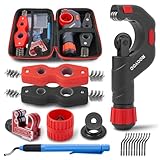
A basic rotary cutter is a better first purchase than an oversized plumbing set. Tighten it gradually as you rotate; cranking down hard can leave a crooked cut or deform thin pipe. In cramped spaces, a standard cutter may not have enough turning clearance. A close-quarter copper tubing cutter can solve that problem, but buy one only if the access actually requires it. A fine-tooth hacksaw can work in a pinch, though it leaves more burrs to remove and makes a square cut harder.
For soldering, inexpensive brushes and lead-free solder are adequate for occasional work. Clean the outside of the pipe and inside of the fitting until the copper is bright, apply a thin layer of flux and assemble the joint. Heat the fitting, not the solder; touch solder to the opposite side of the joint and stop once it draws in. Excess flux left inside or outside can contribute to corrosion, so use it sparingly and wipe residue as directed.
Compare tool value, not just the label
For occasional repairs, mid-priced tools from established plumbing or general-tool brands are often a sensible buy: they tend to cut more consistently and have replaceable cutter wheels. A premium cutter may be worth it if you use it regularly, but it is hard to justify for one accessible joint. Bargain kits can be fine when the cutter turns smoothly and the torch has stable, controllable adjustment; avoid a cutter that wobbles or a torch with erratic flame control.
Check what a torch kit includes before comparing prices. Some include a fuel cylinder, while others do not; fuel type and cylinder availability affect the real cost. Likewise, a soldering assortment may include unsuitable solder. For potable-water plumbing, use solder labeled lead-free for plumbing applications, and check local requirements.
When a torch-free fitting is the better value
Choose a push-to-connect copper repair fitting when nearby wood, insulation or finished surfaces make flame exposure unacceptable, or when there is not room to work safely. It is not automatically cheaper: a single fitting may cost as much as several solder fittings. Cut the pipe square, remove burrs, clean and mark the insertion depth, then push the fitting fully home. A nicked, oval or dirty pipe end can cause a leak. Use only fittings rated for the pipe, service and location, and follow their installation instructions.
Neither method fixes a pipe that remains under water pressure. Shut off the supply and drain the line before cutting or soldering; a small amount of trapped water can keep a joint from getting hot enough to bond. If the shutoff valve does not work, the pipe is near electrical wiring, or the leak is inside a wall, stop and get qualified help rather than improvising.
Time purchases around the job
For a planned repair, compare torch and cutter prices during spring home-improvement promotions and autumn tool sales; common hand tools are often discounted, but a small saving is not worth delaying a leak repair. Buy fittings only after measuring pipe diameter and checking the existing layout. Keep spare lead-free solder, flux and a cutter wheel if you expect repeat work, but do not stock up on perishable consumables for a one-time fix.
Before closing the wall or putting the tools away, restore water slowly and inspect the joint under pressure. Dry it completely and check again after several minutes; a tiny bead can be easier to spot on dry copper than on a wet surface. For an uncertain solder joint, repair it now rather than trusting it behind a finished wall.