Best Value Woodworking Clamps for Building a Small Bench
What's inside
As an Amazon Associate I earn from qualifying purchases. This post may contain affiliate links at no extra cost to you.
A small bench does not need a large clamp collection. For a typical project with a top made from several boards, a useful starter set is four clamps with enough capacity to span the top, plus a couple of shorter clamps for shelves, rails, or quick fixes. Spend for straight bars and dependable pressure where it matters; avoid paying for capacity you will rarely use.
As an Amazon Associate we earn from qualifying purchases at no extra cost to you.



What the bench needs
First estimate the width of the assembly you will clamp. For a top made from 3-inch-wide boards arranged side by side, four boards make a top roughly 12 inches wide. A clamp’s stated capacity is its maximum opening, so 24-inch clamps provide plenty of room for that assembly and for moderate-sized panels later. If your bench top is wider than 24 inches, choose a longer size rather than trying to stretch the clamps beyond their rated capacity.
For edge-gluing a top, you need pressure across the joints, not just a clamp at each end. Four clamps spaced roughly 6 to 8 inches apart along a 24- to 30-inch-long top are a practical minimum. Alternate clamps above and below the panel to reduce bowing. Add cauls—straight scrap boards clamped across the top and bottom—if the board faces do not line up. More clamping force will not fix badly mismatched edges or a twisted board.
Which clamp types are worth buying?
For a first bench, bar clamps or parallel-jaw clamps are the main purchase. Bar clamps are usually less expensive and work well for straightforward glue-ups. Parallel-jaw clamps hold their jaws closer to square under pressure and can make alignment easier, but they cost more and are not essential for every small bench.
24-inch bar clamps are a sensible budget choice for a narrow bench top and general shop work. Look for a rigid bar, smooth jaw movement, and pads that will not easily pop off. A slightly flexible bar may be acceptable for light assembly, but it can let the work bow if you tighten hard over a long span.
24-inch parallel clamps are worth considering when flat panel glue-ups are common or you want jaws that stay square more reliably. Their trade-off is cost and weight. A beginner building one bench can usually get better value by buying more basic clamps rather than spending the full budget on a few premium ones.
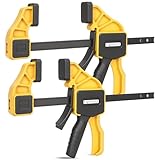
Short clamps have a different job. A couple of 6- or 12-inch clamps help hold a rail, shelf, or caul without crowding the work. 12-inch F-style clamps are inexpensive and useful for small assemblies, though their narrow jaws can dent soft wood. Put scrap pads between the clamp and the work.
Budget choices compared
| Clamp type | Good use | Value trade-off |
|---|---|---|
| Basic bar clamp | Edge-gluing a modest bench top | Low cost; check bar stiffness and jaw play |
| Parallel-jaw clamp | Panel glue-ups where alignment matters | Costs more, but resists jaw tilt better |
| F-style clamp | Rails, shelves, cauls, and small parts | Cheap and versatile; concentrated pressure can mark wood |
| Pipe clamp | Long assemblies when more reach is needed | Often economical, but pipe can bow and may leave rust marks |
Pipe clamps can be a good low-cost route for a wider top if you already have compatible pipe or can buy it locally. The pipe is part of the setup, and longer spans can flex under pressure. Use clean, straight pipe and protect the work from rust or oil. Do not assume a pipe clamp is a bargain until you include the cost of the pipe and fittings.
How many to buy first
For a bench top around 12 to 18 inches wide, start with four clamps sized to the top width and two short F-style clamps. If the top is more than about 18 inches wide, six longer clamps can make pressure distribution easier. That is a practical starting point, not a rule: a wider assembly, uneven stock, or a longer top may call for more clamps or cauls.
Before glue-up, dry-clamp the boards. Check that the clamps reach, that the jaws sit flat, and that you can tighten each one without shifting the boards. Apply enough pressure to close the joint and produce a thin, continuous bead of squeeze-out. Excessive force can bow the panel, crush soft wood, or squeeze out too much glue. If a joint stays open, fix the edge fit instead of tightening until something bends.
When to buy and what to inspect
Clamp prices can shift around major sales, but buying a mixed set just because it is discounted is not always a saving. Compare the price per clamp, the opening capacity, and whether the set includes sizes useful for your project. A low-priced set of short clamps will not help if your bench top needs a 24-inch opening. Check the return policy too: a clamp that arrives with a bent bar or rough screw is not a bargain.
When shopping in person, close and open each clamp, inspect the bar for bends, and check that the moving jaw locks without slipping. On screw clamps, look for smooth threads and handles that do not flex badly. For occasional home-shop work, a basic clamp that operates smoothly is fine; a premium brand makes more sense if you clamp often, need repeatable alignment, or depend on the tool for daily work.
A sensible value setup
For most first-time bench builders, the best-value purchase is four basic 24-inch bar clamps plus two short F-style clamps, assuming the top is no wider than their capacity. Upgrade to parallel-jaw clamps if you expect frequent panel work and can justify the extra cost. Buy longer clamps only when your actual project dimensions require them. Keeping the set modest leaves money for straight stock, a square, and glue—items that affect the finished bench just as much as the clamps do.