How to Decide Whether a Used Premium Tool Beats a New Budget Model
What's inside
As an Amazon Associate I earn from qualifying purchases. This post may contain affiliate links at no extra cost to you.
A used premium tool can be a better buy than a new budget model, but only if its condition, battery platform and repair prospects justify the price. Compare the cost of getting a working tool today—not the original retail price—and be especially cautious with worn batteries, missing parts and tools that depend on a proprietary platform.
As an Amazon Associate we earn from qualifying purchases at no extra cost to you.


Start with the job, not the badge
Write down what you need the tool to do, how often you will use it and what would happen if it failed mid-job. A homeowner drilling a few pilot holes each year has different needs from a contractor using a drill every day. For occasional work, a new budget tool may be the sensible choice: it has a known history, a warranty and no hidden wear.
Premium construction matters more when a tool sees repeated heavy use, needs consistent accuracy or would be costly to replace during a job. Better bearings, gears, switches and heat management can extend service life, but a premium badge cannot tell you how the particular used tool was treated. A tool that spent years in dust, rain or a work van may be a worse buy than a cheaper model that is new and properly supported.
Compare the total cost of ownership
Price the tool as a complete, usable setup. Add any battery, charger, blades, case or accessory you actually need. A bare tool listed for $80 is not an $80 deal if a compatible battery and charger cost another $100. Likewise, an inexpensive new kit can offer better value if it includes everything required to start.
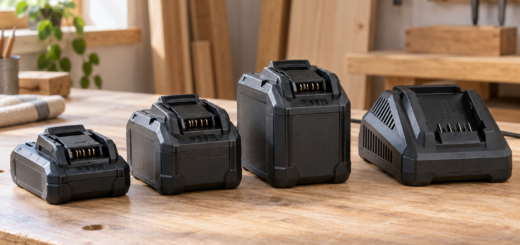
For a used cordless tool, treat an untested battery as having no value. A replacement pack can erase the savings, and some platforms charge a premium for batteries. Check the price of a replacement battery and charger before you buy; if you already own compatible packs, that advantage may change the calculation.
| Factor | Used premium tool | New budget model |
|---|---|---|
| Upfront price | Can be low, but account for missing parts and wear | Usually predictable; kits may include a battery and charger |
| Condition risk | Unknown history, possible hidden faults | New components and a stated warranty |
| Heavy, frequent use | Potential advantage if the tool is sound and repairable | May wear faster under sustained workload |
| Occasional home use | May offer more capacity than the job needs | Often sufficient and simpler to buy |
| Long-term support | Depends on parts availability and platform age | Depends on the maker’s warranty and support |
Inspect the tool before buying
Ask to test it under load, not just hear it spin for a second. For a drill or impact driver, run it at low and high speed, test the trigger gradually, check forward and reverse, and listen for grinding, rattling or a changing pitch. Hold the chuck or bit holder steady and look for obvious wobble. A little play may be normal; visible runout can make accurate holes difficult.
For a circular saw, inspect the shoe for bends, check that the guard moves freely and returns without sticking, and verify that the blade sits square to the base. On a sander, watch for excessive vibration and check that the pad is secure. Smell for burnt insulation, look for cracked housings, damaged cords, loose handles and signs of water or heavy dust inside vents. Test safety switches and guards. Do not buy a tool with a failed safety feature just because the motor still runs.
Run a cordless tool for several minutes if possible. Sudden cutouts, smoke, excessive heat or an intermittent trigger are reasons to walk away. A short test cannot prove years of life remain, but it can uncover immediate problems. If the seller will not allow a basic test, price in the risk—or choose a returnable new tool.
Check repairability and warranty
Before paying a premium for a used tool, search for its manual, parts diagram and replacement components. A tool with an affordable switch, chuck or battery may be worth repairing; a discontinued platform with scarce parts may become disposable after one failure. Confirm whether the warranty transfers to a second owner. Do not assume it does, and ask for the original receipt if coverage matters.
Compare the likely repair cost with the price gap. If the used tool costs $120 and a possible repair could be $70, the apparent savings over a $160 new model are thin—especially without a return option. A seller’s claim that it “just needs a battery” is not proof the tool itself is healthy. Test it with a known-good compatible pack before buying.
Match the tool to how hard you work
For occasional drilling, fastening, sanding or cutting around the house, a new budget cordless drill kit can be entirely adequate. You get fresh batteries and a warranty, and modest runtime or slower work may not matter when the tool is used only a few times a year.
If you use a tool often, compare handling and output as well as advertised power. A heavier used premium tool can cause fatigue during overhead work, while a compact budget model may be easier to control. For a cordless impact driver kit, consider whether its size and battery platform suit your fasteners and workload; maximum torque figures alone do not tell you how comfortably it will perform the job.
Set a price ceiling before you negotiate
As a rough rule, consider a used tool only when its tested, complete price is meaningfully below the equivalent new setup. For a tool with no transferable warranty, a discount of 20% may not compensate for wear and failure risk; a larger discount can make sense if the tool is easy to inspect, parts are available and you can afford a repair. These are decision guides, not fixed market values—local prices and condition vary.
Seasonal sales can make a new budget kit unexpectedly competitive. Check prices around major holiday promotions and clearance periods, but compare the full kit contents and warranty rather than the headline discount. If the used premium tool costs nearly as much as a new model after adding a battery, charger and likely repairs, buy new. If it is in good working order, fits a battery platform you already own and will handle demanding regular use, the used premium option may earn its price.