Best Budget Battery Charger for Maintaining Multiple Vehicles
What's inside
As an Amazon Associate I earn from qualifying purchases. This post may contain affiliate links at no extra cost to you.
Maintaining two or more vehicles does not usually require a high-output shop charger. It does require enough charging capacity for the batteries you own, a proper maintenance mode, and a practical way to connect each vehicle. For most cars, a 1–2 amp automatic maintainer is a good-value choice when the battery is healthy and the vehicle can sit connected for weeks. The main trade-off is speed: a small maintainer preserves charge but is not meant to revive a deeply discharged battery quickly.
As an Amazon Associate we earn from qualifying purchases at no extra cost to you.

What to buy for several vehicles
Start with the battery types and storage pattern. A conventional 12-volt lead-acid battery and an AGM battery need a charger that supports their chemistry; some maintainers have separate settings, while others handle common types automatically. Check the battery label and charger manual rather than assuming every “smart” charger is suitable. Lithium batteries require a charger explicitly approved for the battery’s chemistry and battery-management system.
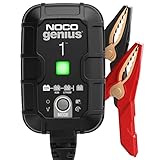
For a garage with multiple cars, a compact automatic maintainer is often the budget pick. You can move one unit between vehicles as needed, or buy a second one if cars sit at the same time and frequent cable swapping is inconvenient. If you need to charge a battery that is substantially depleted, choose a higher-current smart charger—typically 4–10 amps for a passenger-car battery—rather than expecting a 1-amp maintainer to do the job promptly.
Compare 12-volt automatic battery maintainers for long-term storage, or look at 4-amp smart chargers with AGM support if you also need occasional charging. Check the listed output, supported battery types, safety protections, and included leads; a low price is less useful if the charger lacks the mode your battery needs.
Maintainer or faster charger?
| Type | Typical output | Best use | Main trade-off |
|---|---|---|---|
| Automatic maintainer | About 0.8–2 amps | Keeping a healthy battery topped up during storage | Slow to recover a discharged battery |
| Small smart charger | About 3–5 amps | Occasional charging and maintenance | Costs more; still takes hours on a low battery |
| Higher-output smart charger | About 8–10 amps | Faster recovery of common car batteries | More expensive; unnecessary for simple storage maintenance |
These are practical ranges, not guaranteed charging times. Battery capacity, temperature, age, and how deeply it is discharged all matter. As a rough illustration, putting 20 amp-hours back into a battery takes at least 20 hours at a steady 1 amp, and often longer because charging is not perfectly efficient and the current can taper near full. A charger’s “engine start” rating, if listed, is not the same as its normal charging output.
How to maintain multiple vehicles affordably
If only one vehicle is parked for long periods at a time, one maintainer can serve several batteries. Fit a ring-terminal pigtail to each vehicle if the charger maker supplies a compatible one. Leave the pigtail secured away from belts, hot exhaust parts, and sharp edges, then connect the charger only to the vehicle being stored. This avoids repeatedly reaching for the battery posts, but it does not make one charger maintain several vehicles simultaneously.
When two or more vehicles sit unused together, the real choice is one charger moved on a schedule or one maintainer per vehicle. Moving a single unit saves money, but only if you reliably rotate it. A car left disconnected for weeks can still lose charge from alarm systems and other parasitic loads. If checking the vehicles weekly is unrealistic, separate low-current maintainers may be worth the extra cost.
For motorcycles, lawn equipment, and other small batteries, verify that the charger has an appropriate low-current mode. A car-oriented charger may supply too much current for a small battery, particularly if it lacks automatic regulation. Conversely, a tiny motorcycle maintainer may take a long time on a large car battery. Match the output to the battery maker’s guidance.
Features worth paying for—and ones you can skip
Look for automatic shutoff or float maintenance, reverse-polarity protection, short-circuit protection, and clear status indicators. A repair or desulfation mode can be useful for some lead-acid batteries, but it is not a fix for a battery with a failed cell or severe physical damage. Do not pay extra for a feature you cannot use with your battery chemistry.
Brand reputation matters most in clear instructions, dependable protection, and replacement support—not in a promise that a charger will restore every old battery. A basic unit from an established battery-equipment maker can be a better buy than a no-name charger with an impressive amp rating and vague safety information. Still, if you only need to maintain one healthy 12-volt lead-acid battery in a dry garage, an inexpensive automatic maintainer with the correct battery setting is often entirely adequate.
Safe setup and common failure modes
Follow the manual’s connection order, keep the charger ventilated, and charge in a dry area away from sparks or flames. Lead-acid batteries can release hydrogen while charging. Inspect the case and terminals first; do not charge a swollen, cracked, leaking, or frozen battery. In a vehicle, use the manufacturer’s specified connection points, especially if it has a battery sensor or a designated chassis ground.
A maintainer that stays in fault mode may be seeing reversed clamps, a poor connection, or a battery voltage too low for it to detect. Clean corrosion and check the manual before trying another charger. If the battery repeatedly goes flat, test it and check for a parasitic drain rather than leaving a charger connected indefinitely to mask the problem. A failing battery can waste money, and a charger cannot repair a charging-system fault.
When to buy
Buy before the first cold spell or before putting a seasonal vehicle away, not after discovering a dead battery on a frosty morning. Cold weather reduces available starting power, while months of storage allow small electrical loads to drain a battery. Prices and promotions vary, so compare the charger’s actual output and supported battery types rather than choosing by discount alone. For a single stored car, a basic 1–2 amp maintainer is usually the value choice; for several vehicles that sit at once, budget for one compatible unit per battery or accept the routine of rotating a single charger.