Best Affordable Tile Cutter for a Laundry Room Floor Project
What's inside
As an Amazon Associate I earn from qualifying purchases. This post may contain affiliate links at no extra cost to you.
For a typical laundry room, the best-value tile cutter is often a manual score-and-snap cutter, not a large wet saw. It handles straight cuts in many ceramic floor tiles, costs less to buy or rent, and avoids setting up water indoors. But it is the wrong tool for thick porcelain, narrow strips, and notches around pipes. Check the tile material and the cut list before spending money.
As an Amazon Associate we earn from qualifying purchases at no extra cost to you.



Start with the tile, not the tool
Look at the tile box for its material, thickness, and size. A manual cutter is most dependable on ceramic tile with straight edges and a smooth, consistent surface. Porcelain is denser and harder to snap cleanly; some cutters manage it, but results vary with the tile and cutter. Textured surfaces can also make scoring less predictable.
For a small laundry room, count the perimeter cuts, doorway cuts, and any cuts around drain pipes or floor penetrations. A cutter may make most of the cuts while a tile nipper, hole saw, or wet saw handles the awkward ones. Buy extra tile: a handful of spare pieces is cheaper than stopping mid-job because a cut chipped or cracked.
Compare the practical options
| Tool | Best for | Typical trade-off |
|---|---|---|
| Manual snap cutter | Straight cuts in compatible ceramic tile | Fast and tidy, but limited on hard tile, narrow cuts, and notches |
| Compact wet saw | Porcelain, repeated cuts, and some angled cuts | Cleaner control on tough tile, but needs water, cleanup, and a suitable blade |
| Angle grinder with diamond blade | Notches and irregular cuts | Versatile, but dusty, loud, and easier to chip or wander |
| Tile nippers | Small adjustments and rough curves | Inexpensive, but removes material slowly and leaves a rough edge |
Prices vary by size, build, and season, so compare current listings rather than treating a low advertised price as proof of value. A basic cutter may be enough for a few ceramic cuts. For porcelain, look for a cutter explicitly rated for the tile’s size and material, or put the money toward a wet saw.
When a manual cutter is the value pick
Choose a manual cutter if your tile is ceramic, the cuts are mostly straight, and the tool’s cutting capacity exceeds the tile’s longest cut dimension. A cutter that nominally fits a tile may still be awkward if the tile is large or heavy; you need room to position it squarely and support it without rocking.
Cheap cutters can work, but poor alignment, a loose rail, or a dull scoring wheel can turn a simple cut into a cracked tile. Before committing to a full box, test one spare tile. Score once with firm, even pressure, then snap as the tool’s instructions describe. Repeated scoring can widen the groove and make the break less controlled. If the snap breaks diagonally or chips badly, stop and reassess rather than burning through good tile.
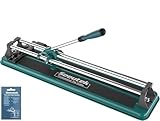
For a one-room job with compatible tile, a manual tile cutter for ceramic floor tile is usually the lowest-hassle purchase. Check the stated cut length, tile-thickness range, wheel availability, and whether the base holds large tiles steady. A bargain tool that cannot cut your tile size is no bargain.
When a wet saw earns its cost
A wet saw is the safer bet when the floor tile is porcelain, when you need many precise cuts, or when the manual cutter leaves unacceptable chips. It can also help with angled cuts, though not every small saw accommodates large-format tile. Confirm the saw’s cutting capacity and use a blade suited to the tile; a poor or worn blade can still chip the glaze.
For a few cuts, renting may cost less than buying and storing a saw. Ask about blade condition, included accessories, pickup and return timing, and whether the rental period includes setup and cleanup. A compact wet saw can be a sensible purchase if you expect more tile work, but factor in a stable work surface, water management, and time spent cleaning slurry. Use it outdoors or in a protected, well-ventilated work area, and follow the manufacturer’s electrical and water-safety instructions.
Search for a compact wet tile saw for porcelain only after confirming the tile dimensions and saw capacity. A larger saw is not automatically better for one laundry room; it may simply cost more and take up more space.
Plan for edges, notches, and dust
Tile cutters are designed for straight cuts, not holes around supply lines or drain pipes. For a small notch, nippers can remove material in short bites, but taking too much at once can split the tile. A diamond hole saw is more appropriate for a round opening, while a grinder can shape a notch but creates hazardous dust. Do not dry-cut indoors without effective dust control; use suitable respiratory protection and follow the tool and tile manufacturer’s safety guidance.
Hide cut edges under baseboard or at a threshold where the layout allows, but do not use trim to disguise a badly unsupported tile edge. Dry-lay a row first and adjust the layout so you avoid very narrow slivers. A cut narrower than about an inch is harder to handle and more likely to break during cutting or installation; shifting the layout can often produce wider pieces on both sides.
Spend where the job needs it
Compare total job cost: cutter, blade or scoring wheel, rental fees, delivery, and likely broken tiles. Tool prices can dip around major retail sales and end-of-season promotions, but waiting is worthwhile only if it does not delay installation or leave you short on materials. Check the return policy and buy from a seller that lets you return an unsuitable tool after an unpowered fit check.
If you are undecided, buy the least expensive tool that is demonstrably compatible with your tile and cut list. For straightforward ceramic, that is often a manual cutter; for dense porcelain or a layout full of intricate cuts, a wet saw is usually better value despite the higher upfront cost. Keep a few extra tiles for test cuts, and make the first test before laying the floor.