Best Affordable Tool Organizer for a Vehicle Maintenance Kit
What's inside
As an Amazon Associate I earn from qualifying purchases. This post may contain affiliate links at no extra cost to you.
A vehicle maintenance kit does not need a premium tool chest. It needs a container that keeps the right tools together, stays put while driving, and survives dirt, oil, and temperature swings. For most drivers, a medium tool bag or compact, latching organizer offers the best value. The right choice depends on how heavy the kit is, where it will ride, and whether you need to carry it to the work.
As an Amazon Associate we earn from qualifying purchases at no extra cost to you.



Choose the organizer around the kit
Start by listing what you actually carry: a small socket set, pliers, screwdrivers, gloves, tire gauge, flashlight, and perhaps a compact jump starter. A basic kit like this often fits in a 12- to 16-inch bag or a roughly 14- to 18-inch plastic toolbox. Measure the storage spot in the vehicle before buying; a box that is only an inch too tall may not fit beneath a seat or in a trunk compartment.
For tools you use roadside, a bag is usually easier to lift and carry. For small parts and items that leak or collect grit, a hard case is easier to wipe out. If the kit includes a heavy wrench set or a large jump pack, check the organizer’s handle and stated load capacity rather than assuming its size tells you how much weight it can safely carry.
Compare the main options
| Organizer type | Typical budget range | Best for | Main drawback |
|---|---|---|---|
| Soft tool bag, 12–16 inches | $15–$35 | Portable tools and irregularly shaped kits | Fabric can absorb oil; contents can shift |
| Plastic toolbox, compact to medium | $12–$30 | Basic hand tools and a clean, stackable package | Hinges and latches may crack under rough handling |
| Small divided parts organizer | $8–$25 | Fuses, terminals, clips, and other small items | Not a good main container for heavy tools |
| Rigid modular case | $30–$70 or more | Frequent use, stacking, and better organization | Costs more and can waste space in a small vehicle |
Prices are common retail ranges, not fixed quotes; size, material, and sales change them. A low-cost option is fine if it stays secured and its handle, seams, and closures are sound. Paying more makes sense when you regularly move the kit between vehicles or need compartments that remain closed when the case tips over.
Best value: a medium soft tool bag
For a typical maintenance kit, a bag with a wide opening, reinforced bottom, and several interior or exterior pockets is a practical starting point. Pockets help keep a tire gauge and flashlight from disappearing beneath sockets, while a broad opening makes it easier to see what is missing. Look for a zipper that runs around the top rather than a narrow slit that forces you to unload the bag to reach tools.
Budget bags often fail at the handle stitching or at the base, especially when loaded with metal tools and lifted by one handle. Check seams and the weight rating if the maker provides one. Avoid packing a bag so tightly that the zipper strains; leave room to close it without pressing down on the tools. Browse medium tool bags with reinforced bottoms and compare dimensions before choosing.
A bag is a poor choice for wet or oily items unless it has a washable lining or you store those items in separate sealed pouches. It also offers less protection if cargo can slide into it. Secure it with a cargo strap or place it in a stable compartment; do not leave a heavy tool bag loose in the passenger area.
Choose a hard toolbox for dirty or loose contents
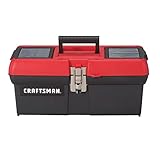
A compact plastic toolbox is better if the kit contains loose sockets, small bottles, or greasy parts that you want to keep away from upholstery. Removable trays can hold frequently used pieces, but check that the tray still leaves enough room for larger tools. A two-compartment lid is useful for fuses and fasteners only if its small lids latch firmly; weak dividers can let parts mix after a rough drive.
Low-cost plastic boxes do the job for a light kit, but their weak points are usually the hinge pins, handle attachment, and latches. Open and close the box several times in the store if possible. Avoid loading the lid with heavy tools: it can bow, making the latches difficult to close. A simple compact plastic toolbox with a removable tray is enough for many drivers; a rugged modular case is worth its higher price mainly if you stack cases or carry the kit to jobs often.
Keep small parts separate
Fuses, wire connectors, spare bolts, and valve caps are easy to lose in either a bag or a large toolbox. A small divided organizer can solve that problem for less than buying a bigger case, but inspect the compartments with the lid closed. If dividers are removable, a bump can let parts migrate between sections. Put tiny parts in labeled bags or choose a model with secure, fixed compartments.
Do not store liquids such as brake fluid or oil in the same open compartment as electrical supplies. If you carry a small bottle, keep it upright in a leak-resistant pouch or a separate sealed container. Heat inside a parked vehicle can be severe, so follow product labels for storage limits and avoid keeping temperature-sensitive items in the kit year-round.
What to check before buying
Compare usable interior dimensions, not just the outside measurement. Check how the organizer closes when filled, whether the handle is comfortable under load, and whether it fits the vehicle’s storage location with room to remove it. For a hard box, test the latches and inspect the hinge. For a bag, look for dense stitching at the handle ends and a bottom that will not sag when loaded.
Seasonal sales can make a better-built organizer cost little more than a flimsy one. Spring and early summer promotions often include tool storage alongside automotive and garage supplies; late-year sales can also be worthwhile. Compare the current price with the organizer’s ordinary price and make sure the discount is not simply attached to a larger size you do not need. For a modest kit, spending $20–$35 on a sound bag or basic toolbox is usually more sensible than paying $60 or more for modular storage that will sit untouched.
Secure it and inspect it
Whatever you buy, keep the organizer low and restrained so it cannot become a projectile during hard braking. After the first drive, check whether the contents have shifted and add dividers, pouches, or a strap if needed. Every few months, remove the tools, wipe out grit, and check for rust, leaking batteries, torn seams, or cracked latches. Replacing a worn $20 organizer is cheap; discovering its handle has failed while carrying a roadside kit is not.