Best Budget Clamp Meter for Home Electrical Troubleshooting
What's inside
As an Amazon Associate I earn from qualifying purchases. This post may contain affiliate links at no extra cost to you.
A clamp meter is useful when you need to measure current without disconnecting a wire. For home electrical troubleshooting, the best budget choice is usually not the meter with the highest current rating. It is a safe, clearly marked meter with reliable voltage readings, a clamp that opens wide enough for the conductors you work on, and controls you can operate while wearing gloves.
Expect to spend roughly $30 to $60 for a competent basic clamp meter. Below that price, some meters are perfectly serviceable for occasional checks, but quality control, input protection, and accuracy become less predictable. For household work, I would rather buy a simpler meter from an established test-equipment brand than a feature-packed no-name meter claiming an implausible number of functions.
As an Amazon Associate we earn from qualifying purchases at no extra cost to you.


What a Budget Clamp Meter Should Measure
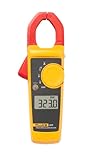
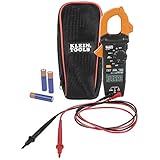
Start with AC voltage, AC current, resistance, continuity, and frequency. These cover most homeowner jobs: checking whether a receptacle is energized, testing a switch or fuse, measuring the draw of a motor, and finding a broken connection.
Auto-ranging is convenient, but it is not essential. A manual-ranging meter can be faster when you already know whether you are measuring 120 volts or a few ohms. True RMS is more valuable. It gives more credible readings on electronic loads, dimmers, variable-speed tools, and compact fluorescent or LED equipment. A basic average-responding meter may read ordinary resistive loads acceptably but become misleading on distorted waveforms.
DC current is useful for automotive and battery work, but it is not required for most house wiring. If you want to troubleshoot cars, lawn equipment, solar batteries, or low-voltage systems too, look for a meter with a DC-current clamp function. Do not assume every clamp meter measures DC current; many inexpensive units clamp only AC.
For a first purchase, compare budget true-RMS clamp meters by their safety rating and included leads, not just their maximum amperage.
Features Worth Paying For
| Feature | Why it matters at home | Budget verdict |
|---|---|---|
| True RMS | More accurate readings on electronic and non-sinusoidal loads | Worth the small price increase |
| AC clamp measurement | Measures current without opening the circuit | Essential |
| DC clamp measurement | Useful for vehicles, batteries, and solar wiring | Buy only if you need it |
| CAT III 600 V rating | Appropriate protection for many branch-circuit measurements | Minimum target for household work |
| Backlight | Readable display inside panels and under appliances | Very useful |
| Inrush current | Captures startup surges from motors and compressors | Helpful for appliance diagnosis |
| Temperature probe | Checks HVAC, motors, and overheating connections | Optional |
A CAT III 600 V marking is a sensible baseline for measurements at a home’s fixed wiring, such as panels, branch circuits, and permanently connected equipment. CAT ratings are not simply voltage ratings; they describe the meter’s ability to withstand transient energy in that measurement environment. Buy from a seller that provides a real manual and clear safety markings. A printed “1000 V” claim on a bargain meter is not enough by itself.
The Best Budget Buying Options
For most homeowners, a $35-to-$50 AC/DC clamp meter with true RMS, a backlight, continuity beeper, and a 600-amp maximum is the sweet spot. Six hundred amps sounds excessive, but the higher range is useful for starting currents and does not mean the meter is better at measuring small currents. Check the stated resolution. A meter that displays tenths of an amp is more useful for a 2-amp appliance than one that only shows whole amps.
An AC-only clamp meter can be a good cheaper option at about $25 to $35. It is fine for checking a furnace blower, shop vacuum, refrigerator compressor, or a circuit’s approximate operating load. It will not help with car batteries, DC motors, or solar charge wiring. If those jobs are outside your plans, skipping DC can save money without compromising ordinary household troubleshooting.
Entry-level products from established brands often cost more than marketplace alternatives, but the difference may buy better leads, a clearer display, tighter calibration, and more credible input protection. You do not need an industrial electrician’s meter for occasional home checks, though. A reputable basic meter is enough if you are not working inside energized service equipment.
For a second meter kept in a workshop or vehicle, an AC/DC clamp meter with a backlight is usually a better value than buying separate current and voltage testers.
Limits and Common Failure Modes
The clamp must surround one conductor, not an entire cable containing both hot and neutral. If both conductors pass through the jaw, their magnetic fields largely cancel and the display may show nearly zero. This is a common source of false troubleshooting results.
Clamp meters also struggle with very small currents. A device drawing 0.08 amps may be below the practical resolution of a cheap meter. For leakage current, standby consumption, or parasitic automotive drains, use a meter designed for low-current work or a plug-in power monitor. Never place a meter’s current leads across a receptacle; that creates a short circuit.
Do not use resistance or continuity mode on an energized circuit. Turn off power, verify it with a known-working tester, and then test again before touching conductors. On a panel, the service lugs may remain live even when branch breakers are off. Homeowners should generally avoid probing those areas.
Another failure mode is measuring current on the wrong conductor or with the jaw not fully closed. Keep the conductor centered, close the jaw completely, and allow a few seconds for the reading to settle. Motors and compressors can draw several times their running current at startup, so a normal running reading does not rule out a startup problem.
When to Buy and What to Skip
Prices commonly dip during spring tool promotions, Father’s Day sales, Black Friday, and end-of-year clearance. Watch the normal selling price for a few weeks; a “sale” price is not necessarily a bargain. Batteries, test leads, and a protective case are worth counting in the final cost.
Skip meters advertising dozens of functions you will never use, especially models with no clear CAT rating, no manual, permanently attached leads, or vague claims about professional certification. Also be cautious with clamp openings under 25 millimeters if you plan to work around larger appliance or panel conductors.
If your work is limited to checking whether outlets are live and testing continuity, a conventional CAT III 600 V digital multimeter may cost less and provide better low-current accuracy. Choose a clamp meter when non-contact current measurement is the reason you are buying it, not simply because it looks more capable.
A Practical Buying Checklist
Before ordering, confirm five things: AC clamp measurement, the voltage range you need, a genuine CAT III 600 V or better marking, replaceable standard test leads, and a display readable in the locations where you will work. Add true RMS and DC clamp measurement if the price difference is modest.
The best budget clamp meter is therefore a safe, honest midrange tool—not the cheapest meter with the largest number on its box. Spend extra for true RMS and better protection when you will use it regularly. Save money by skipping DC, temperature, and inrush functions when your troubleshooting is limited to ordinary AC household circuits.